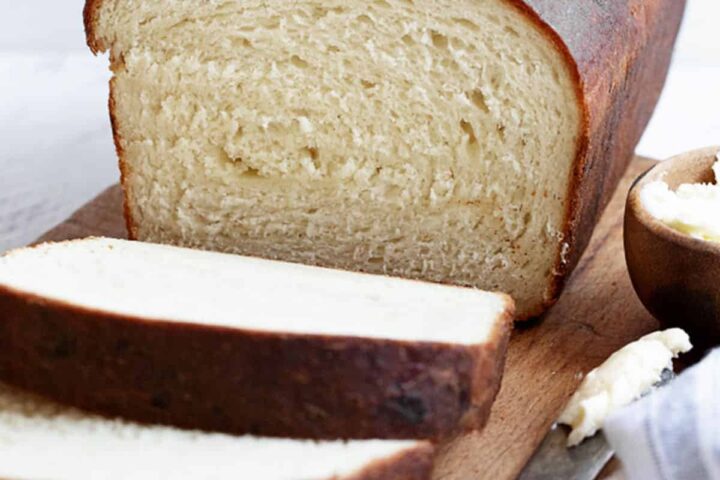
Get the Recipe: Buttermilk Cheese Bread
A large and impressive yeast bread, this buttermilk cheese bread is flavoured with a bit of sharp Cheddar cheese. A quick and easy bread that is great for using up leftover buttermilk!
Ingredients
- 4 1/2 teaspoons active dry yeast or Instant yeast
- 3/4 cup lukewarm water, 105-110F.
- 1 1/2 cups buttermilk, at room temperature *see Notes below for substitute
- 4-4 1/2 cups all-purpose flour, approximately
- 2 Tablespoons white granulated sugar
- 2 teaspoons baking powder
- 2 teaspoons fine salt
- 1 cup sharp Cheddar cheese, shredded and packed
- 2 Tablespoons butter, melted, for brushing loaf before and after baking
Equipment
- One 9 x 5 inch loaf pan
Instructions
- Grease one 9 x 5-inch loaf pan and set aside. If using a glass loaf pan, be sure to reduce the stated oven temperature by 25° F.
- In a large bowl or the bowl of a stand mixer fitted with a kneading hook, add the warm water and yeast to the bowl and stir to combine. Allow to stand for 5 minutes.
- Add the room temperature buttermilk to the bowl with the yeast mixture, 2 1/2 cups of the flour, the white sugar, baking powder and salt. Blend together with a spoon or on low speed in a stand mixer for about 30 seconds. Scrape down the sides of the bowl, then increase speed to medium speed and mix for about 2 minutes (or vigorously stir with a spoon if using a bowl).
- Reduce speed to low and add the shredded cheese and a bit more flour. Mix to combine. Begin adding more flour, in small increments, mixing between additions, until you have a moist and smooth dough that cleans the side of the bowl. You may not need quite all the flour specified or you may need a touch more. Only add as much flour as needed to bring the dough to the desired consistency.
- Remove the dough to a floured work surface and knead briefly, adding additional flour only if the dough is sticking to your hands or the work surface. Form into a ball. Using a rolling pin, roll the dough into a rectangle that is about 11 inches wide and about 15-16 inches long. Starting from the short side, roll the dough up jelly-roll style, pinching the seam together to seal the roll. Fold about 1 inch of each end of the roll underneath the roll. Your roll should now be about 9 inches long. Place the roll into your greased 9x5-inch loaf pan.
- Brush the top of the loaf with some melted butter, then cover with plastic wrap or a clean tea towel. Allow the loaf to rise until the loaf crests the pan by about 1 inch in the centre of the pan, approximately 90 minutes (depending on how warm your kitchen is). I like to set mine on top of my pre-heating oven for a bit of extra warmth.
- Move oven rack to the lower-third position in your oven. Preheat oven to 425° F (non-convection/not fan-assisted) Reduce 25° F. for glass pans.
- When loaf has risen, you can test if it is ready to bake by poking your baby finger into the corner of the loaf. If the indentation persists and fills back partway very slowly, it's ready to bake.
- Bake in preheated oven for about 35-40 minutes, checking the loaf at about 25 minutes and loosely covering the top with a sheet of aluminum foil to prevent the top of the loaf from over-browning. Bake loaf until the internal temperature reaches between 195-200° F. If you don't have a thermometer, remove the loaf from the oven, then from the pan and tap on the bottom of the loaf. It should sound hollow. If not, return to the pan and to the oven and bake a little longer.
- Once baked, immediately remove the loaf from the pan and place it onto a cooling rack. Brush the top of the loaf with more melted butter for a little shine and softer crust.
Notes
If you don't have buttermilk on hand but still want to make this bread, you can make your own buttermilk substitute. Simply mix regular milk with either lemon juice or white vinegar and let stand 10 minutes, before using. For this recipe, you'll need to add 1 Tbsp + 1 tsp of lemon juice or vinegar to 1 1/2 cups regular milk.
Tips!
Be sure to check the loaf early and cover loosely with a sheet of aluminum foil, if needed, to prevent over-browning.
You can leave out the cheese completely if you'd like a straight-up buttermilk bread. No other modifications are needed.
Starting a yeast dough with a cold liquid isn't going to help your bread rise quickly :) Starting with room temperature buttermilk, combined with the warm water, will give your yeast a nice warm environment to rise in. If you're in a hurry, give your buttermilk a quick shot in the microwave to take the chill off it.
Be sure to read the notes above this Recipe Card where I share more detailed tips, variations and substitution suggestions for this recipe!
Serving: 1serving, Calories: 267kcal, Carbohydrates: 42g, Protein: 10g, Fat: 7g, Saturated Fat: 4g, Cholesterol: 18mg, Sodium: 498mg, Potassium: 210mg, Fiber: 2g, Sugar: 4g, Vitamin A: 202IU, Calcium: 140mg, Iron: 2mg
Tried this recipe?If you enjoyed this recipe, please leave a star rating and comment. It helps others to find it!
