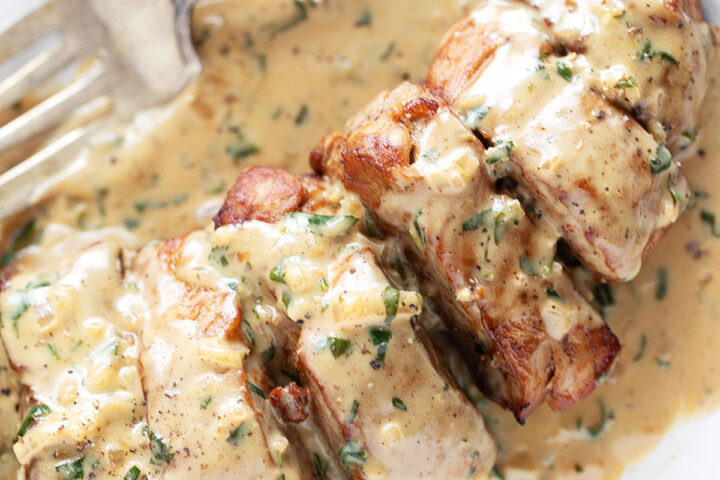
Get the Recipe: Pork Medallions with Creamy Dijon Mustard Sauce
Tender and juicy pork tenderloin medallions, served with an easy, creamy Dijon mustard pan sauce. The twice-seared pork tenderloin ensures the pork is juicy and never dry. This mustard pork tenderloin cooks entirely on the stovetop!
Ingredients
Pork:
- 1 - 1 1/2 lb pork tenderloin, silver skin and visible fat removed
- 2 Tablespoons extra virgin olive oil, DIVIDED
- 2 Tablespoons butter, DIVIDED
Dijon Mustard Sauce:
- 1/4 cup shallot, diced, or yellow onion together with a small clove of garlic
- 1/2 cup dry white wine, or more chicken broth
- 3/4 cup chicken broth
- 1/2 cup heavy whipping cream, 35% b.f. *see Note 1 below
- 1 Tablespoon Dijon mustard, or more to taste
- 1 Tablespoon fresh parsley, chopped or 1 teaspoon dried parsley
- 1/4 teaspoon salt
- freshly ground pepper
- 1 Tablespoon cornstarch
- 1 Tablespoon cold water
Instructions
- Prepare the pork tenderloin by removing the silver skin and any visible fat. Season the pork with salt and pepper.
- Heat a stainless steel or cast-iron skillet over medium-high heat for 1 minute, then add 1 Tablespoon of butter and 1 Tablespoon of olive oil. When the butter foaming subsides, add the pork to the skillet, curving it if necessary, so it lies flat. Brown it well on all sides (top, bottom and both sides), for about 5-6 minutes total.
- Remove the pork to a cutting board and slide the skillet off the heat for a minute. Cut the pork tenderloin into 1-inch thick slices.
- Return the skillet to the heat, over medium-high heat. Add 1 Tablespoon of butter and 1 Tablespoon of olive oil to the skillet. When the butter has melted, return the pork slices to the skillet and brown well on all sides, about 2-3 minutes on each side. (I like to further brown the side edges a bit more, too.)
- The pork should be cooked through at this point. If you have an instant-read thermometer, you can check them. They should be 140-143F internal temperature. (The temperature will rise a few degrees as it rests.) If you don't have a thermometer, the best test is to cut into the centre of the medallion and check the colour. It should be only light pink in the centre, and the juices should run clear. Remove the pork slices to a warm plate (or loosely tent them with aluminum foil).
- Lower the heat under the skillet to medium heat. If the skillet is dry, add a splash of oil. Add the shallots and cook, stirring, until softened. Add the wine to the pan and use a wooden spoon to scrape up the browned bits from the bottom as the wine cooks off for a minute or two.
- Add the chicken broth to the skillet, along with the Dijon mustard. Bring to a boil and allow to simmer briefly to reduce slightly. Add the heavy cream, parsley, salt and some freshly ground pepper and stir in. Taste the sauce and add additional salt, as necessary, to round out the flavours in the sauce.
- In a small bowl, stir together the cornstarch and cold water. Drizzle into the simmering sauce, stirring until the sauce is thickened to your desired consistency.
- Spoon the warm Dijon sauce over the pork medallions to serve. Garnish with additional chopped parsley, if desired.
Start with the right pan! Use either a stainless steel skillet or a cast iron skillet. Don't use a non-stick skillet. Why? Because non-stick skillets won't give you those tasty brown bits when browning the pork (known as "fond"), and fond is so delicious it would be a shame to miss out on it.
Notes
Note 1: Heavy cream is recommended as the higher fat content prevents it from splitting when combined with the acidic wine. While you can use a lower-fat cream, the sauce may split. You may also need to use more cornstarch and water to thicken the sauce at the end of cooking.
Tips!
Don't cut the medallions too thick! As the pork cooks entirely on the stovetop, if the medallions are too thick, it will be difficult to cook the pork all the way through. Stick closely to the recommended 1-inch thickness.
If skipping the wine, consider adding a small squeeze of lemon juice to the sauce at the end of cooking, for a bit of an acidic note.
If you enjoy tarragon, it would be a great flavour variation in place of the parsley.
These pork medallions are lovely served with mashed potatoes and a green vegetable, such as broccoli, broccolini, asparagus or green beans.
This dish is best enjoyed freshly cooked, as making ahead and rewarming risks over-cooking the pork. If you absolutely need to make it ahead, keep the pork and sauce separate and refrigerated and undercook the pork just slightly. Rewarm the pork medallions in a skillet over low heat until warmed through, and rewarm the sauce in a saucepan.
Be sure to read the notes above this Recipe Card for more tips, substitution suggestions, step-by-step photos and a recipe video that you might find helpful.
Watch how to make it
Serving: 1serving, Calories: 470kcal, Carbohydrates: 7g, Protein: 38g, Fat: 30g, Saturated Fat: 14g, Polyunsaturated Fat: 2g, Monounsaturated Fat: 12g, Trans Fat: 0.3g, Cholesterol: 159mg, Sodium: 346mg, Potassium: 818mg, Fiber: 1g, Sugar: 2g, Vitamin A: 703IU, Vitamin C: 3mg, Calcium: 45mg, Iron: 2mg
Tried this recipe?If you enjoyed this recipe, please leave a star rating and comment. It helps others to find it!
