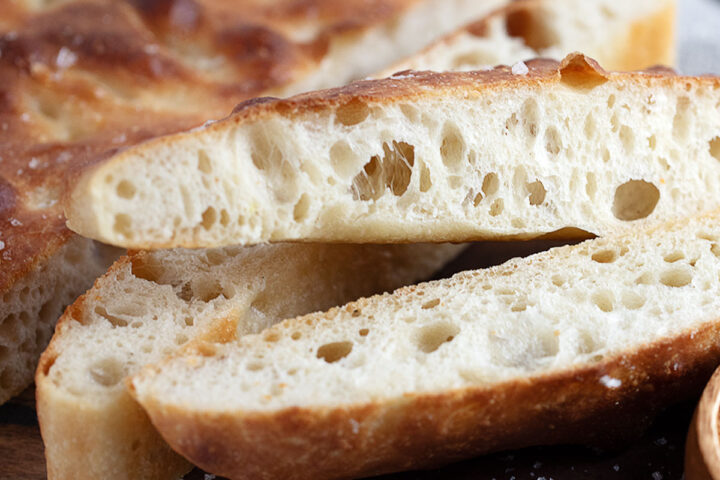
Get the Recipe: Overnight Focaccia (9x13 Recipe)
A 9x13-inch focaccia recipe, perfect for slicing, bruschetta and focaccia sandwiches. With an overnight refrigerator rise for the fullest flavour.
Ingredients
- 350 g (1 1/2 cups) lukewarm water, about 105F
- 1/2 teaspoon instant or active dry yeast
- 500 g (4 cups) bread flour, *see Note 1 below for all-purpose flour
- 10 g (1 1/2 teaspoons) fine sea salt
- 25 g (2 Tablespoons) extra virgin olive oil, plus extra for greasing the pan and topping before baking
Instructions
- Dissolve the 1/2 teaspoon instant or active dry yeast in the 350 g lukewarm water (about 105F) and let it stand for 5 minutes until slightly foamy. (Instant yeast doesn't require proofing in water, but it is perfectly fine to do so anyway.) In a large mixing bowl or the bowl of a stand mixer fitted with the kneading hook, add the 500 g bread flour (*see Note 1 below for all-purpose flour) and the yeast and water mixture. Stir or mix together on Speed 2 until the flour is incorporated into a shaggy dough with no visible flour. Add the 10 g fine sea salt to the dough and stir or knead in with the mixer for a few minutes. Add the 25 g extra virgin olive oil (plus extra for greasing the pan and topping before baking) and stir or knead in with the mixer for a few more minutes. Cover the bowl with a tea towel and let stand for 30 minutes.
- Perform a series of stretch-and-folds every 10-15 minutes for one hour to improve the texture of the dough and develop gluten. The dough should feel smoother and stretch more easily after the stretches and folds. Grease a bowl with olive oil. Scrape the dough into the oiled bowl. Drizzle the top of the dough with olive oil and use your hand to spread it over the top of the dough to completely coat with olive oil. Cover the bowl with a lid or with two layers of plastic wrap and refrigerate overnight - 12-24 hours (or up to 48 hours, if needed).
- Remove the refrigerated dough from the fridge. The dough should be a bit bubbly and should have expanded, but not necessarily doubled. Generously oil a 9x13-inch baking tray or pan with 2 Tablespoons of olive oil. Place a strip of parchment paper across the middle of the pan (about 6-7 inches wide), overhanging the sides of the pan slightly, and oil the parchment paper as well. (The parchment strip forms handles so the bread releases easily from deeper pans.) Using a spatula or a dough scraper, gently release the dough from the bowl and transfer it onto the tray. Gently stretch the dough out to fill the pan by about 60-70%. Let the dough proof for 2 1/2-3 hours or until the dough is puffy and bubbly in spots. The dough should wobble when the pan is gently shaken and show bubbles beneath the surface. (You can also test the dough for readiness by poking gently with a fingertip. It is ready if it springs back slowly and leaves a small, visible dimple. If it springs back fast, it needs more time. If it stays sunken, it may be over-proofed.)
- Preheat your oven to 425F (Regular bake setting; adjust as needed for convection or fan-assisted ovens), with the oven rack in the middle of the oven. Drizzle about 2 Tablespoons of olive oil all over the focaccia. Using your fingertips, press deep dimples all over the dough, working from the centre to the corners and gently stretching the dough to fill the ends and corners, if needed. Sprinkle with flaky sea salt, if desired.
- Place the focaccia and bake for 22-25 minutes, or until it is a deep golden brown and crispy on top. If you have an instant-read thermometer, bake until it reaches 200-210F internal temperature. Remove from the oven and immediately drizzle 1-2 tbsp extra virgin olive oil for extra flavour. Let it cool slightly, then remove to a cooling rack. Slice into squares and serve warm or allow to cool completely.
- Once cooled, store the focaccia well-wrapped at room temperature for 2-3 days. Refresh the focaccia in a 350F oven for 8-10 minutes before serving. For longer storage, wrap well and freeze for up to 3 months.
For the best and most consistent results, use a kitchen scale and the weight measurements provided. If you don't have a kitchen scale, be sure to measure the flour using the stir, spoon and level method.
To "stretch and fold" focaccia dough, dip your hand into a bowl of cold water and shake off the excess. Using your wet hand, grab the side of the dough, reaching down as far as you can. Pull the dough straight up, as far as you can, then gently lay it over the top of the dough ball. Rotate the bowl a quarter turn and repeat until you have worked around the bowl and performed 4 stretches and folds. Do this every 15 minutes if you mixed the dough in a stand mixer or every 10 minutes if you mixed the dough by hand.
Any 9x13-inch baking pan will work here. I've used a 9x13-inch ceramic baking slab here that has 1 1/4" high sides. That would be the minimum side height needed. A metal or glass 9x13-inch deeper cake pan or a 9x13-inch rimmed baking sheet (a rimmed quarter sheet pan) would also work. Glass and ceramic pans are more prone to sticking. Be sure to oil well. Some people like to rub with butter before oiling to ensure a clean release.
It's fine to let the focaccia rise uncovered at room temperature. If you'd like to cover a bit, don't cover with plastic wrap unless you are using a deep 9x-13-inch pan where there is no risk of the rising dough touching the plastic wrap. I like to use another 9x13-inch rimmed baking sheet turned upside down to make a cover that won't touch the rising dough. It is better to leave it uncovered than to risk the sticky rising dough touching a cover.
If you have a clean spray bottle, fill with water and spray the focaccia lightly with water right before placing in the oven. This will help improve the oven spring a bit.
Notes
Note 1: If you only have all-purpose flour on hand, you can use it for this recipe. As all-purpose flour doesn't absorb liquid as much as bread flour, consider reducing the water just to 330g, to achieve the desired dough consistency.
Tips!
If you plan to use the focaccia for sandwiches, consider trimming an inch or so off the slab of focaccia around all sides. This leaves just the thickest centre part, with nice clean-cut edges. Keep the trimmings, cut into cubes and use for dipping!
If you want to bake the focaccia on the same day, place the dough in a lightly oiled bowl, cover, and let it rise for 60 minutes until doubled in size, instead of refrigerating. Proceed with the recipe, reducing the 2nd rise to 1-2 hours.
Focaccia topping ideas
- Sea salt and rosemary
- Cherry tomatoes and basil
- Garlic and olive oil
- Caramelized onions and thyme
- Olives and oregano
Serving: 1serving, Calories: 102kcal, Carbohydrates: 18g, Protein: 3g, Fat: 2g, Saturated Fat: 0.2g, Polyunsaturated Fat: 0.3g, Monounsaturated Fat: 1g, Sodium: 195mg, Potassium: 26mg, Fiber: 1g, Sugar: 0.1g, Vitamin A: 1IU, Calcium: 4mg, Iron: 0.2mg
Tried this recipe?If you enjoyed this recipe, please leave a star rating and comment. It helps others to find it!
