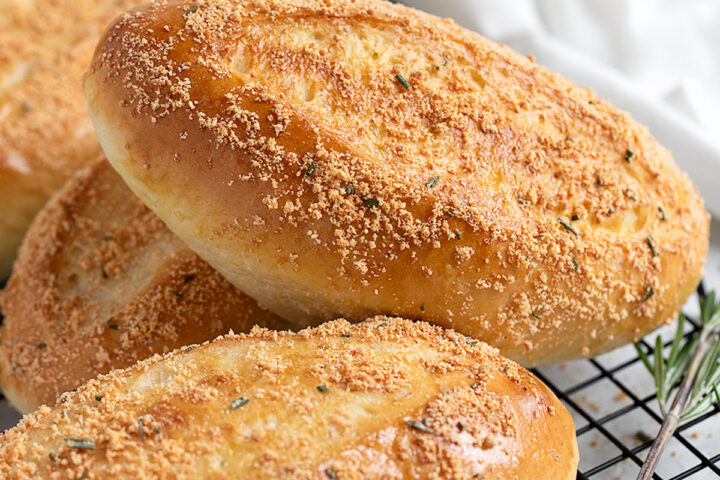
Get the Recipe: Rosemary Parmesan Sandwich Rolls
Easy and delicious, these rosemary Parmesan sandwich rolls are perfect for sandwiches, subs and hoagies. They freeze beautifully, too!
Ingredients
- 1 cup (240 ml) water, lukewarm, about 105F
- 1/2 cup (120 ml) milk, warmed to lukewarm, about 105F
- 2 Tablespoons honey
- 1 Tablespoon active dry or instant yeast
- 3 Tablespoons (42 6) butter, cut into 3 pieces
- 3 1/2 cups (375-425 g) bread flour, spooned and levelled *see Note 1 for substituting all-purpose flour
- 1-1 1/2 teaspoons fine salt, use a bit less in the dough if you would like to use the flaky salt for the tops
Egg wash:
- 1 large egg, beaten
For the rosemary Parmesan topping:
- 1/4 cup (60 ml) grated Parmesan
- 1 1/2 teaspoons rosemary leaves, fresh or dried, finely chopped
- 1/2 teaspoon garlic powder
- flaky sea salt, optional
Instructions
- Combine 1 cup water (lukewarm, about 105F) and 1/2 cup milk (warmed to lukewarm, about 105F) in a 2-cup measuring cup or a saucepan and warm just to lukewarm, about 105F, on the stovetop or in the microwave. Stir in 2 Tablespoons honey and 1 Tablespoon active dry or instant yeast. Add the 3 Tablespoons butter (cut into 3 pieces) and let stand for a few minutes. Add to a large bowl or the bowl of a stand mixer fitted with the kneading hook.
- Add 3 cups of the 3 1/2 cups bread flour (spooned and levelled *see Note 1 for substituting all-purpose flour) and the 1-1 1/2 teaspoons fine salt (use a bit less in the dough if you would like to use the flaky salt for the tops). Mix to combine well. Begin adding the remaining 1/2 cup of flour, a bit at a time, kneading between additions. Add only as much flour as needed, just until the dough cleans the bowl and wraps the kneading hook, but is still a bit sticky. You may not need to add the full amount, or you may need to add a couple of Tablespoons more. Knead the dough for a few minutes on Speed 2.
- Remove the dough to a floured work surface. Knead the dough by hand, adding additional flour only if the dough is sticking to your hands or the work surface. Knead the dough briefly, then form the dough into a ball. Place the dough ball into a greased bowl. Cover tightly with plastic wrap and let rise just until doubled, about 45 minutes.
- Remove the dough to a work surface and gently deflate. Divide the dough into 6 equal-sized pieces. (I like to weigh the dough on a kitchen scale, then divide the total weight by 6 to get the weight for each bun. Weigh out the individual pieces on the scale as well.)
- Form each piece of dough into a ball by pinching it together (see step-by-step photos), then flipping it over and rolling gently on the work surface with a cupped hand.
- Take one dough ball and use your hands to press the ball into an oval shape, about 6 inches long and 4 inches wide, with the long side closest to you. Take the top edge of the oval and fold it down to the middle. Take the bottom edge of the oval and fold it up to meet and slightly overlap in the middle. Pinch together from end to end, pinching the fleshy part of the dough together (see step-by-step photos). Flip over and place onto a large, parchment-lined baking sheet.
- Repeat with the remaining pieces of dough, placing them onto the baking sheet at least 2 inches apart (2 rows of 3 works well). Spray a large piece of plastic wrap (or two, if needed) with cooking spray and cover the baking sheet tightly. Allow the buns to rise until puffy, about 30 minutes.
- While the buns are rising, mix together the rosemary Parmesan topping by combining the 1/4 cup grated Parmesan, 1 1/2 teaspoons rosemary leaves (fresh or dried, finely chopped) and 1/2 teaspoon garlic powder in a small bowl. (I like to use kitchen scissors to snip the rosemary leaves into small pieces, rather than using a knife.) Set aside.
- Preheat oven to 350F (regular bake setting, adjust as needed for convection or fan-assisted), with the rack in the centre of the oven.
- Remove the plastic wrap. Using your sharpest knife, slash down the centre of the buns with one quick, confident stroke, starting and ending about 1 inch in from the ends of the bun. The cut should be about 1/2-inch deep.
- Beat 1 large egg (beaten) together with a teaspoon of water. Brush onto the buns, being sure to brush evenly and thoroughly, all the way to the bottom and all around the buns. Sprinkle evenly with the prepared rosemary Parmesan topping, then sprinkle the buns with a bit of flaky sea salt, if using.
- Bake the buns in the preheated oven for about 15 minutes, give or take a couple of minutes, or until deep golden in colour and the internal temperature reaches 195F. Remove from the oven, then immediately transfer to a cooling rack to cool completely. (If any of the buns bake together, leave them connected until cooled. Separating them while hot causes the steam to escape, which can make the crumb gummy.)
- Once cooled completely, store at room-temperature in an airtight container for 2-3 days or freeze up to 3 months, for longer storage.
The amount of flour you will need will vary a bit from kitchen to kitchen and depending on whether you are using bread flour or all-purpose flour. You may need to add a few Tablespoons more of all-purpose flour to reach the same consistency. Take a minute to look at the consistency of the finished dough in the step-by-step photos above this Recipe Card so you know what you are aiming for. Avoid adding too much flour in the mixer. You can always add more/adjust on the counter. The finished dough on the counter should be kneadable.
Notes
Note 1: Bread flour is recommended if available. If not, you can use all-purpose flour. It will change the texture of the finished buns slightly, and you may need to use a bit more flour to get the dough to the same consistency as shown in the step-by-step photos.
Be sure to read the notes above this Recipe Card for substitution suggestions, step-by-step photos and uses for your rosemary Parmesan buns, that you might find helpful!
Serving: 1bun, Calories: 376kcal, Carbohydrates: 61g, Protein: 12g, Fat: 9g, Saturated Fat: 5g, Polyunsaturated Fat: 1g, Monounsaturated Fat: 2g, Trans Fat: 0.2g, Cholesterol: 51mg, Sodium: 723mg, Potassium: 138mg, Fiber: 2g, Sugar: 7g, Vitamin A: 297IU, Vitamin C: 0.1mg, Calcium: 82mg, Iron: 1mg
Tried this recipe?If you enjoyed this recipe, please leave a star rating and comment. It helps others to find it!
