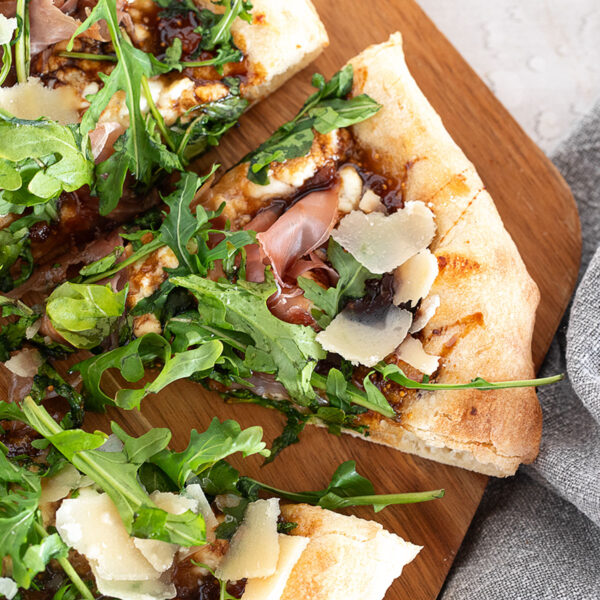
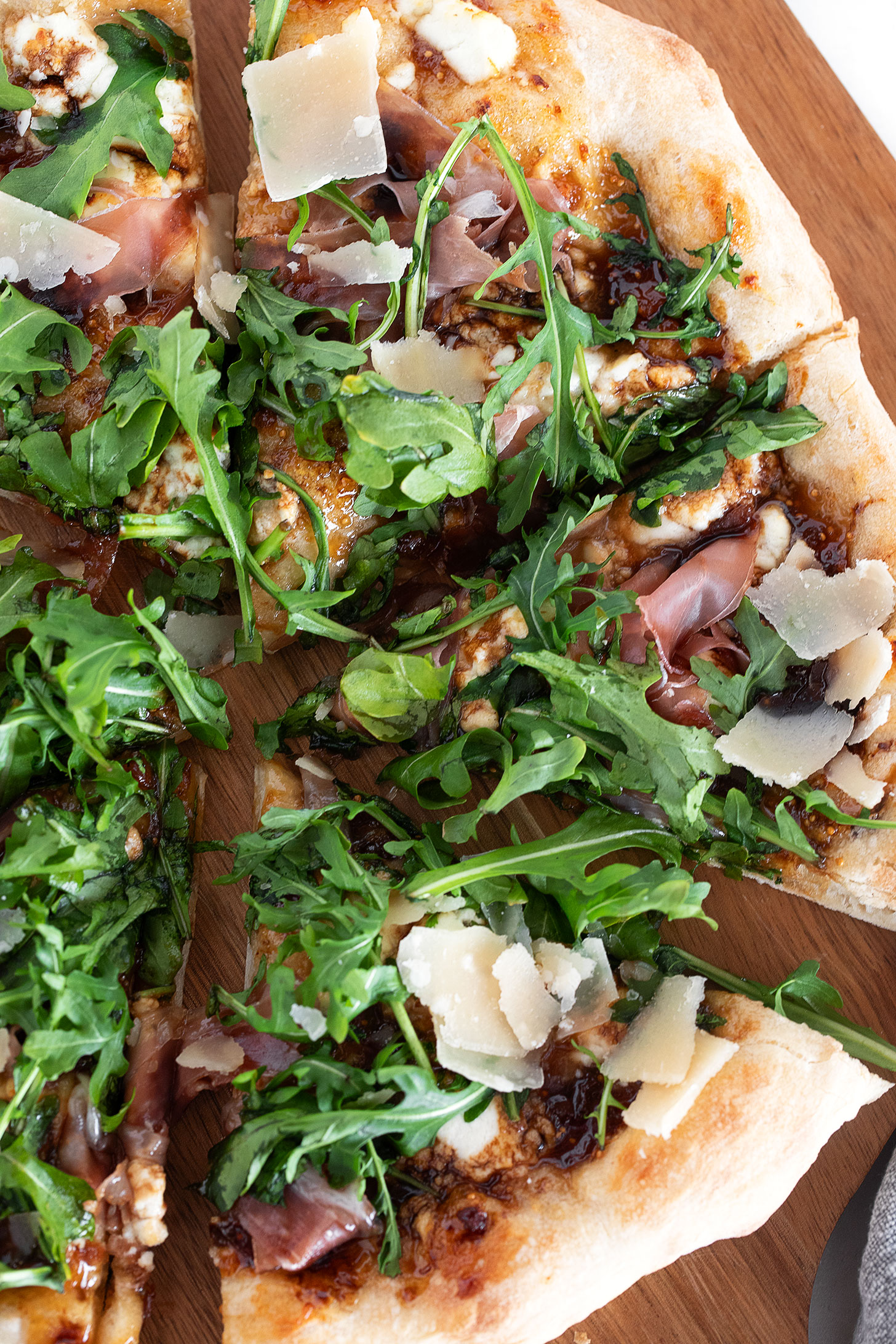
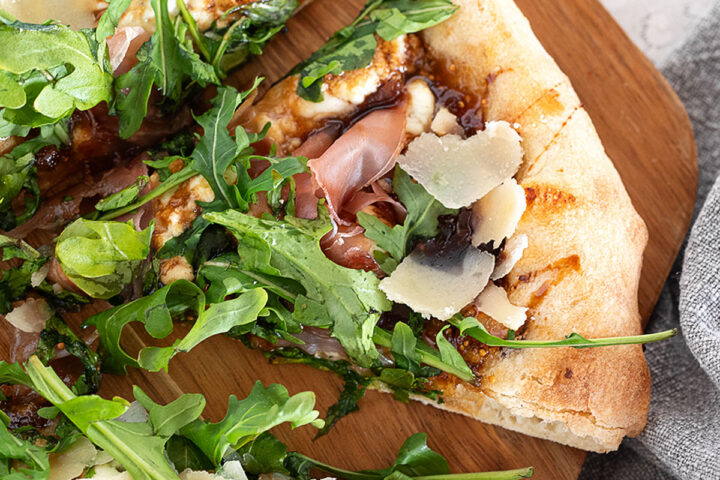
For something a little different on pizza night, try this sweet and salty prosciutto white pizza, with fig jam and goat cheese, often referred to as “Fig and Pig” pizza. Classic flavour combinations come together with fig, prosciutto and balsamic, while the plentiful fresh arugula and Parmesan shavings finish off this pizza beautifully.
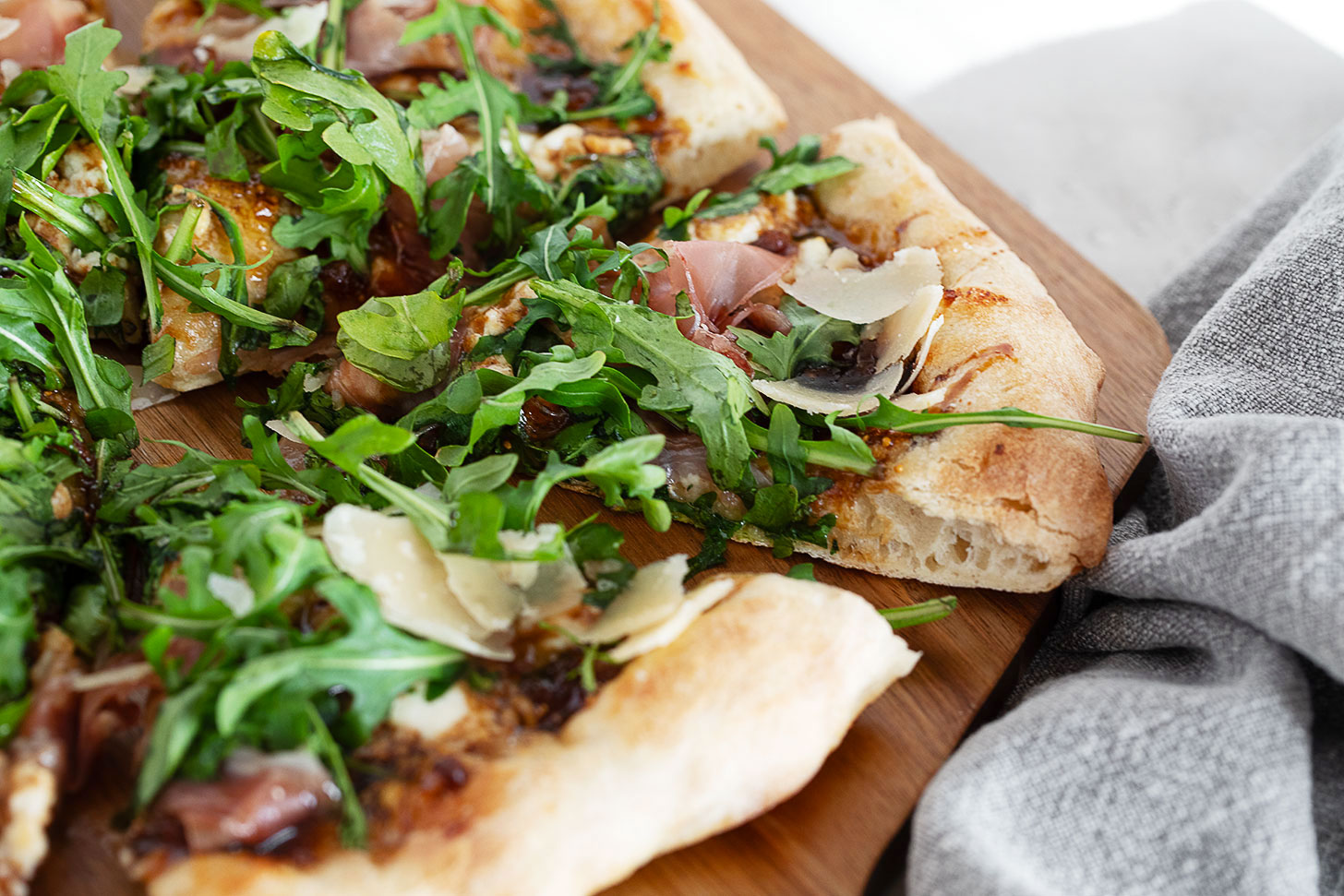
Yes, you can make gourmet-style pizza at home! This prosciutto pizza is much more than the sum of its parts. With a base of fig jam, creamy, tangy goat cheese, salty prosciutto, peppery arugula and nutty Parmesan, it’s a feast for the taste buds. You can start with store-bought pizza dough or make your own.
This white pizza brings the sweet and salty beautifully for restaurant flavours at home! (If you love a white pizza and the sweet and savoury combination, you might want to try my Honey Goat Cheese Pizza next.)
Ingredients and substitutions
A few notes about the key ingredients …
Pizza dough – Make your own pizza dough or pick up a ball of frozen or fresh pizza dough at the grocery store. Generally sold in 1 – 1 1/2 lb balls, one ball of this size will yield one large (14-16 inch) or two small (10-12 inch) pizzas.
Fig jam – Look for the little jars of fig jam in and around the cheese bunkers at the grocery store. Look for the bright orange lid! If you can’t get your hands on it, search online for homemade fig jam, that’s made from dried figs.
Goat cheese – I love goat cheese on this pizza, for the creamy, tangy flavour. If you aren’t a fan of goat cheese, try goat feta! It has a bit of the goat cheese tang, in crumbly feta format.
Prosciutto – You’ll find prosciutto in packages in the deli meat section at the grocery store, or often the deli counter has prosciutto for slicing.
Balsamic glaze – Balsamic glaze is the thickened, syrupy version of balsamic vinegar. Look for it in small bottles with the balsamic vinegar. Nonna Pia’s is the most common brand.
How to make fig and pig pizza
This is a visual summary of the steps to make this recipe. Scroll down to the Recipe Card below for the complete list of ingredients and full instructions.
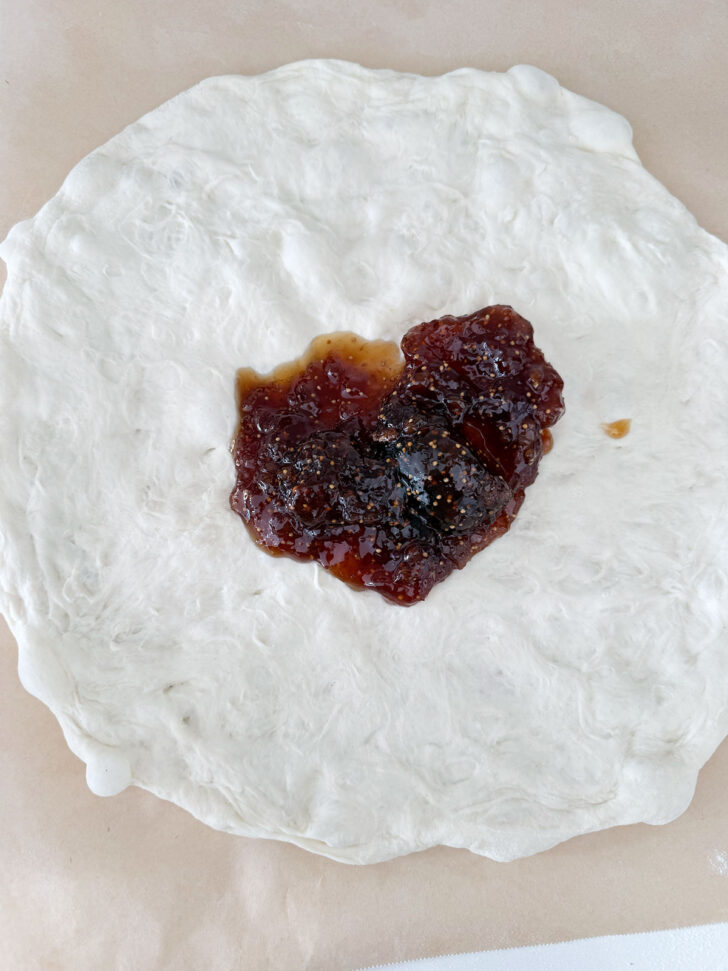
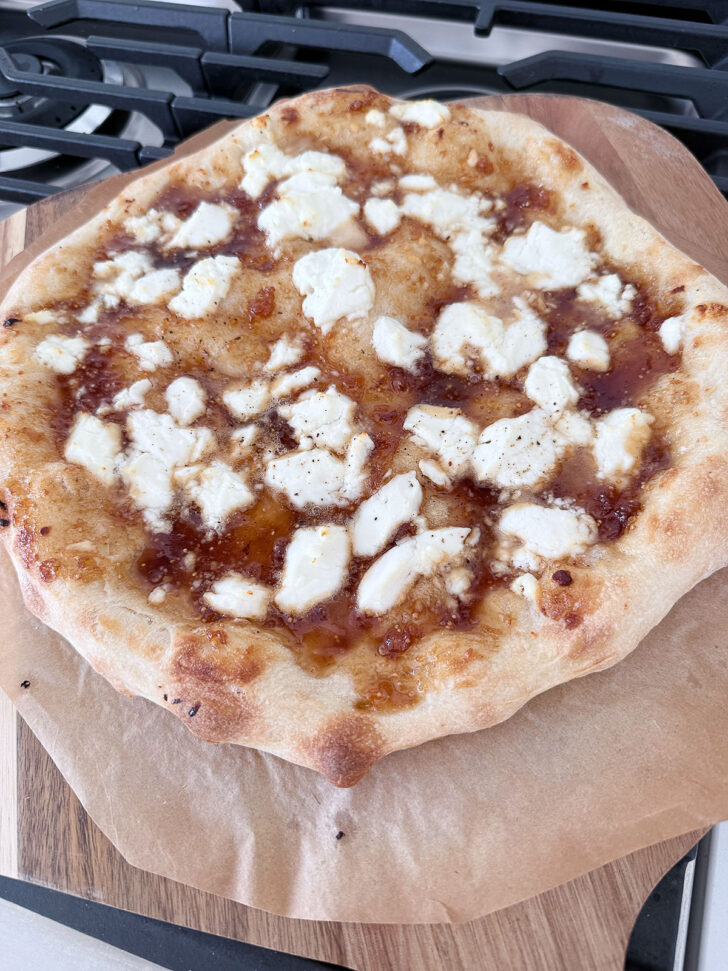
- Press the pizza dough out into a roughly 12-inch round on top of parchment paper. Spoon the fig jam on top. I like to scatter some red pepper flakes over the fig jam for a bit of a sweet-heat flavour.
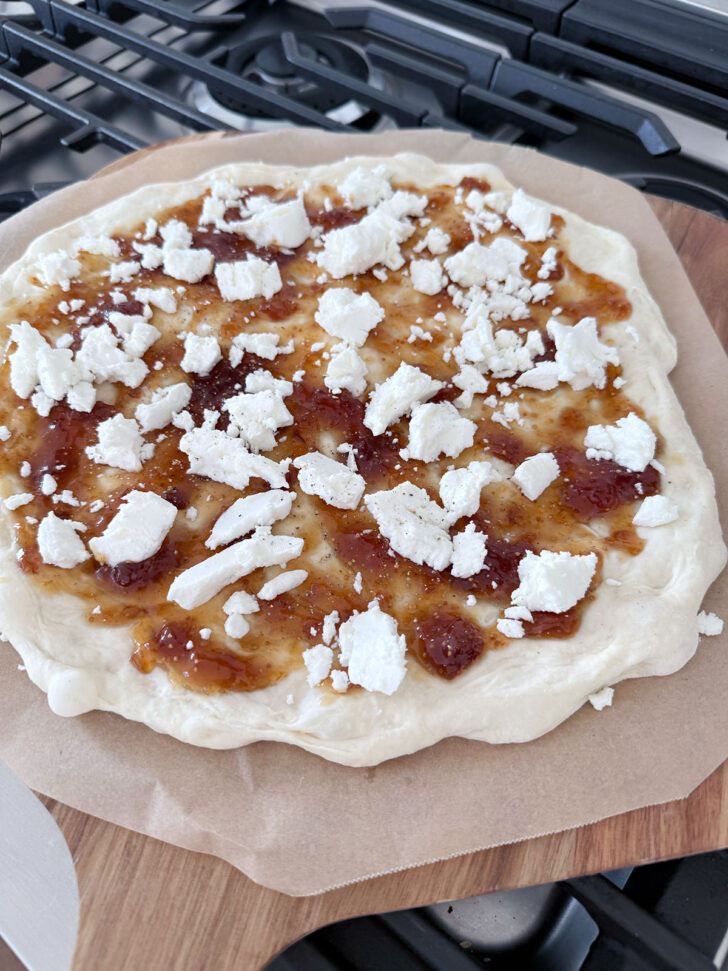
- Spread the fig jam over the dough, leaving about 3/4-inch around the outside bare. Break up the goat cheese and scatter it over the top of the pizza. Bake at 500F for 8–12 minutes until golden
- Remove the pizza from the oven when the crust is golden and set.
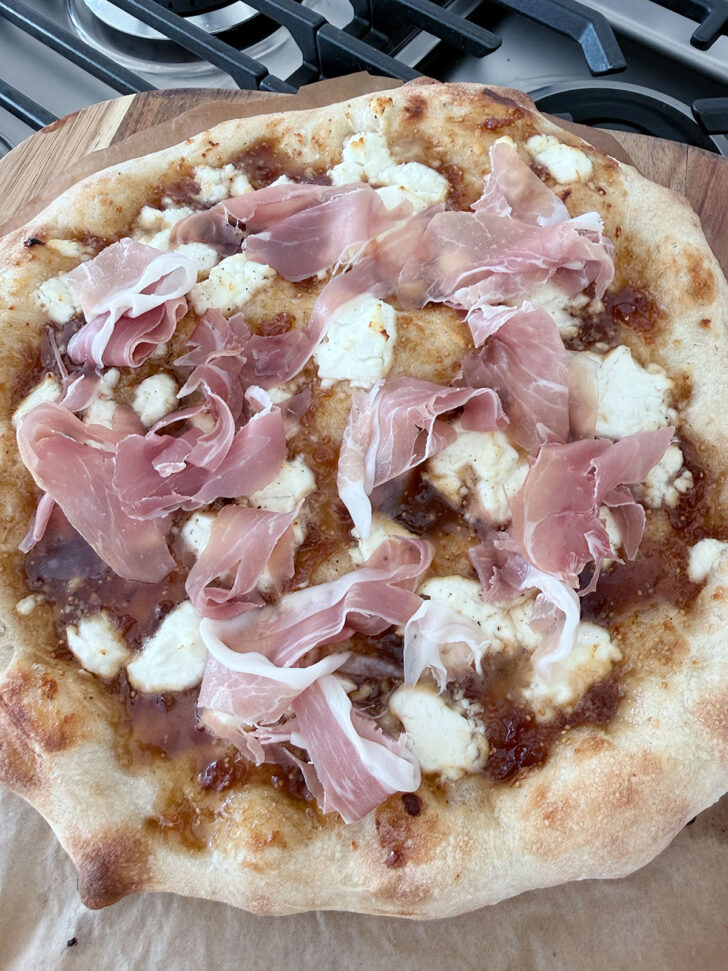
- Arrange the prosciutto over the baked pizza.
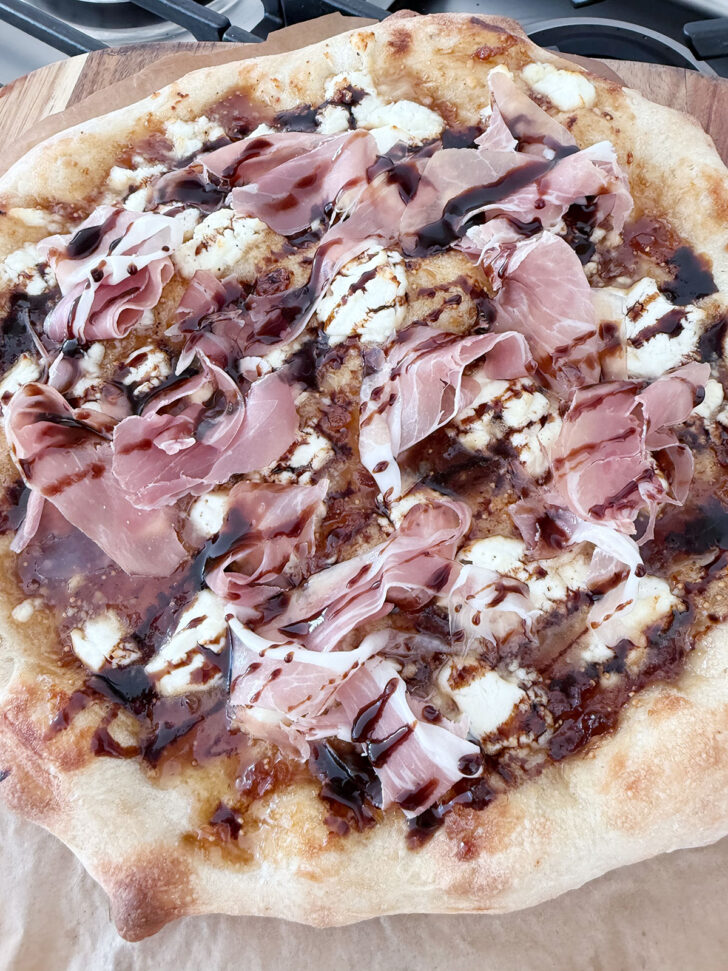
- Drizzle the pizza with balsamic glaze.
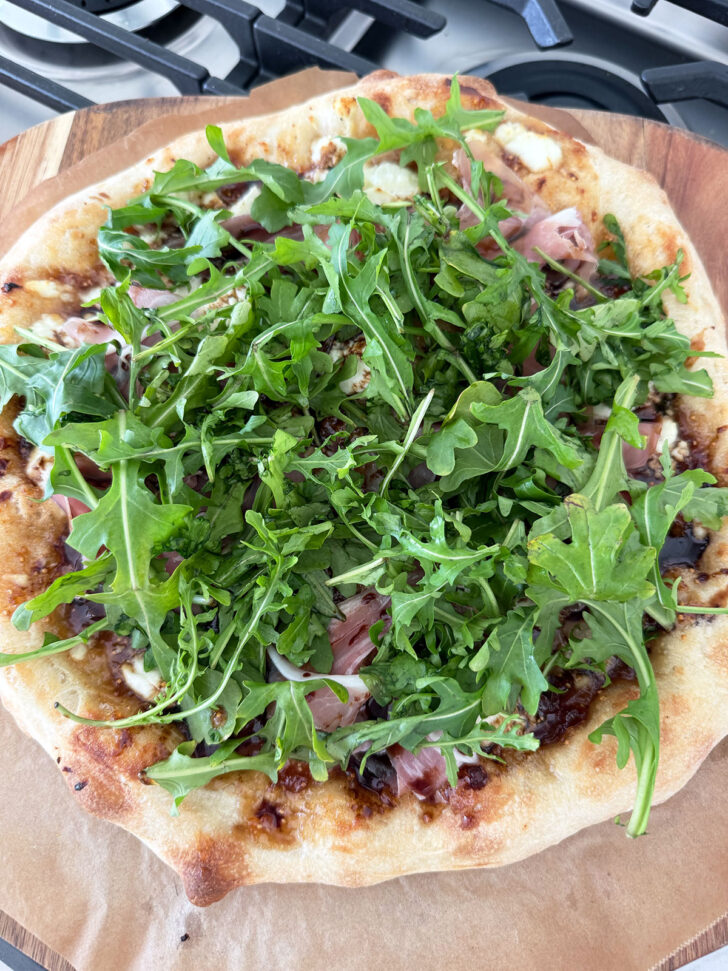
- Scatter a generous layer of fresh arugula over the top of the pizza to finish.
Recipe tips!
- The fig jam base can lean a little sweet. I like to balance it with a few red pepper flakes. A drizzle of chili oil on the finished pizza would accomplish the same thing.
- I know there are some who don’t love the texture of prosciutto and prefer it a little cooked. If you are one of those people, simply scatter the prosciutto over the pizza for the last minute or two of cooking. You don’t want to put it on at the start of cooking, as it will be burnt to a crisp.
Tips for restaurant-quality pizza at home
If you’re new to making pizza at home, here are my best tips for restaurant-style pizza at home …
- My favourite homemade pizza dough: I always use Jim Lahey’s No-Knead pizza dough when I make pizza at home. It does require an 18-hour head start, but it’s well worth it if you’re looking for restaurant-quality pizza at home. I’ll pop the ingredients and instructions in the Recipe Card Notes below.
- Parchment paper makes everything easier! Assembling the pizza on parchment paper makes transferring the pizza to the oven much easier. I use a wooden pizza peel, but if you don’t have a peel, just use a rimless baking sheet or flip a rimmed baking sheet over and use the bottom as a flat surface. Be careful! Metal is slippery, so don’t move too quickly ;)
- A pizza stone is a worthwhile investment! If you enjoy making pizza at home. I have tried glazed ceramic and even a baking steel, but I still swear by the classic clay-type pizza stone. Just remember to always place it in the oven before turning the oven on, so it heats up along with the oven. Leave the hot stone in the oven to cool after using it as well, to avoid temperature shock, which can cause the pizza stone to break.
- Bake the pizza on the parchment: For less mess and easier removal from the oven. Having the parchment under the pizza won’t compromise the bake at all. You’ll still get a golden bottom on the crust. I like to trim the parchment back to within an inch of the pizza, so there’s less paper exposed to the high oven heat. It will scorch in the oven, but I have never had it catch fire.
Want to save this recipe?
Enter your email and I’ll send it to your inbox. Plus, you’ll get great new recipes from me every week!
By submitting this form, you consent to receive emails from Seasons and Suppers.
You can unsubscribe at any time.
Get the Recipe: Fig and Pig Pizza
Ingredients
- 1 1/2 lb pizza dough, store bought or homemade *see Note 1 below for my favourite homemade pizza dough recipe
- 8 oz (240 g) fig jam
- Red pepper flakes, optional *see Note 2 below
- 10 oz (240 g) goat cheese, *see Note 3 below
For topping after cooking:
- 3 oz (85 g) prosciutto, *see Note 4 below
- balsamic glaze, *see Note 5 below
- 5 oz (142 g) fresh arugula
- shaved Parmesan, for garnish
Instructions
- The recipe, as written, will yield two 12-14-inch pizzas, or 16 slices. The two pizzas will serve 4-6. Use the "1/2" button above to adjust the ingredients automatically if making only one pizza.
- Place a pizza stone (if using) onto the centre rack of the oven (if using). Preheat the oven to 500F (non-convection/not fan-assisted). Allow the oven to preheat for at least 30 minutes. If you're not using a pizza stone, use a large baking sheet instead. Turn the baking sheet upside down if necessary to have a large, flat area for the pizza. Prepare the pizza on the parchment on top of the baking sheet and then transfer the pizza on the baking sheet directly to the preheated oven. Baking time will likely be a little longer using a baking sheet, as it isn't cooking on a heated stone.
- Prepare the pizzas: Start with a sheet of parchment paper large enough to hold your shaped pizza. Sprinkle a bit of cornmeal or flour onto the parchment paper. Take a 3/4-pound piece of pizza dough and, using your fingertips, press it out into a 12-to 14-inch round. Spoon half of the fig jam (about 4oz) onto one round of pizza dough and use the back of a spoon to spread the jam over the top of the pizza dough, leaving the outside 3/4-inch bare. If using, sprinkle about 1/8- 1/4 teaspoon of red pepper flakes over the fig jam. Crumble up half of the goat cheese and scatter it over the fig jam.
- Transfer the pizza into the oven on the parchment paper, using a pizza peel or baking sheet to transfer the pizza on the parchment onto the hot pizza stone.
- (While the first pizza is baking, you can prepare the second pizza to have it ready to go in the oven when the first one comes out.)
- Bake the pizza until the crust is puffy and golden. You can use tongs to gently lift up the pizza to check the crust underneath. It should have golden spots when it's done, about 8-12 minutes, depending on the thickness of the crust.
- Remove the pizza from the oven. Arrange half of the prosciutto (1.5oz) on the pizza, scrunching it up a bit. Drizzle the pizza with balsamic glaze and then top with a generous layer of fresh arugula (5oz) and Parmesan shavings. Slice each pizza into 8 slices and enjoy!
- Pizza is best enjoyed fresh. You can reheat slices in a hot skillet or on a baking sheet in a 425F oven for a few minutes.
Notes
1 gram instant yeast (1/4 teaspoon)
350g room temperature water (1 1/2 cups)
16g fine sea salt (about 2 teaspoons) *I usually use just 1 1/2 teaspoons myself I mix the dough up in my stand mixer fitted with the paddle attachment, mixing until the flour is moistened. Remove the paddle attachment and scrape the dough into a mound at the bottom of the bowl. Cover the bowl with plastic wrap and let stand for 16-18 hours at room temperature. One hour before you want to bake your pizza, scrape the dough onto a generously floured work surface. It will seem really sticky at this point, but dusting it with a bit of flour and rolling it around in the flour on the counter will quickly remove the stickiness. Divide the dough into two equal pieces and form each piece into a ball. Cover the balls of dough with an inverted large bowl (one bowl for each ball) and let stand for 1 hour before forming into pizzas. Will make two 12-14-inch pizzas. (Adapted from Jim Lahey) Note 2: The fig jam can be a touch sweet, so I love to balance it a bit with a few red pepper flakes. You could also drizzle the finished pizza with a bit of chili oil after baking for the same effect. Note 3: If you aren’t a fan of goat cheese, try goat feta! It has a bit of the tang of goat cheese, but in feta format. Regular feta would be a fine substitute, or try something creamier, such as a few dollops of labneh or ricotta. I’d even be tempted to give Brie a try on this one! Note 4: As written, the prosciutto is placed on top of the pizza after baking. I know some aren’t fond of the texture of prosciutto and might prefer a little cooking on it. You don’t want to put the prosciutto on at the start, though, as it will burn to a crisp. I suggest waiting until the pizza is nearing cooking, place the prosciutto on top and allow it to cook with the pizza for the last minute or two. Note 5: Look for balsamic glaze in small bottles with the balsamic vinegars at the grocery store. Nonna Pia’s is a popular brand. If you can’t find balsamic glaze, simply simmer 1/2 cup of balsamic vinegar with 1 1/2 teaspoons of brown sugar on the stovetop until thickened and syrupy, about 10-15 minutes.
More pizza recipes to love!

Hi! I’m Jennifer, a home cook schooled by trial and error and almost 40 years of getting dinner on the table! I love to share my favourite recipes, both old and new, together with lots of tips and tricks to hopefully help make your home cooking enjoyable, stress free, rewarding and of course, delicious!