

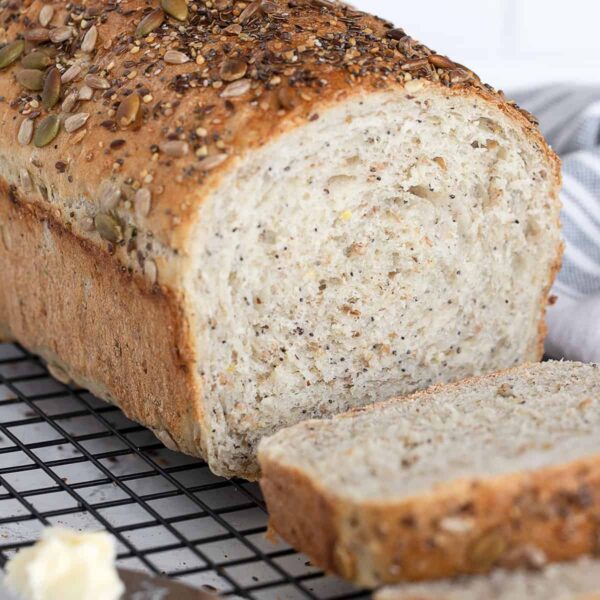
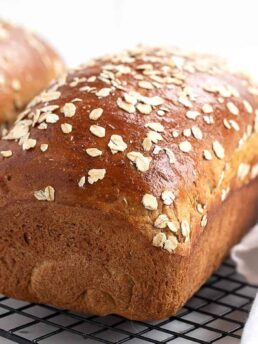
This light and fluffy multigrain bread recipe has become my go‑to everyday sandwich loaf. Made with multigrain cereal and a crunchy seed topping, it bakes up soft enough for sandwiches and toast, but still delivers all the hearty flavour and goodness of whole grains. If you’re looking for a reliable, homemade multigrain sandwich bread you can make on repeat, this simple multigrain bread is a great place to start!
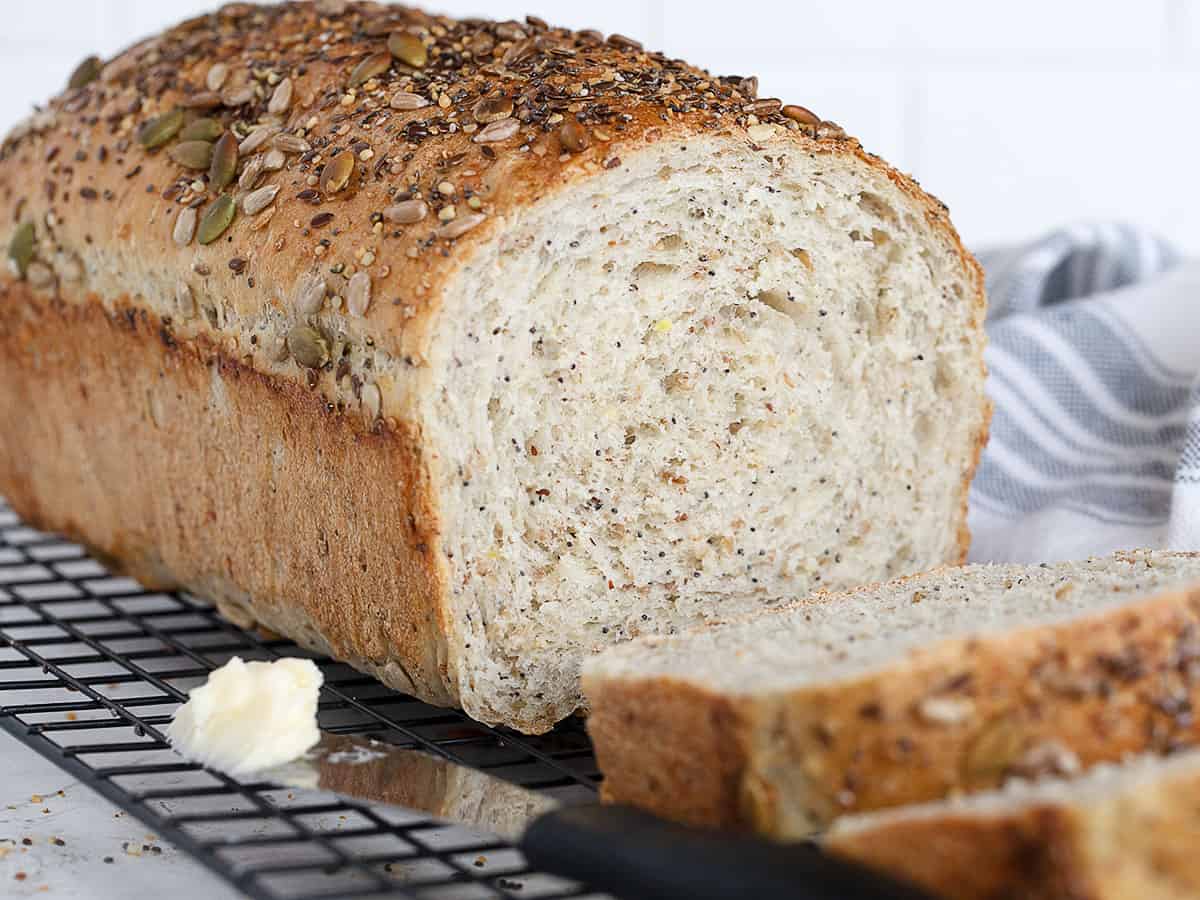
Multigrain bread recipe: at a glance
- This easy multigrain bread recipe is ready in about 2 1/2 hours, including rising time (fast-rising, so it’s ideal for weekly baking!)
- Uses pantry-friendly multigrain cereal mix and other simple ingredients for great flavour and texture.
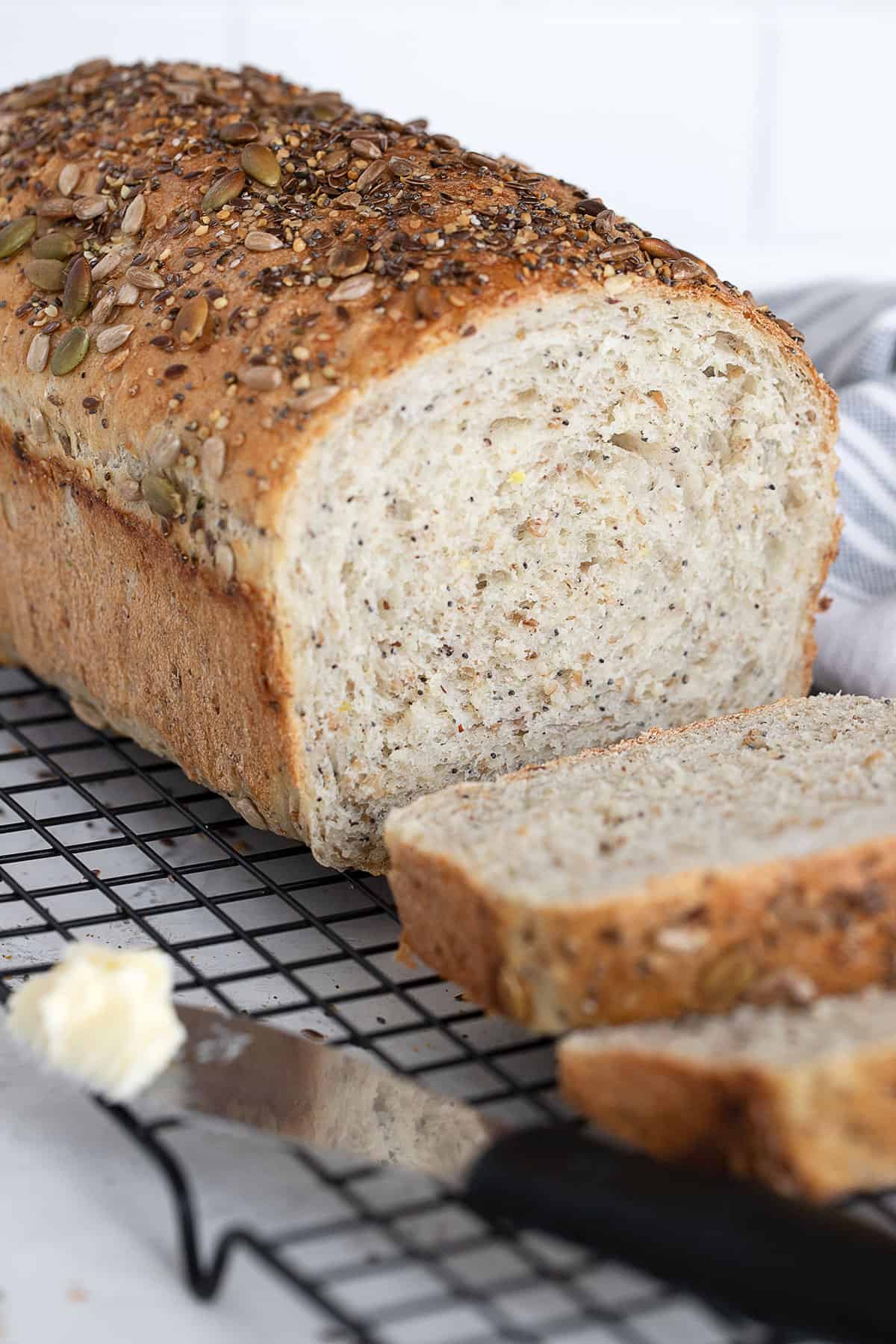
- Makes a soft, sliceable light multigrain sandwich loaf perfect for toast and everyday slicing.
- Readers have successfully used different multigrain cereals, swapped in whole wheat flour, and added dried fruit or nuts, so you can easily tailor this loaf to your taste
- This detailed multigrain bread recipe includes all my best tips, step‑by‑step photos, and an overnight rise option.
Why this multigrain recipe works
- It starts with a soaked multigrain cereal for flavour and moisture, so the loaf stays soft.
- It uses just enough flour and a relatively quick rise for a light, fluffy crumb.
- Includes clear timing and internal temperature cues so you avoid dense or gummy loaves.
- Flexible base dough you can adapt with seeds, nuts, or dried fruit without extra adjustments.
What readers are saying …
Hundreds of readers have made this loaf, with many calling it their new “everyday bread” for breakfast and sandwiches.
“I have been searching for an earthy loaf of multigrain bread for a very long time. I love to bake and have been doing so for over 40 years. I’ve made many loaves of bread by many authors and cookbooks. Nothing wowed me till I made this loaf. The directions and video were perfect and easy to follow. This was THE BEST homemade loaf of bread!! My husband loved it and said it was better than our fancy favorite bakery.” – Cheryl
“Love this recipe! This is my go to for multigrain bread. Also gave it to a friend in Newfoundland, Canada and it’s her favourite also. Bread from the store/supermarket is a thing of the past. Thank you.” – Madeline
- Multigrain bread recipe: at a glance
- Why this multigrain recipe works
- What readers are saying …
- Ingredients and substitutions
- Homemade multigrain cereal mix
- How to make this multigrain bread recipe: at a glance
- How to make multigrain bread: step-by-step photos
- How to make multigrain bread: video
- Recipe tips!
- Multigrain bread recipe FAQ
- Troubleshooting this multigrain bread recipe
- Overnight refrigerator rise option
- Storing and freezing multigrain bread
- Get the Recipe: Light and Fluffy Multigrain Bread
- More bread recipes to love!
Ingredients and substitutions
A few notes about the key ingredients …
Cereal mix – This loaf uses a multigrain cereal mix, which is generally used to make a hot cereal when combined with hot water or milk. Using a multigrain cereal mix in this multigrain bread recipe is the easiest way to pack a variety of whole grains into every slice. These mixes are 100% whole grains, with no added sweeteners, so steer away from the commercial flavoured oatmeal mixes, etc.
This multigrain bread recipe works with most unsweetened multigrain hot cereals you’ll find in the grocery store.
Here are some suggestions based on your location …
In Canada: Look at Bulk Barn for 7‑grain or 12‑grain cereal. Grocery store options include Bob’s Red Mill 7‑grain, 8‑grain, 10‑grain, or 12‑grain cereals, Rogers porridge mixes, Quaker Super Grains Hot Cereal or Red River Cereal.
US and beyond: I believe Bob’s Red Mill 7, 8, 10 or 12-grain cereal is widely available and suspect the Quaker Super Grains may be as well. Beyond that, my best advice is to browse the hot cereal/oatmeal section at the grocery store or the natural foods section and see what you can find. If you really can’t find something, see below for a homemade multigrain cereal mix.
All-purpose flour – for the lightest loaf, use all-purpose flour. I prefer unbleached all-purpose flour. You can also use bread flour if you like, though you may need a little less than specified. If you want to add some whole-wheat flour to the loaf, you can replace up to 1 cup of the all-purpose flour with whole wheat flour, though your loaf will not be as light and fluffy as the original with this change.
Vegetable oil – Using oil in yeast breads helps create the soft and light texture. It is also good for anyone wanting a vegan yeast bread. That said, you can certainly replace the oil with an equal amount of melted and cooled butter.
Homemade multigrain cereal mix
If you can’t find a pre-mixed multigrain cereal mix, you can mix up your own with a combination of any of the following whole grains: rolled oats, quick oats, steel-cut oats, quinoa, flaxseed meal, flaxseed, sesame seeds, oat flakes, rye flakes, barley flakes, cracked wheat, wheat bran, oat bran, millet, buckwheat.
How to make this multigrain bread recipe: at a glance
To make multigrain bread, soak multigrain cereal, mix it with yeast, oil, flour, honey, salt and seeds to form a soft dough, let it rise, shape it into a loaf, proof again, then top with seeds and bake until golden.
- Soak the multigrain hot cereal in boiling water until cooled to lukewarm.
- Stir in the yeast and oil, then add flour, honey, salt and seeds to form a soft dough.
- Knead until smooth, then cover and let rise until doubled.
- Gently deflate, shape into a loaf and place in a greased loaf pan.
- Let rise again, then brush with egg wash, sprinkle with seeds and bake until golden and cooked through.
- Cool completely on a rack before slicing for sandwiches and toast.
How to make multigrain bread: step-by-step photos
This is a visual summary of the steps to make this bread. Scroll down to the Recipe Card below for the complete list of ingredients and instructions.
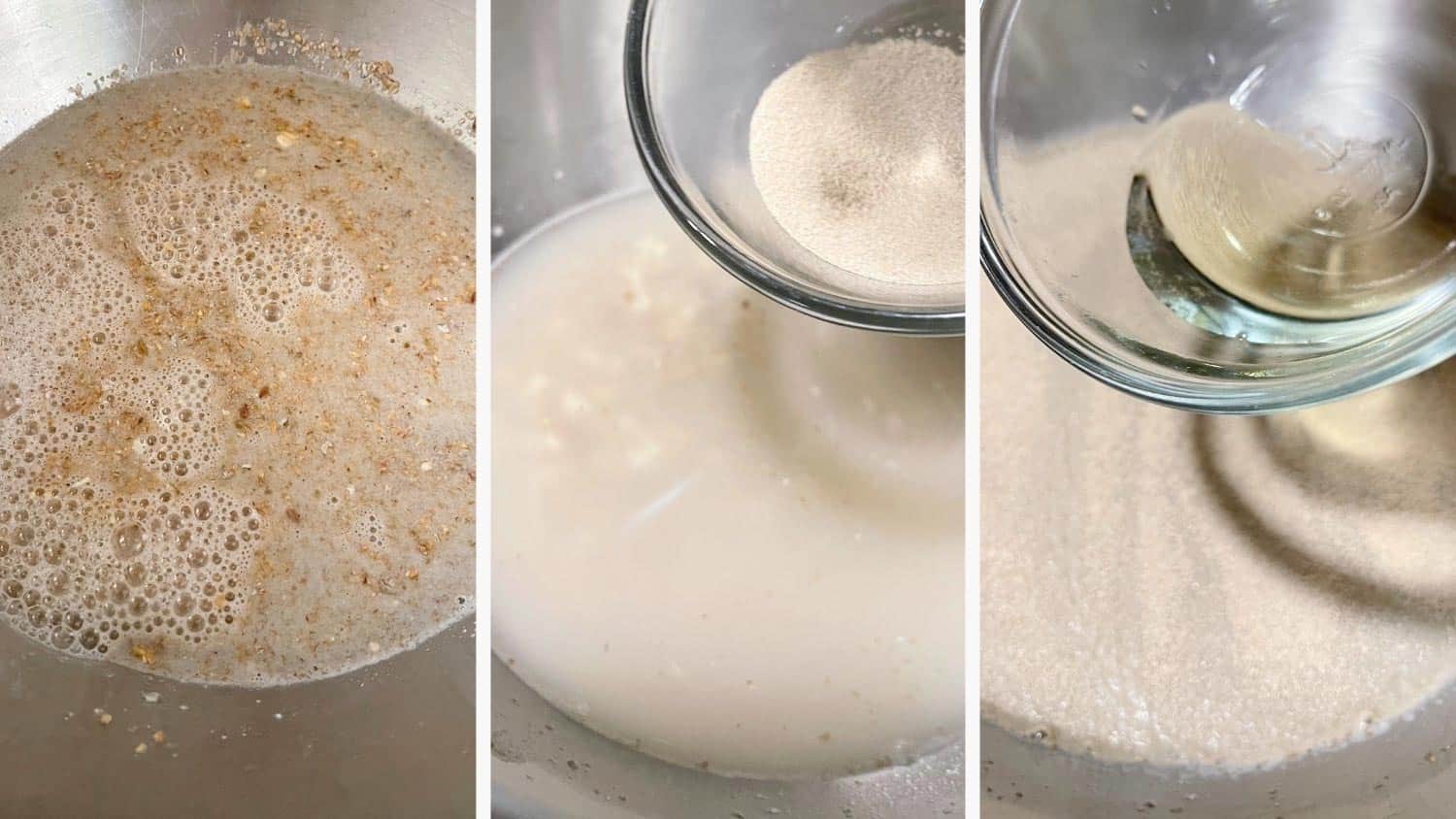
Step 1: Start by soaking the multi-grain cereal mix in boiling water for about 20 minutes, or until it cools to just lukewarm. Since this dough can start with any number of multigrain cereal mixes, it may absorb the water differently. You may find you have less water in the bowl than shown here after it sits for 20 minutes. That’s ok :)
Be sure your cereal mix has cooled to just lukewarm before adding the yeast, or you could kill the yeast before you get started. Test with an instant-read thermometer if you have one and make sure it’s about 105F. Otherwise, test with your finger. It should be lukewarm and not feel hot at all. Add the yeast and stir to combine. If using Active Dry Yeast, let stand 5-10 minutes before proceeding.
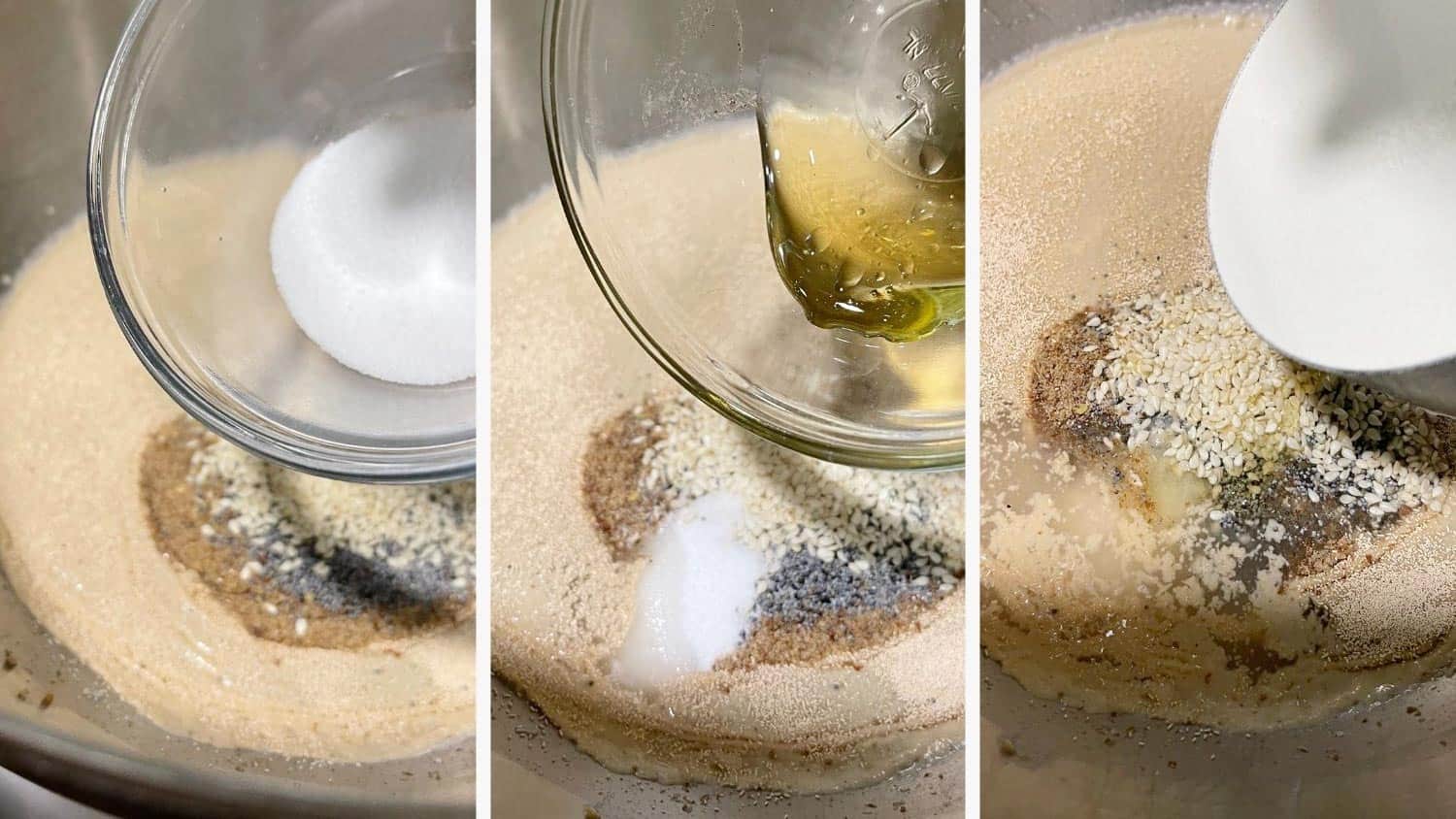
Step 2: Add the oil, honey and salt. If you’d like to add-in some extra seeds at this point, go ahead. I added sesame seeds, poppy seeds and ground flax seed here. This is optional.
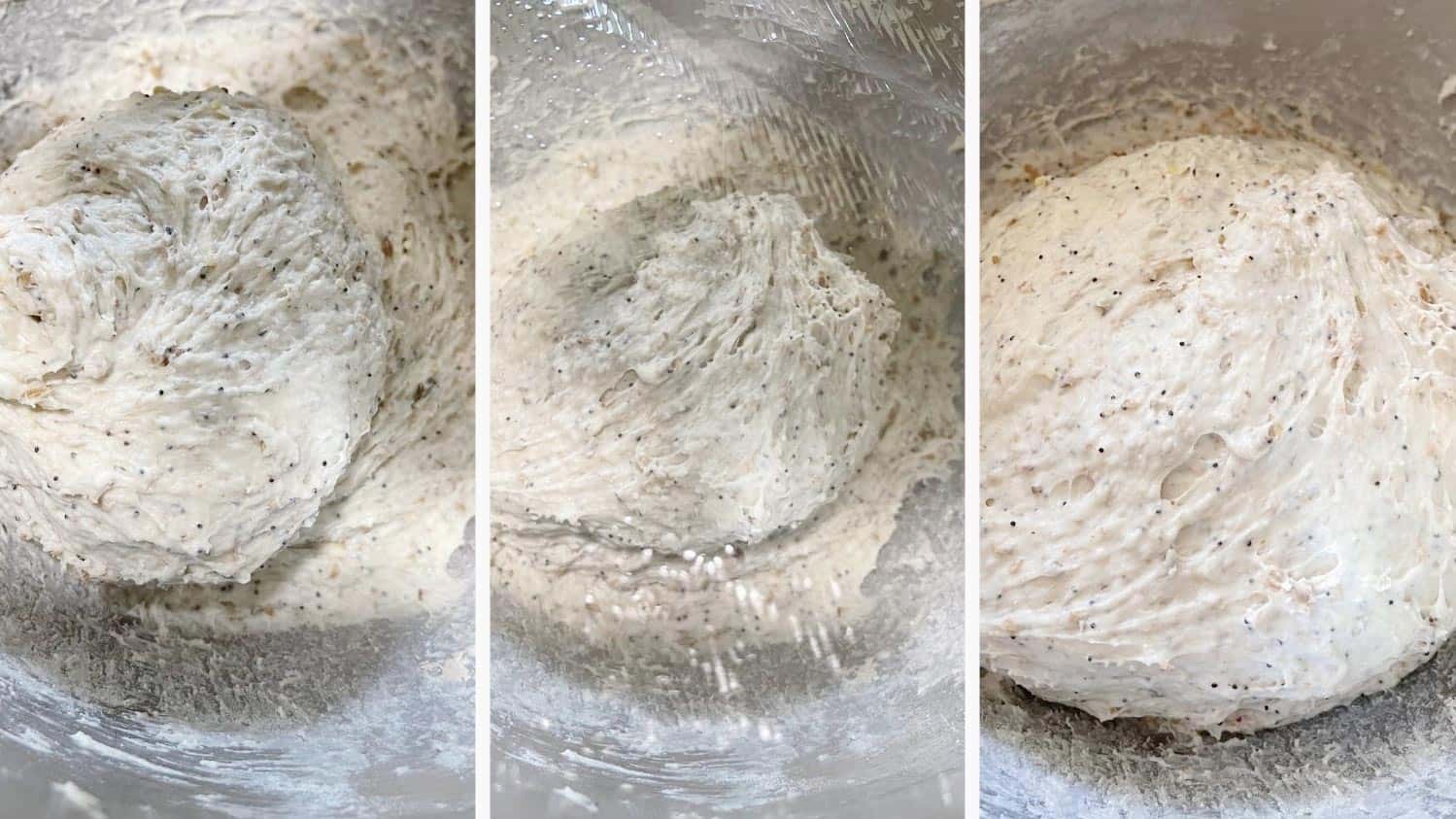
Step 3: Begin adding the flour to the bowl, kneading in as you go. Thee secret to a light and fluffy loaf is to not add too much flour! In the photo above, you’ll see that the dough with the 4 cups of flour added is loose and wet. Yours may be a little less loose, depending on the cereal mix that you used, but it should be very moist at this point. That’s what we want. You may be tempted to add more flour, but resist the urge to add it at this stage.
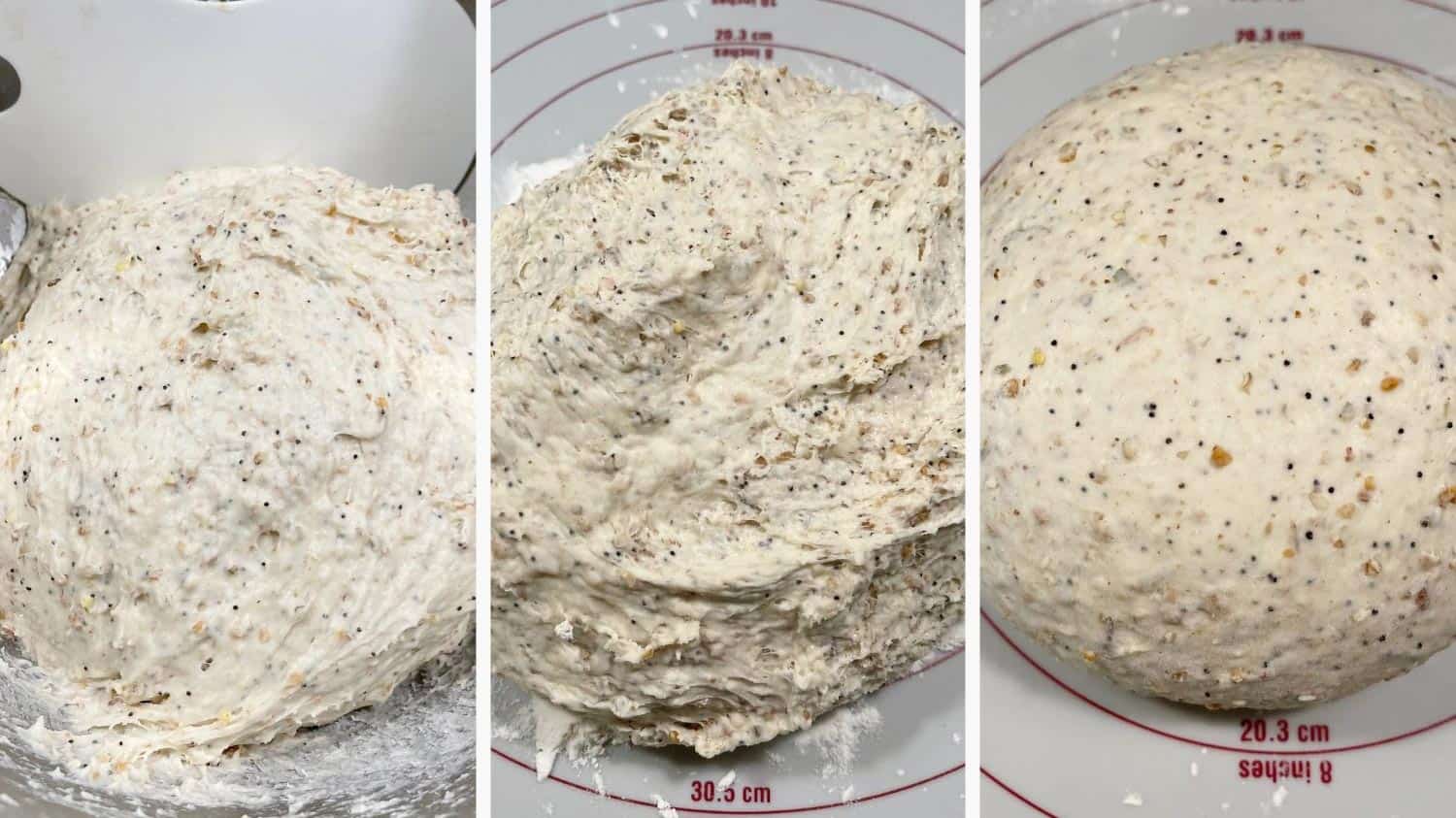
Step 4: Remove the dough to a floured work surface and add a bit more flour, as needed, only if the dough is sticking to your hands or the work surface. Form the dough into a ball.
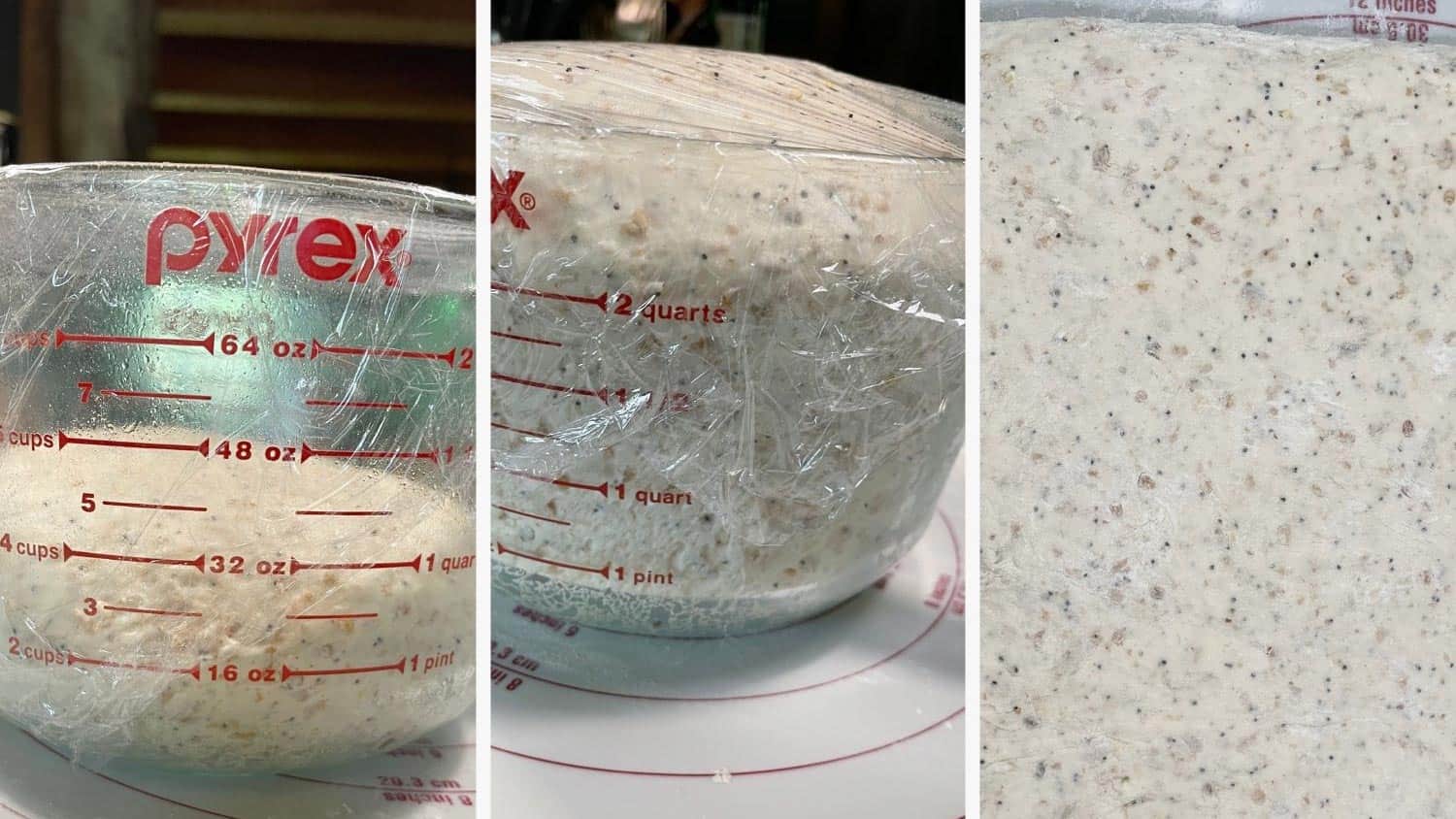
Step 5: Set the dough into a greased bowl or large measuring cup. Cover tightly with plastic wrap and set to rise until doubled in size. This bread is a FAST RISER! Don’t wander far and keep a good eye on it. This 1st rise shown here was only about 40 minutes. Be sure you just allow the dough to rise until doubled and no more.
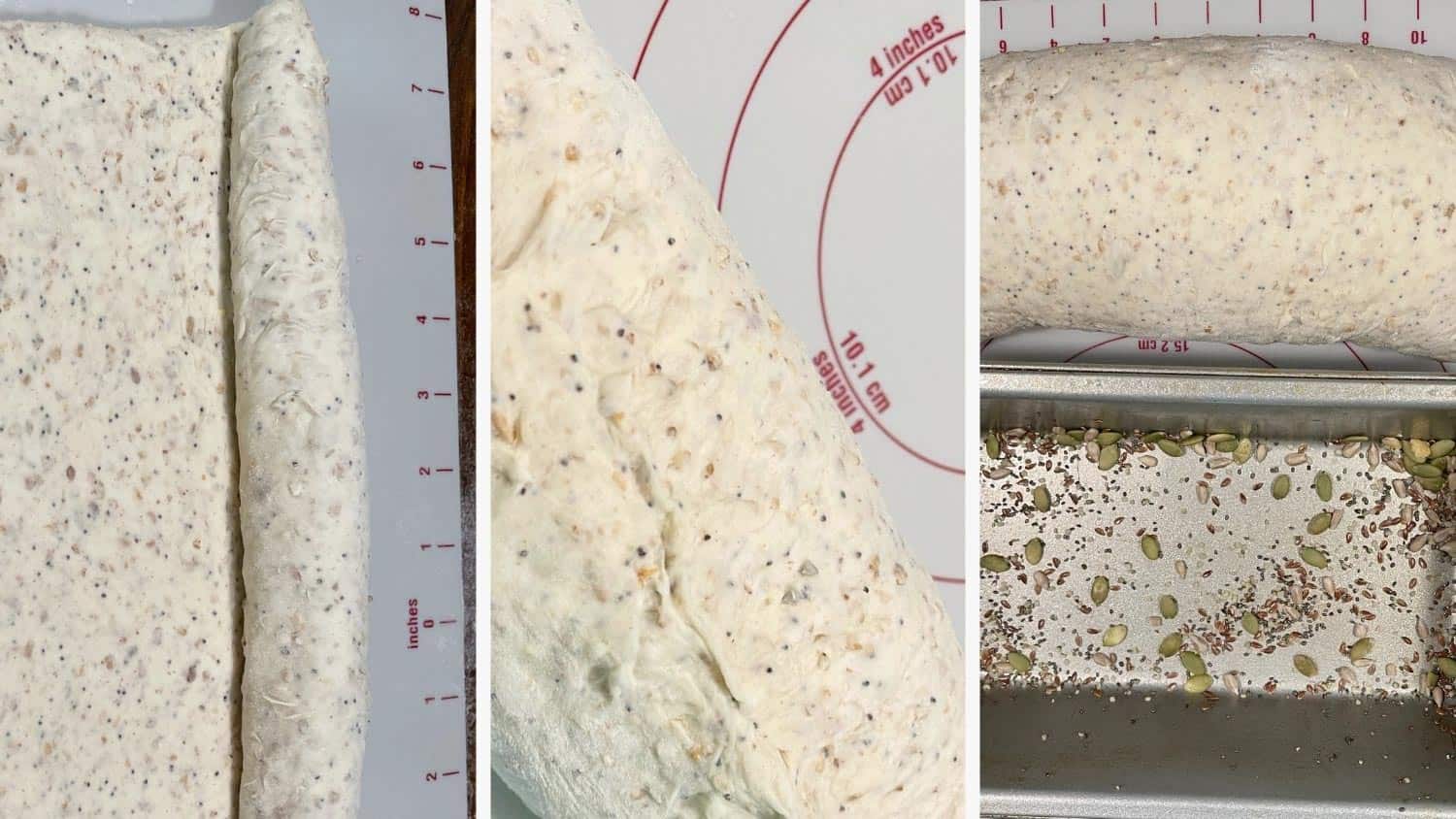
Step 6: Remove the dough to a lightly floured work surface and roll the dough out into a rectangle, then roll up jelly-roll style. Pinch the season together. Grease a loaf pan (or pans, depending on what size loaves you are making). Sprinkle some seeds into the pan, if you like.
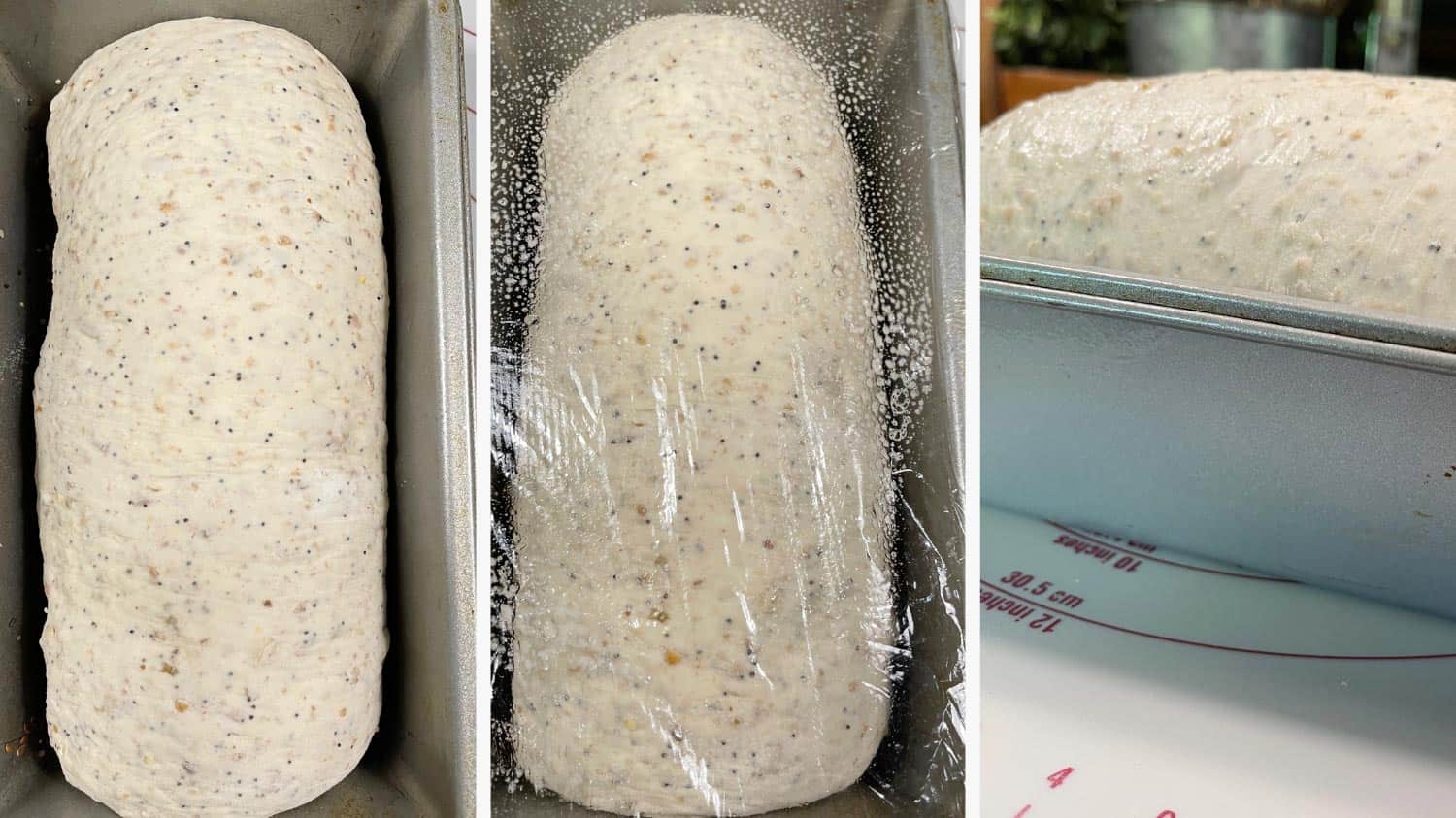
Step 7: Set the rolled dough into the prepared baking pan. Spray some plastic wrap with cooking spray and cover the pan (greased side down). Allow to rise until doubled in size, about 25-30 minutes, but may be less! In a 9×5-inch pan, it should crest the pan by about 1 1/2-inches in the centre.
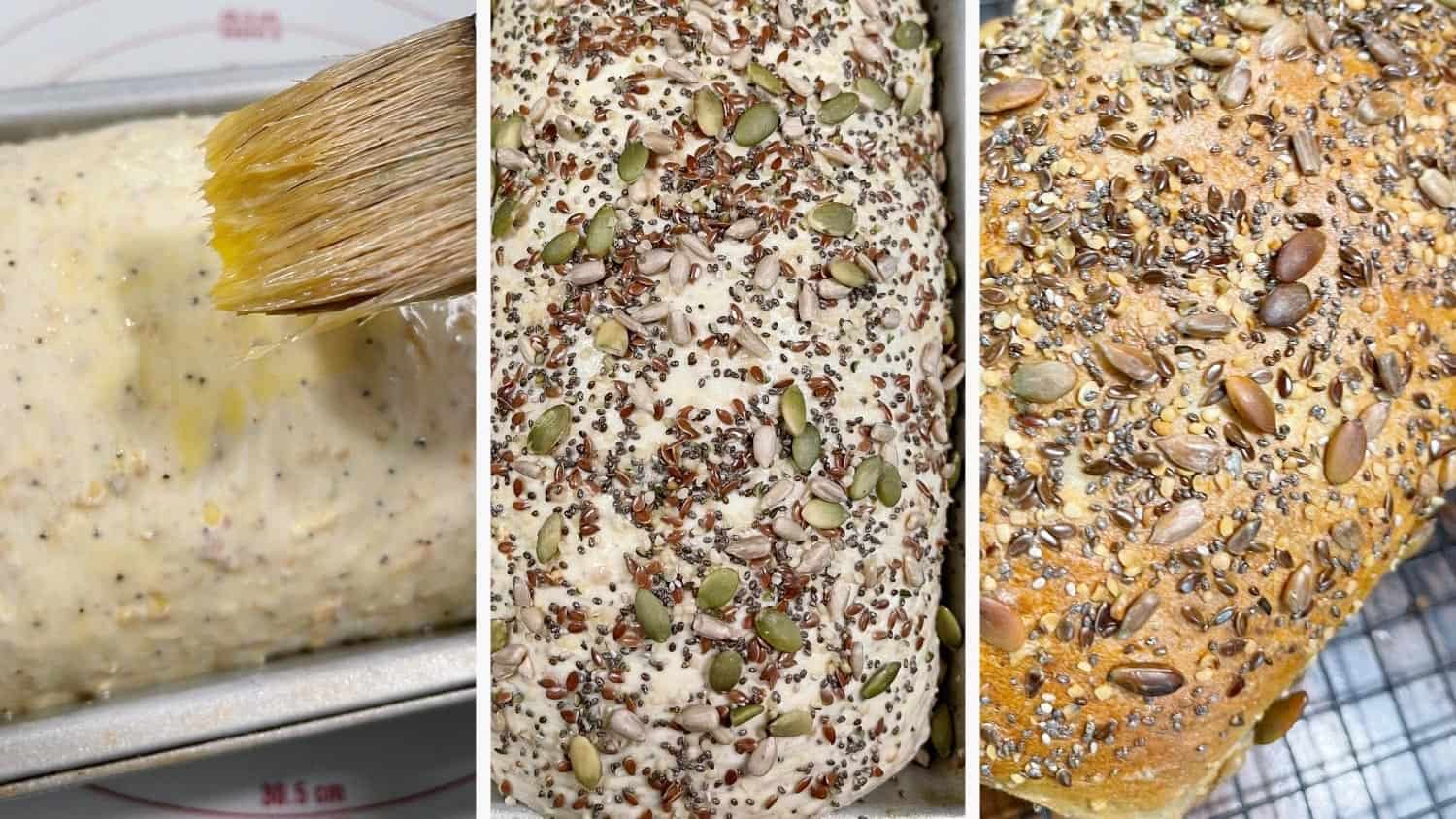
Step 8: When the loaf has risen, brush the top of the load with the egg wash and sprinkle with seed mix. This bread tends to brown quickly, so have a sheet of aluminum foil handy and be sure to cover the top loosely with a sheet of aluminum foil after about 18-20 minutes of baking to keep the top from over-browning. Baking the loaf in the lower third of the oven (one rack position down from the centre) helps to slow the browning a bit.
The early browning can also make the loaf look done before it is. A large 9×5-inch loaf like this will need a total of 40-45 minutes in the oven to bake through. An instant read thermometer is invaluable here to test the loaf for doneness. Bake until the internal temperature is 195-205F (I aim for about 200F).
How to make multigrain bread: video
Recipe tips!
- For the lightest, fluffiest loaf – avoid adding too much flour. After you’ve added the 4 cups of all-purpose flour, the dough will seem quite loose and wet. Avoid adding more flour in the bowl or mixer, but instead, transfer it to the counter and add a bit more flour there, if needed.
- The seed topping is optional – While I love the seed topping on this bread, you can easily skip it if you prefer. Leave it plain, do the egg wash only for a shiny finish, or do an egg wash and some rolled oats on top instead.
- Make as two smaller loaves – You can make this bread as one large 9×5-inch loaf or as two shorter, smaller 8 1/2 x 4 1/2-inch loaves. Note that baking time will be less for the 8×4 loaves. Refer to the Recipe Card below for some guidance.
- Avoid overbrowning – If you go the 9×5 loaf route, be warned that it does take time to bake through but will look quite done before it actually is. I cover the loaf with foil after about 20 minutes and then continue to bake the full 45 minutes. If you have an instant-read thermometer, you can take out the guesswork. You’ll want your loaf to be at least 195F internal temperature before you take it out. I aim for about 200F.
Multigrain bread recipe FAQ
I don’t have a bread machine to test this, but I suspect it would work just fine, with the following caveats. First, this recipe makes a big loaf, so I think the larger 2lb bread machine would probably be needed. Secondly, you would need to soak the cereal and grains outside of the bread machine, let them cool, then proceed to add the soaked grains to the bread machine with the other ingredients.
This bread can be vegan if made with brown sugar (instead of honey) and by using water to brush the top instead of the egg wash.
Yes, you can, but be careful with doubling this recipe as the dough is quite bulky and doubling may put too big a strain on a stand mixer.
This multigrain bread recipe can be used to make great soft multigrain rolls for sandwiches or burgers. Divide the dough into 8 to 16 evenly sized pieces, depending on the size of rolls or buns you want. Form the dough pieces into smooth balls, and rise and bake on a baking sheet. I would reduce the oven temperature to 400F and watch closely. Depending on the size of the rolls, they will probably bake in 10-20 minutes. Bake to an internal temperature of 200F.
Replacing all of the all-purpose flour with whole-wheat flour will result in quite a dense loaf (without other changes). You can easily swap out 1 cup of the all-purpose flour with 1 cup of whole-wheat flour, with only small changes to the finished loaf. The loaf will be slightly denser, but still soft enough for sandwiches. If you’d like to add even more whole-wheat flour, you can experiment with increasingly more and more whole-wheat flour, but at some point, you’ll start moving away from the “light and fluffy” texture.
I have not tried it myself, but readers report that a 2.2 lb (13.6″×5.4″×4.7) Pullman loaf pan worked nicely (with the lid on).
Troubleshooting this multigrain bread recipe
If your loaf is dense, you likely used too much flour or replaced too much of the all-purpose flour with whole wheat flour. Over‑proofing can also create a dense loaf, as it has over-risen and collapsed. Only rise until just doubled.
If the top of your loaf is too dark, bake lower in the oven and/or tent with foil earlier. You can also reduce the heat to 400°F and extend the bake slightly.
If the bread is gummy inside, it probably needed more bake time. Aim for an internal temperature of about 200°F. A gummy loaf can also result if you slice into a hot loaf. Be sure to let the bread cool fully before slicing.
Overnight refrigerator rise option
You can prepare the bread through to shaping and placing in the loaf pan, then immediately cover and refrigerate overnight or up to 12 hours. In the morning, simply remove from the fridge and allow to rise on the counter for about 1 hour before baking or until it has risen sufficiently as shown above.
Storing and freezing multigrain bread
You can store this bread for several days at room temperature, stored in an airtight container.
This bread will also freeze well, tightly wrapped, for up to 3 months.
You can also freeze the shaped loaf right after placing it in the loaf pan (before the 2nd rise). I like to freeze in the loaf pan, then once solid, wrap the frozen dough log tightly and store only the dough in the freezer up to 3 months. When ready to bake, remove the frozen dough log, unwrap, place in a greased loaf pan, cover with plastic wrap and thaw at room temperature for 4-5 hours, or until thawed and risen. Bake as usual.
Want to save this recipe?
Enter your email and I’ll send it to your inbox. Plus, you’ll get great new recipes from me every week!
By submitting this form, you consent to receive emails from Seasons and Suppers.
You can unsubscribe at any time.
Get the Recipe: Light and Fluffy Multigrain Bread
Ingredients
Basic Multigrain Bread Dough:
- 1/2 cup (120 ml) multi-grain cereal, such as 7, 10 or 12-grain cereal *see Note 1 below
- 2 cups (454 ml) boiling water
- 2 1/4 teaspoons (7 g) active dry or instant yeast, (not rapid or quick rise yeast)
- 1 Tablespoon (15 ml) vegetable oil, or other neutral tasting cooking oil, or melted and cooled butter
- 1 Tablespoon (15 g) honey, or light or dark brown sugar
- 1 1/2 teaspoons (9 g) fine sea salt
- 4 cups (480 g) unbleached all-purpose flour , spooned and levelled *see Note 2 below
OPTIONAL Add-ins *See Note 3 below
- 1/3 cup raisins or dried cranberries
- 1/4 cup raw pumpkin or sunflower seeds, chopped
- 1/4 cup nuts (pecans, walnuts etc), chopped
- 2 Tablespoons mixed small seeds, poppy, sesame and/or flax seeds
Egg Wash:
- 1 large egg, mixed with 1 Tbsp water (or alternately, just water, for a vegan loaf, though seeds may not stick as well).
Topping Seed Mixture:
- 2 teaspoons (10 ml) sesame seeds
- 2 teaspoons (10 ml) flax seeds
- 2 teaspoons (10 ml) poppy seeds
- Raw pumpkin and or sunflower seeds, optional
Instructions
- Place multigrain cereal in a large bowl or the bowl of a stand mixer fitted with a kneading hook. Pour boiling water over, then let stand until mixture cools to between 105°F. and 115°F. for active dry yeast or to about 120F for Instant yeast, about 20 minutes. *Don't rush it. If your mixture is too hot, it may kill your yeast. A thermometer is handy here to make sure of the temperature before adding the yeast.
- Sprinkle yeast over cereal mixture. If using Active Dry Yeast, allow to stand for 5-10 minutes before proceeding. Add 1 cup of the flour, the oil, honey (or brown sugar) and salt and stir until smooth. Gradually mix in the remaining flour, incorporating any of the optional add-ins during the mixing. Once all the flour is added, you'll have a moist dough that may also seem a bit loose. Resist the urge to add more flour at this point. Cover the bowl with plastic wrap and let rest 15 minutes. The grains will absorb more of the moisture during the rest period.
- Turn the dough out onto a floured surface. Knead a few minutes until smooth and elastic, adding more flour, as needed, if it's sticking to your hands or the work surface.
- Oil a large bowl or measuring cup. Add the dough to the bowl, then flip over the ball of dough so the oiled side is up. Cover bowl with plastic wrap and let rise in warm spot until doubled in size. **Don't wander far. This bread is a quick riser and may double in as little as 35-40 minutes. It may take longer. The important thing is to make sure it rises only until doubled, no matter how long that is.
- Prepare the Seed Mixture by stirring together all the seeds in a small bowl. Set aside.
- When dough has doubled in size, remove to a work surface and gently deflate dough by pressing down the dough.
- Grease one 9×5-inch loaf pan or two 8×4-inch loaf pans. Sprinkle a bit of the seed mixture into the pan (or divide between two pans), if you like. For 8×4-inch loaves, divide the dough into two equal-sized pieces. For a 9×5-inch loaf, leave as one piece. Roll the dough out into a rectangle about 10 inches wide and 18 inches long for a 9×5 loaf, or 9×16-inch rectangles each of the two 8×4 loaves. Roll up jelly rolls style, starting with the short side, then pinch seams together. Place rolls seam side down into prepared loaf pan(s).
- Cover the loaves with a clean kitchen towel or greased/sprayed plastic wrap and let rise until doubled in size, about 25- 30 minutes.
- When the dough is nearing risen, preheat oven to 425F. (regular bake/non-convection), with rack positioned just below centre (a little lower rack position, one down from centre, will help to keep the top of the bread from browning as quickly).
- Before baking, brush the top of the loaf with the egg wash and sprinkle the top with the remaining seed mixture. Use the palm of your hand to press the seeds into the top of the loaf slightly to help them stick.
- Bake in preheated 425F oven for 18-20 minutes, then cover the top loosely with a sheet of aluminum foil to prevent over-browning. Bake a further 20-25 minutes for a 9×5 loaf or 10-15 minutes for 8×4 loaves, or until golden and crusty and have an internal temperature of 195-205F when tested with an instant-read thermometer. *Bread will look done, even when it isn't cooked through. The large 9×5 loaf will need the full 40-45 minutes in the oven to be cooked through.
- Remove from oven. Run a knife around the edges of the pan and immediately remove to a cooling rack to cool. Allow to cool completely (or almost completely) before slicing to avoid a gummy bread.
- Store bread well wrapped at room temperature for a couple of days, or freeze for longer storage. This bread will freeze well for up to 2-3 months or more.
Notes
Watch how to make it
More bread recipes to love!


Hi! I’m Jennifer, a home cook schooled by trial and error and almost 40 years of getting dinner on the table! I love to share my favourite recipes, both old and new, together with lots of tips and tricks to hopefully help make your home cooking enjoyable, stress-free, rewarding and of course, delicious!


Do you have a converted recipe for a bread maker?
Hi Erin, I’m sorry I don’t. I don’t have a bread maker, so I have no way to test. I believe it should work by soaking the grains outside of the bread maker, then adding them to the machine with the other ingredients. It’s a large loaf, so a large (2lb?) bread maker might be needed.
Excellent recipe. I’m vegan so anyone want to make this bread vegan use molasses and for the egg wash, I use a half tbsp soy milk with a half tbsp of molasses or maple syrup. To get the seeds to stick on the top I just rolled the dough over the seeds then put it rolled side up inside the greased pan with the remaining seeds on the bottom. I brushed the top with my soy mixture before baking.
Glad you enjoyed it, Maddalena and thanks for sharing your vegan swaps! Thanks :)
My husband loves this sandwich bread. It is now my go bread!
I’m so pleased to hear, Gale :) Thanks so much!
Thanks for the recipe.
We have a local mill that makes Red River Cereal and it works perfectly in this recipe. After making this a few times i think it is our new house bread.
Sounds perfect, Thomas! So glad you’re enjoying it. Thanks :)
Hi Jennifer,I made your multi grain recipe today .I baked the dough in 2.2 Pullman loaf pan which I was afraid might be too big but it came out beautiful with the lid on .I used whole wheat flour and All purpose flour half and half and added 2 tbsp of wheat gluten,a half cup of mixed seeds.i wish I could upload the picture of this perfect bread,
Thank you for the recipe
So glad to hear, Noor :) Thanks so much!
Easy to make and very delicious. I mixed my own grains and it came out great
Glad to hear, Gabs :) Thanks!
I followed the recipe to a T and it came out perfectly. Not bad for a first timer bread maker. I would love the sourdough version of a multigrain loaf ❤️
So glad to hear, Paul! Thanks :) I’m not a sourdough baker, but if you are, you could adapt this one to sourdough with alterations, of course. I’ve certainly done it the other way (from sourdough to yeast).
I feel compelled to write because I’ve been making this delicious recipe for three years now. It’s our standard breakfast bread. I do change the recipe slightly to suit our taste: I use 1 to 2 cups of whole wheat flour instead of all bread flour, and add a heaping cup of add-ins, usually dried cranberries and walnuts in a 50-50 ratio. I make my own 7 grain cereal using Jim Lahey’s recipe. I’m so grateful to have this recipe, thank you for sharing!
I’m so pleased you’re enjoying it, Sonya :) Thanks so much!
I have been trying to find Jim Laheys 7 grain cereal recipe…but no luck. Do you have a link for it? Thank you!
I’ve been making sandwich loaves using this recipe for quite some time now and love the ease and results! I am curious, though; can this recipe be used for sandwich rolls? If so, other than baking time, are there any changes that need to be made to the recipe?
Hi Robin, so lad you’re enjoying it and yes, you could certainly divide and shape into sandwich rolls. No need to change anything other than baking time.
Jennifer, thank you for the prompt reply. I’ll make sandwich rolls tomorrow!
Hi! I love your recipes but have just started my bread-making journey. I use a Zojirushi Bakery Supreme. Do you ever convert your recipes for those of us who use a bread machine? I’m not ready to be a full-fledged baker! Lol
Hi Terra, I’m afraid I have no way of doing that as I don’t have a bread machine to test the recipes. What I can tell you is that most standard recipes can simply be added to a bread machine, and you’re golden. Any recipes that require soaking of oats or grains (such as this one!) would require you to soak the grains outside of the machine first, then cool, then add to the machine with the rest of the ingredients, as usual. Hope that helps a bit.
Wow! This is just fantastic!! I’ve tried a number of multigrain loaves and just wasn’t pleased. Your recipe however is the best!!
I’m so thrilled to have found you and thank you so much!
Keeper!!
Thanks, Jean! So glad you enjoyed it :)
This is a fantastic recipe, well written, great tips and flexible with ingredients. I made it with a homemade grain cereal mix with what I had on hand and it couldn’t have been better. (Chia, quinoa, oats, sesame seeds, cornmeal). Other than that I followed the directions. Thank you! We are adding it to our recipe box for every week baking 😁.
So glad you enjoyed it, Amanda! Thanks so much :)