

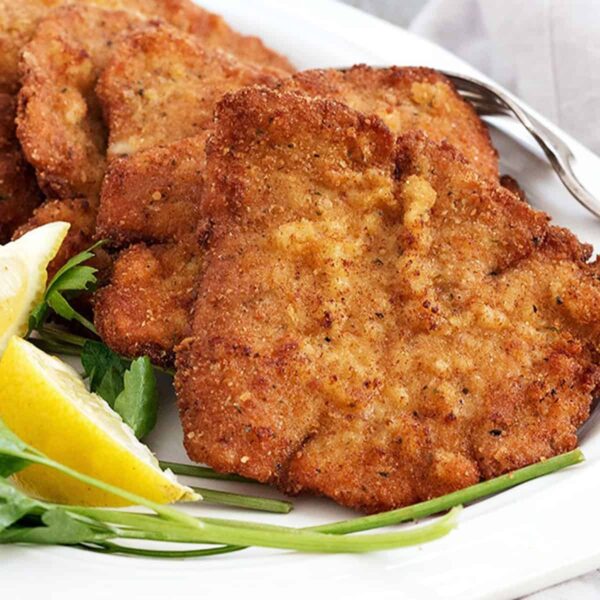
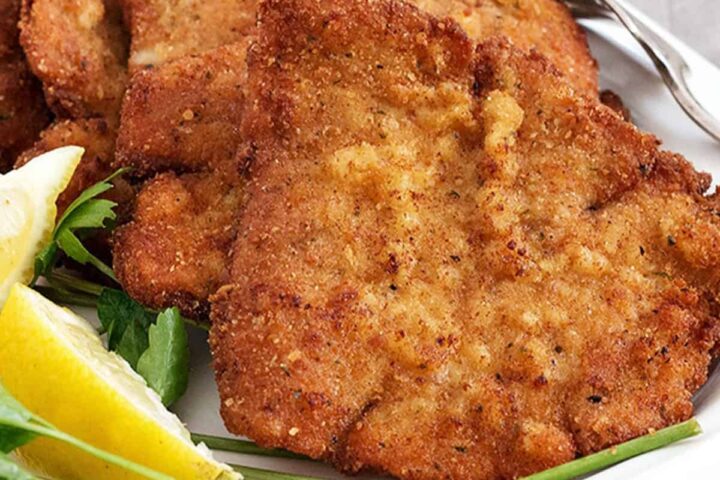
This classic, German-style pork schnitzel is made with boneless centre-cut pork loin chops, pounded very thin, coated in fine breadcrumbs and shallow-fried until crisp and golden.
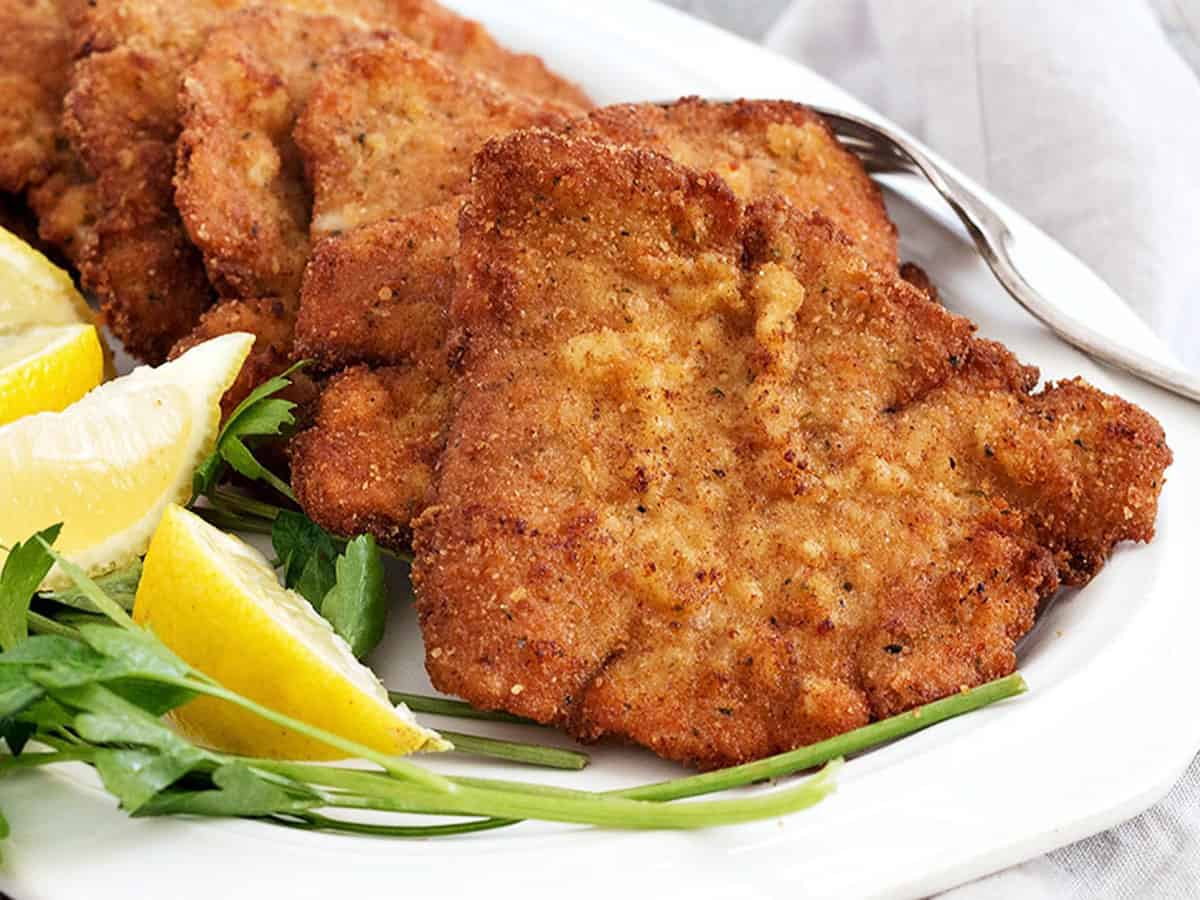
The key to schnitzel that stays crisp and tender is pounding the pork very thin, chilling the breaded cutlets uncovered for one hour, and frying them in enough hot oil to let them float rather than sit on the pan. Pork loin chops are my favourite easy-to-find cut for a classic, full-sized pork schnitzel.
I learned to take schnitzel seriously during my university years in Kitchener-Waterloo, home to the largest Oktoberfest celebration outside Germany.
I picked up a few tips for schnitzel making back then, that have served me well over the years of making schnitzel at home. And I’m going to share all the little tips and tricks with you, so you can enjoy perfect, pork schnitzel at home. So don’t be put off by my wordiness. Schnitzel is easy, I just take my schnitzel seriously :)
- Ingredients and substitutions
- How to make pork schnitzel with pork loin chops: step-by-step
- How to make pork schnitzel with pork loin chops: video
- Recipe tips!
- The three rules for crispy pork schnitzel
- Schnitzel FAQ
- How to serve pork schnitzel
- What to serve with pork schnitzel
- How to store and reheat schnitzel
- Get the Recipe: Classic Pork Schnitzel with Pork Loin Chops
- More German recipes to love!
Ingredients and substitutions
A few notes about the key ingredients …
Boneless centre-cut pork loin chops – This is an easy-to-find, classic choice that produces larger, dinner-plate-size schnitzel. I will sometimes use the thinner pork loin chops, often labelled as “fast fry”. They are about 1/2-inch thick. They require less pounding and while they produce smaller schnitzel, they are easier to fit 2 or 3 in a skillet at one time.
Breadcrumbs – For classic German-style schnitzel, use dried, unseasoned breadcrumbs. Avoid Italian-seasoned breadcrumbs, which will introduce flavours inconsistent with classic schnitzel.
How to make pork schnitzel with pork loin chops: step-by-step
This is visual summary of the steps to make this recipe. Scroll down to the Recipe Card below for the complete list of ingredients and instructions.
- Pound the boneless pork loin chops until very thin.
- Bread the schnitzel by dipping in flour, egg and then breadcrumbs.
- Chill the breaded pork for 1 hour.
- Shallow-fry in oil until crispy and golden.
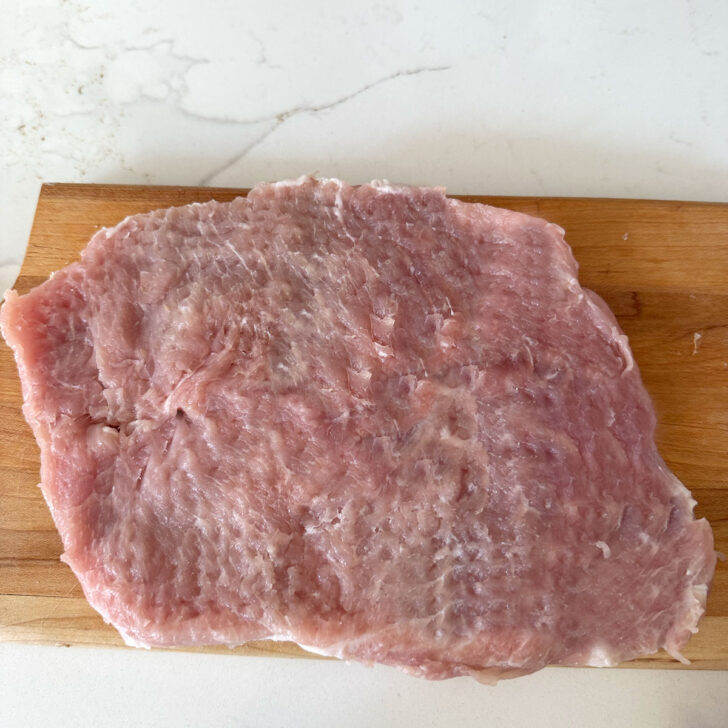
Step 1: Trim any fat from the boneless pork loin chops and pound very thin (about 1/4-inch). Cut small slits on the edges to prevent curling when cooking.
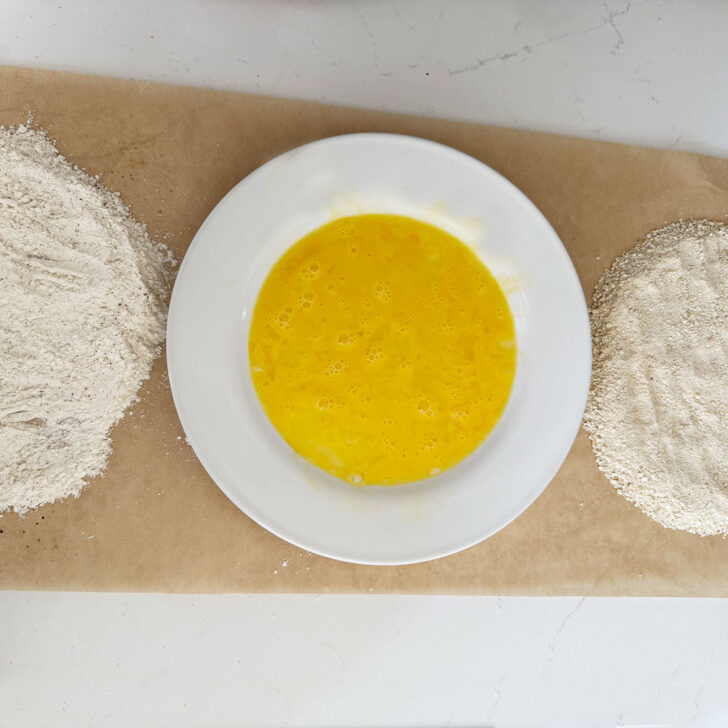
Step 2: Set up a breading station with the seasoned flour, beaten eggs and breadcrumbs.
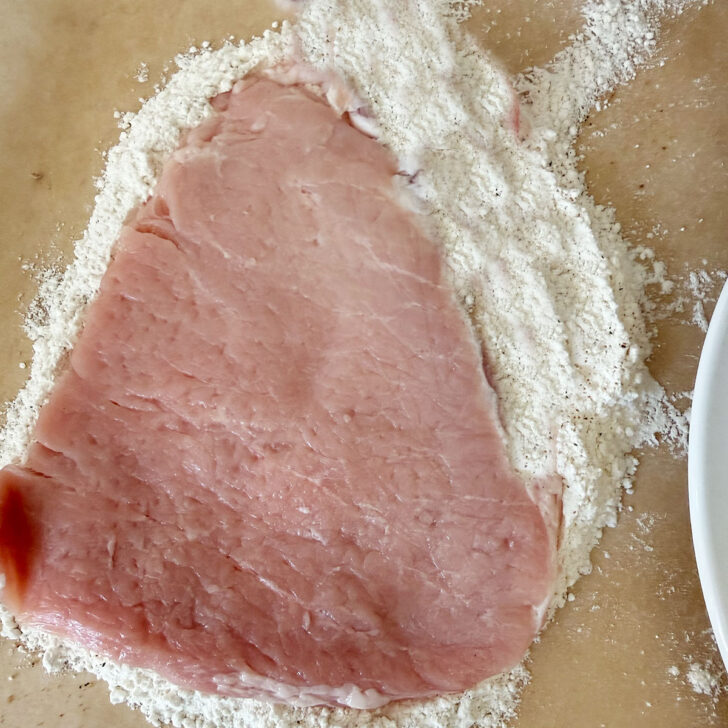
Step 3: Start by dredging the pork in the seasoned flour on both sides.
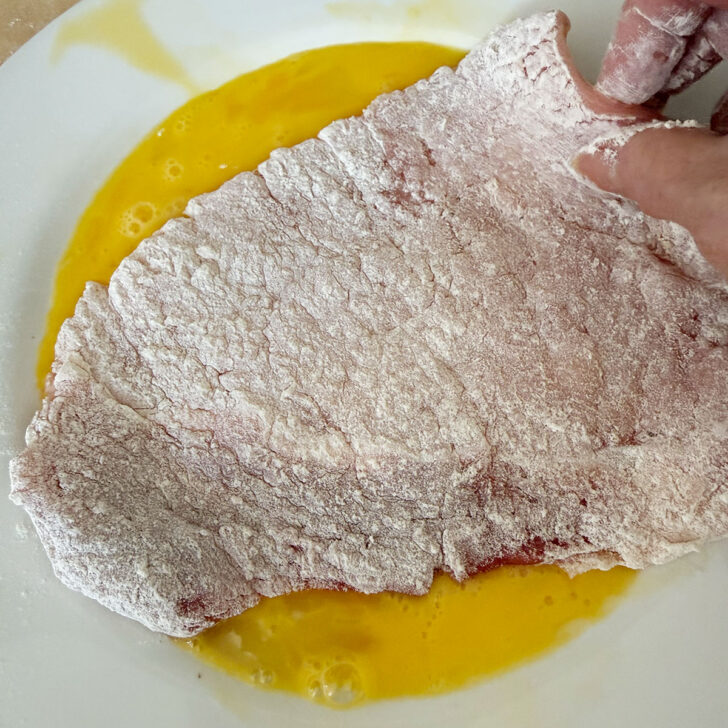
Step 4: Dip the floured pork into the beaten egg, coating both sides and letting the excess drip off.
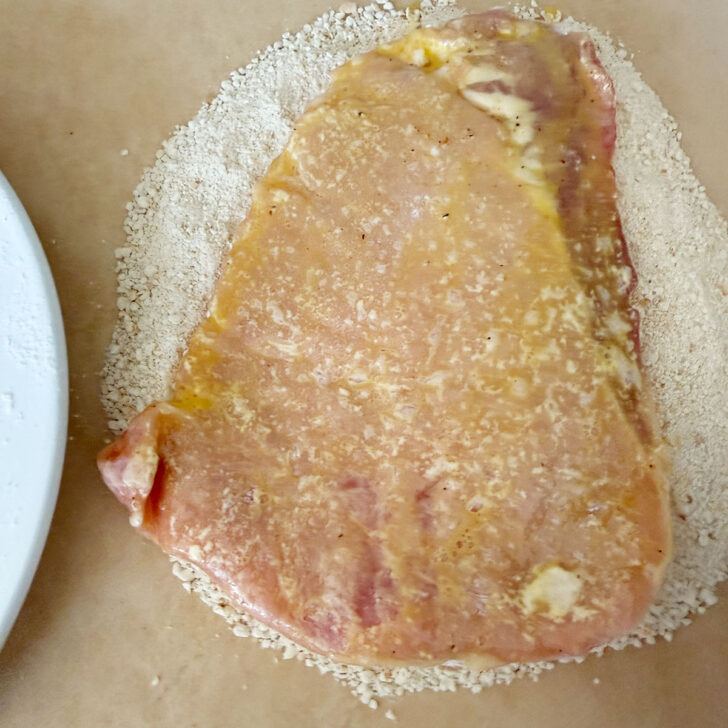
Step 5: Finally, press the egg-coated pork into the breadcrumbs on both sides, until well coated.
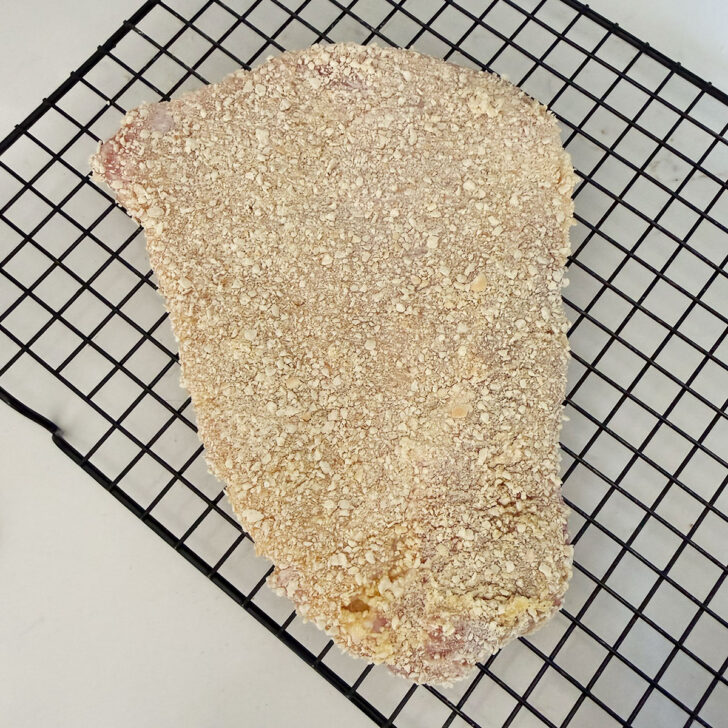
Step 6: Place the breaded pork onto a wire rack. Repeat with the remaining pork, then place the wire rack into the refrigerator to chill for 1 hour.
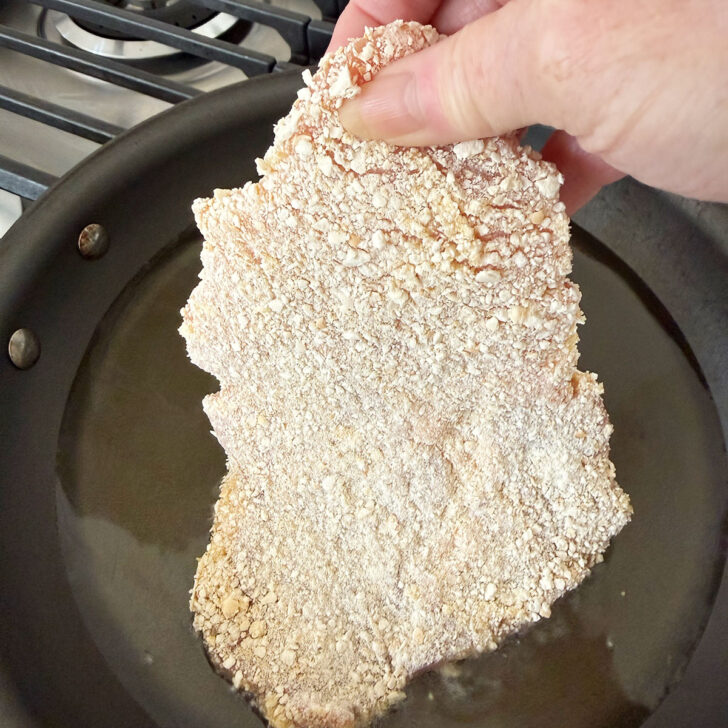
Step 7: When ready to cook, heat about 1/2-inch of oil in a large skillet over medium heat. Add the breaded pork to cook.
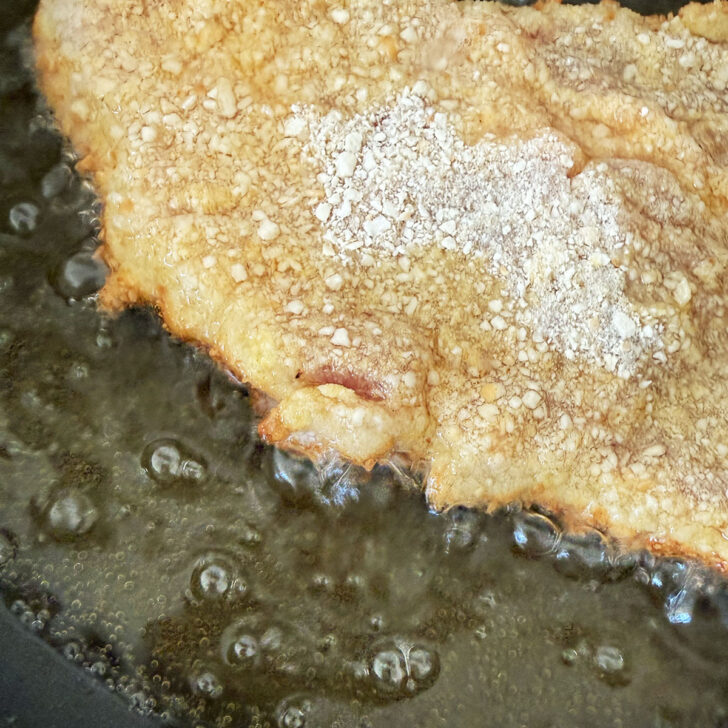
Step 8: When the edges turn golden, flip and cook the other side. Then flip again to finish the first side briefly.
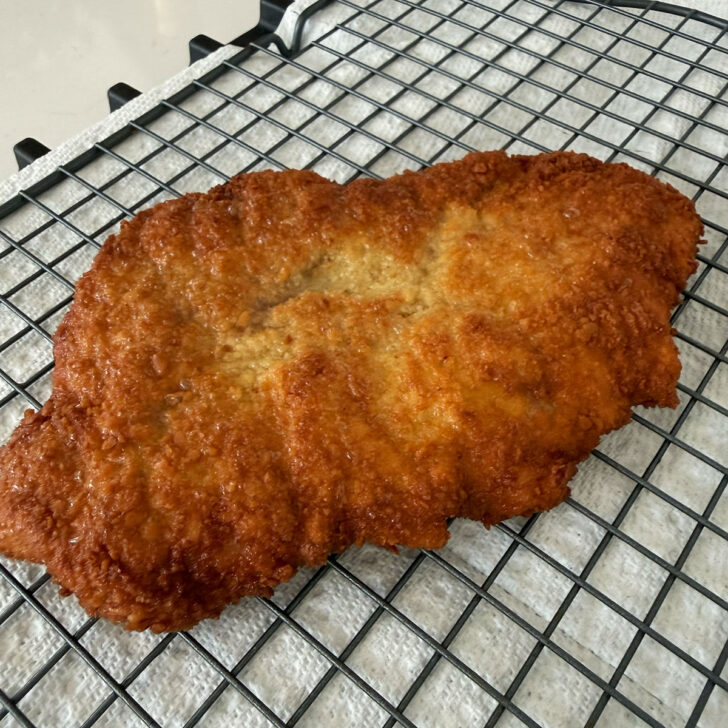
Step 9: Transfer to a wire rack. Serve immediately or place into a 200F oven to keep warm while you cook the remaining schnitzel.
How to make pork schnitzel with pork loin chops: video
Recipe tips!
- I like to make a schnitzel breading station on a sheet of parchment paper, as shown above in the step-by-step photos. This makes for easy clean-up!
- If you’re cooking many batches of schnitzel, you will need to top up the oil level after a few batches and completely replace and reheat the oil after about 3 batches. Allow the oil to re-heat thoroughly before proceeding.
- Schnitzel is best cooked with the shallow-fry method and I don’t recommend deep frying schnitzel. Schnitzel should not be that crispy and it’s way more work than is necessary.
The three rules for crispy pork schnitzel
- Pound it very thin – The pork should be thin enough that the cooked crumb coating is as substantial as the meat.
- Chill the breaded cutlets before frying – Chill the breaded pork cutlets on a wire rack, in the refrigerator, for one hour so the coating dries and adheres.
- Shallow-fry in enough hot oil – Use about 1/2 inch of neutral oil so that the schnitzel floats slightly instead of touching the pan. Fry without crowding the pan, doing multiple batches, if necessary.
Schnitzel FAQ
While pork schnitzel can be made from a variety of cuts, the easiest choice for home cooks is boneless centre-cut pork loin chops.
Pork tenderloin can be used for schnitzel, but I prefer boneless centre-cut pork loin chops for a more classic, full-sized schnitzel. Pork tenderloin is usually sliced into small medallions before pounding, so it produces smaller cutlets and is a different preparation from the pork loin chop schnitzel shown here.
I recommend using store-bought, unseasoned dried breadcrumbs for schnitzel. I prefer not to use Italian-style dried breadcrumbs, as the added flavours are not needed in schnitzel. Fresh breadcrumbs are not recommended, as they are likely to be both not dry enough or not uniformly fine enough to produce a nice schnitzel breading.
While Panko will technically work, if your goal is to make classic German-style schnitzel, dried breadcrumbs are recommended. Panko would produce a lighter, less uniform coating than a typical schnitzel breading.
Schnitzel needs to be thin. Even if you start with thin pork loin chops, you will need to pound them even thinner. Hopefully, you have a meat pounder to do the job, if not, grab your cast-iron skillet or a rolling pin and use it to pound the pork. Do this on a cutting board. Keep pounding until it is as thin as it can possibly be without tearing or falling apart.
The single best tip for cooking schnitzel at home is to allow the breaded pork to rest/chill in the fridge for one hour before frying. Simply bread the pork, then lay on a wire rack in a single layer. Place into the fridge, uncovered, for one hour before cooking. This step dries the breading and ensures it will stick perfectly to the meat during the frying process.
The absolutely best way to perfect schnitzel is to shallow-fry in neutral-tasting cooking oil (vegetable oil, canola oil, peanut oil or sunflower oil). So you don’t need to use a lot of oil, but you want to use enough oil so that the schnitzel will slightly “float” in the oil as it cooks. I usually aim for about 1/2-inch of oil to start and I will top it up as I go, as needed.
Place a wire rack on top of a baking sheet. Place the freshly fried schnitzel onto the wire rack and place into a 200F oven to keep warm. Don’t stack or overlap the schnitzel, to prevent the breading from becoming soggy.
I recommend 1 hour ahead, though it can be stretched up to 2 hours, in a pinch. Any longer and the breading will begin to pick up moisture from the pork and create a soggy breading. If you’d like to do some advance preparation, you can pound the pork up to one day ahead and refrigerate; bread it only 1 to 2 hours before frying.
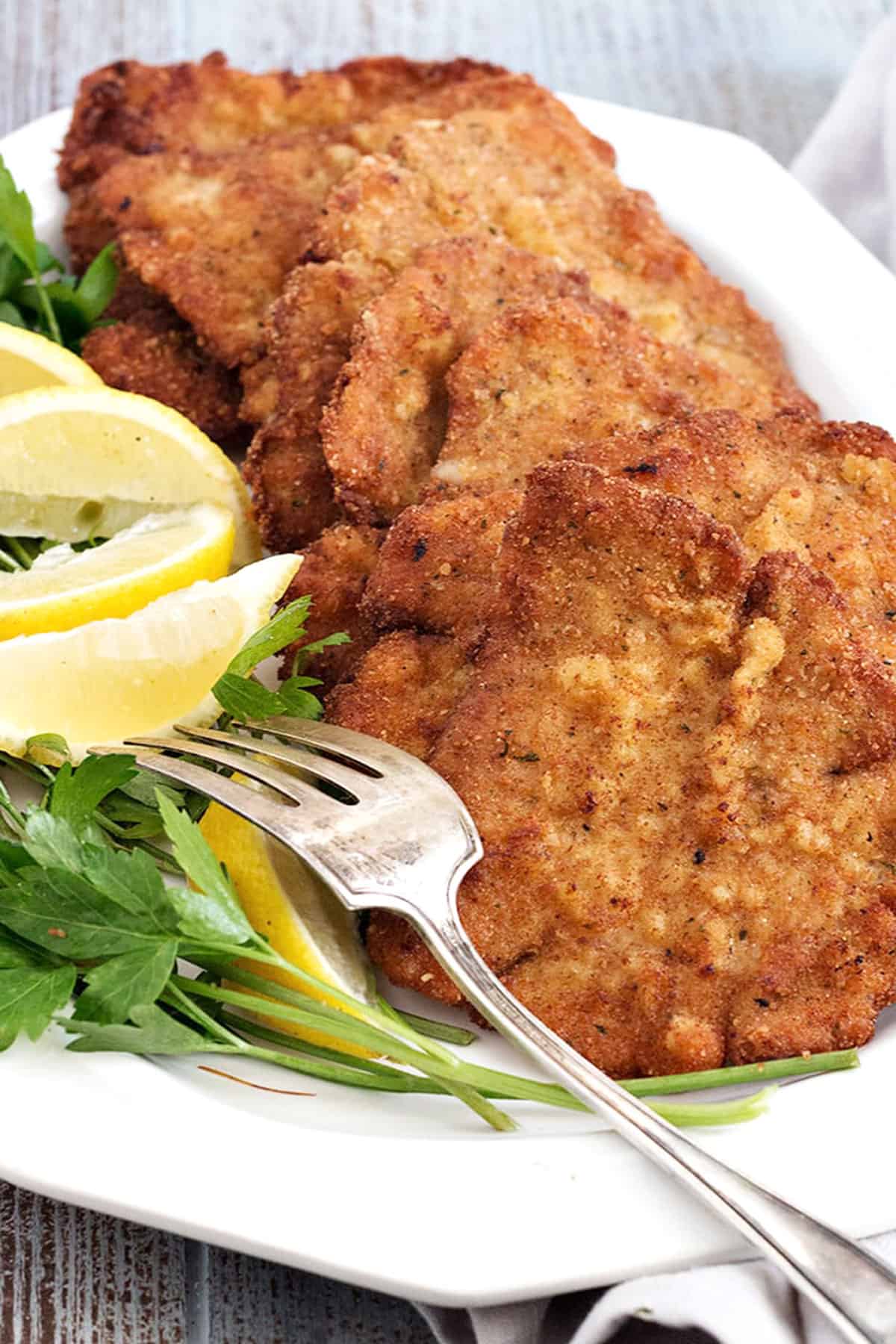
How to serve pork schnitzel
Serve schnitzel hot and freshly fried so the crust is perfectly crisp. Garnish with a fresh lemon wedge for squeezing. I love serving schnitzel with lingonberry jam (yes, the IKEA jam!) as the tart, cranberry-like flavour pairs perfectly with pork schnitzel. A mushroom gravy served on top will make it a Hunter’s Schnitzel.
What to serve with pork schnitzel
Schnitzel is often served with potatoes – either potato salad (German-style would be perfect!), fried potatoes or sometimes boiled potatoes. I think mashed potatoes are a fine side, as well. Add a salad, cucumber salad or a green vegetable to round it out, if you like.
How to store and reheat schnitzel
Refrigerate cooked schnitzel for up to 3 days, then reheat in a 375F oven for 8-10 minutes or air fryer for 3-4 minutes, until hot and crispy. Avoid reheating in the microwave, as it will not re-crisp the schnitzel.
I don’t typically freeze cooked schnitzel, though it is an option if necessary to avoid waste. Reheat from frozen in a 350F oven for 15-20 minutes, or until crispy and hot.
Want to save this recipe?
Enter your email and I’ll send it to your inbox. Plus, you’ll get great new recipes from me every week!
By submitting this form, you consent to receive emails from Seasons and Suppers.
You can unsubscribe at any time.
Get the Recipe: Classic Pork Schnitzel with Pork Loin Chops
Ingredients
- 6 boneless, centre-cut pork loin chops, 1/2-3/4-inches thick
Breading:
- 1/2 cup all-purpose flour, unbleached recommended
- salt and freshly ground pepper
- 2 large eggs
- 2 Tablespoons water
- 2 cups dried plain (unseasoned) breadcrumbs, plus more as needed.
- 1/2 – 1 teaspoons seasoning salt
- vegetable, canola, peanut or sunflower oil, for shallow frying.
- lemon slices, for serving
Instructions
- Trim the boneless centre-cut pork loin chops of any fat along the edge. Pound very thin, almost, but not quite, to the point of tearing, about 1/4-inch thick. Using the point of a sharp knife, cut small, 1/4-inch slits every 2-inches around the outside edge of the cutlet. This helps to prevent the cutlet from shrinking and curling at the edges during cooking. Set aside.
- Set up a breading station with 3 large shallow plates (or make a breading station on a sheet of parchment paper for easy clean-up). Add the flour to the first plate, spreading it into an even layer. Season with some salt and freshly ground pepper. On the second plate, use a fork to whisk together the eggs and water. Scatter the breadcrumbs on the 3rd plate and add the seasoning salt. Stir to mix in well. To bread your pork: first press the pork into the flour, flouring both sides and shaking off any excess. Next lay the floured pork into the egg mixture and swirl it around a bit. Flip over and do the same on the other side. Lift and let excess egg drip off back onto the plate. Finally, lay the pork onto the plate with the breadcrumbs. Use your fingers or a spoon to move some of the breadcrumbs onto the top of the pork. Press down gently so that the underside gets nicely coated in crumbs, then flip over and press down again. Make sure you have an even layer of crumbs covering the entire piece of pork on both sides. If there are bare spots, sprinkle breadcrumbs over that area and press down onto the meat with the palm of your hand.
- Place the breaded pork onto a cooking rack set on top of a baking sheet. Repeat with each piece of pork, placing onto the cooling rack without overlapping at all. Place the baking sheet/cooling rack with the breaded pork into the fridge, UNCOVERED, for one hour.
- When it has been almost an hour, start heating your oil. Add oil to a heavy-bottomed, high-sided skillet to about 1/2-inch (or about 1/2 the height of your breaded pork). Heat oil over medium-high heat until hot. Test by taking a few crumbs from the pork and dropping them into the oil. They should immediately sizzle and quickly float to the top.
- Add 1-2 pieces of pork to the hot oil. Don't crowd the pan or overlap them. The schnitzel should lay flat and have a nice bit of space between. Allow to cook for about a minute, then use tongs to regularly check the progress of browning on the underside. You may need to adjust your heat down if they seem to be browning too quickly or up a notch if they aren't browning quickly enough. It should take about 3 minutes per side with the right temperature of oil and the proper thinness of the schnitzel. Once the underside is a deep golden brown, flip and brown the other side, then flip again to finish the first side a bit more. Remove to a cooling rack with a piece of paper towel under the bottom of the rack (not directly under the meat) to catch any drips. Repeat with remaining pork pieces. *If making lots and you want to keep them warm, place a wire rack on top of a baking sheet in a 200F oven and transfer the cooked schnitzel to the oven to keep warm and crispy. Don't overlap or stack the cooked schnitzel in the oven.
- Serve the schnitzel hot with lemon wedges for drizzling or try some lingonberry jam on the side (my favourite!).
Notes
Watch how to make it
More German recipes to love!
Hi! I’m Jennifer, a home cook schooled by trial and error and almost 40 years of getting dinner on the table! I love to share my favourite recipes, both old and new, together with lots of tips and tricks to hopefully help make your home cooking enjoyable, stress-free, rewarding and of course, delicious!


Wife made this last night and we now have a new “Go Too” pork chop dish. Fantastic! Thank you 🙏
So glad you enjoyed it! Thanks so much :)
Hi I made this yesterday with tenderloin yesterday and it was amazing. I cut the tenderloin in half and then “butterflied” it twice, then flattened it and the result was enormous and super tender.
So glad you enjoyed it, Jon :) Thanks so much!
Can this be made ahead of time if you’re serving company?
Hi Suzie, schnitzel is really best enjoyed freshly cooked. I have re-heated left-overs before and they were still pretty good. You need to let them cool on a cooling rack, then refrigerate. Place on a baking sheet and re-heat in a 350F oven until warmed through. Honestly though, if making for company, I would do test run and compare fresh vs. re-heated, just to be sure you’re happy with it.
Restaurants serving good examples German cuisine are extremely difficult to find. Preparing authentic dishes at home is the way to go, thus avoiding the shoe leather schnitzel. Great instructions in this…I will be looking for more recipes in your blog.
I like my schnitzel “jaeger”, or with just a bit of tart Apple jelly on the side, but the beauty of this dish is that six different people at one table can each have their own unique topping on their portion from the same batch of schnitzel. In our house everybody enjoyed your recipe tonight, and yes, dads search for excellent food blogs too!
So glad you all enjoyed it, Bruce! And yes, I love that schnitzel is so delicious with so many toppings. Or none. Thanks so much :)
Can you clarify the step “cut about three 1/4-inch slits along the edge where you trimmed the fat”? Do you mean horizontal slits as though you were stuffing or butterflying the chop? Or vertical through the thin end? Also, what is the purpose behind this step?
Hi Carolyn, I’ll start with the purpose first :) This step prevents the pork from curling as it cooks and encourages it to lay flat while it cooks, which cooks the breading more evenly. So the how … after you have pounded the pork, just take the tip of a knife (or even kitchen scissors) and make a couple of 1/4-inch long cut from the outside edge towards the centre. This just severs any fat along that edge, so it won’t shrink and curl. Hope that helps :)
I used to work at the “Rathskeller” on Frederick St. in Kitchener, Ont., over 20yrs ago, and your recipe if very close to to our prep recipe.
Possibly you worked there?!
A compliment to this dish is croquettes, and/or Zigeuner sauce.
Sauce ingredients can vary, to taste.
EJ’s in Baden, Angie’s Kitchen in the K-W area also had excellent schnitzel, with the fresh bread at Angie’s to die for.
Cheers Jennifer
Hi Raymond and no, I didn’t work there. My experience with schnitzel is limited to eating a lot of it in the years I was at U of W. I’ve eaten at a lot of those places as my husband was born and raised in KW, so we spend a lot of time in the area still :) I do like the sound of the Zigeuner sauce. I must make some next time. Thanks!
Hello – I grew up in Kitchener and went to the Rathskeller with my Dad more than once. I agree that was some really good schnitzel. Concordia Club and Schwaben had very good schnitzel. Dinner and dance was so popular. Cheers
Hi Mandy and yes, great memories :)
Hello ! I just discovered your website and your recipes look delicious. I am eager to try your Classic Pork Schnitzel, I have a pork tenderloin in my refrigerator do you think I could pound it out flat and use it for this recipe? Thank you…
Hi Robin and yes! I would just try to pound the tenderloin whole, or you probably won’t get it thin enough. I would just cut diagonal slices out of it and pound them. Should be good :)
Born and raised in Kitchener Ontario. Love your tribute recipe.
Thanks Deb :) I still have strong connections to KW, as my husband was born and raised in Kitchener, too!
There’s a restaurant in Boston we used to go to quite often when our girls were in college, and I always got the pork Schnitzel. I loved it – and now I’m happy to have your recipe!! Thank you!
Thanks Annie and it’s really super easy to make at home, too!
I love your recipes! I’ve just recently found your site! I have made the rustic chicken recipe and it was so good!! I’m going to have to try this! Thanks!
I also saw you have a recipe for guiness stew, I recently went to Scotland and had this and loved it! I will have to try your recipe! Thanks!
Thanks so much, Ginger!
My hubby is a bit picky, but he likes pork. We both do, actually. So I definitely need to add this to the dinner rotation. And thanks for all the helpful information on preparing the pork schnitzel!
Thanks Leanne! This is one of our favourite meals here. Always a treat :)
We love schnitzel in our home! This looks so golden brown and crispy and would make for such a delicious dinner tonight! Total comfort food right there :)
Thanks so much, Dawn. It’s on the menu here this weekend :)
We love schnitzel Jennifer! I want to grab that fork and start eating. Delicious!
Thanks so much, Mary Ann!
I’ve never made Schnitzel but now I’m ready with this terrific recipe. I LOVE all your tips and tricks for making the best. All those years of Octoberfest fun served you well ;) My husband is going to love this dish!
Thanks Tricia and lol! Yes, good memories :)
With a name like Scheuer, I should be a wonderful Schnitzel maker. But I’m not, at all! Thanks for all these great tips. My German mouth is watering! :)
Thanks Chris! My last name doesn’t offer me any advantage, for sure :) I have always just loved schnitzel though, so I’ve been highly motivated to crack the code :)