

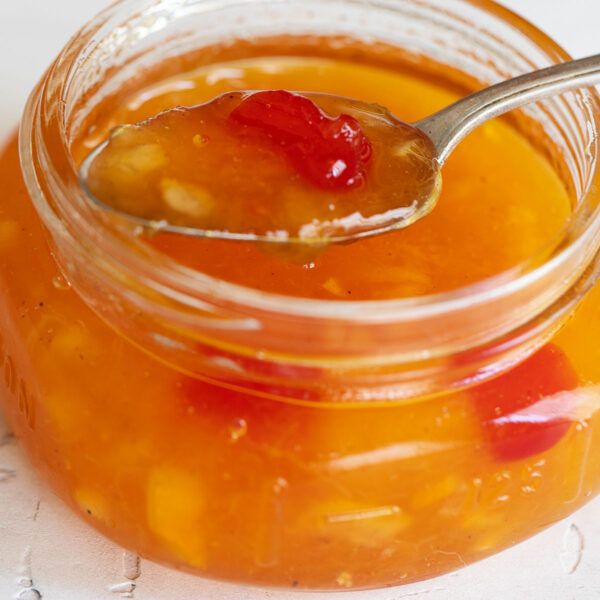
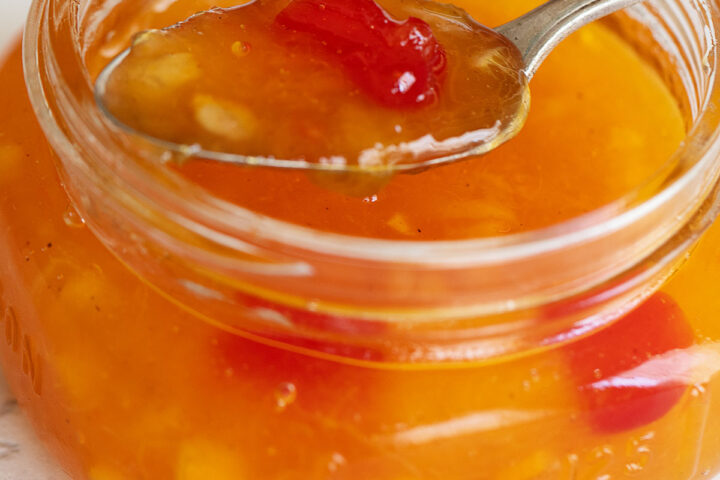
This peach marmalade recipe is the love child of peach jam and orange marmalade, with fresh peaches and oranges and a handful of maraschino cherries added to brighten the mixture. An easy jam with no pectin and no canning needed!
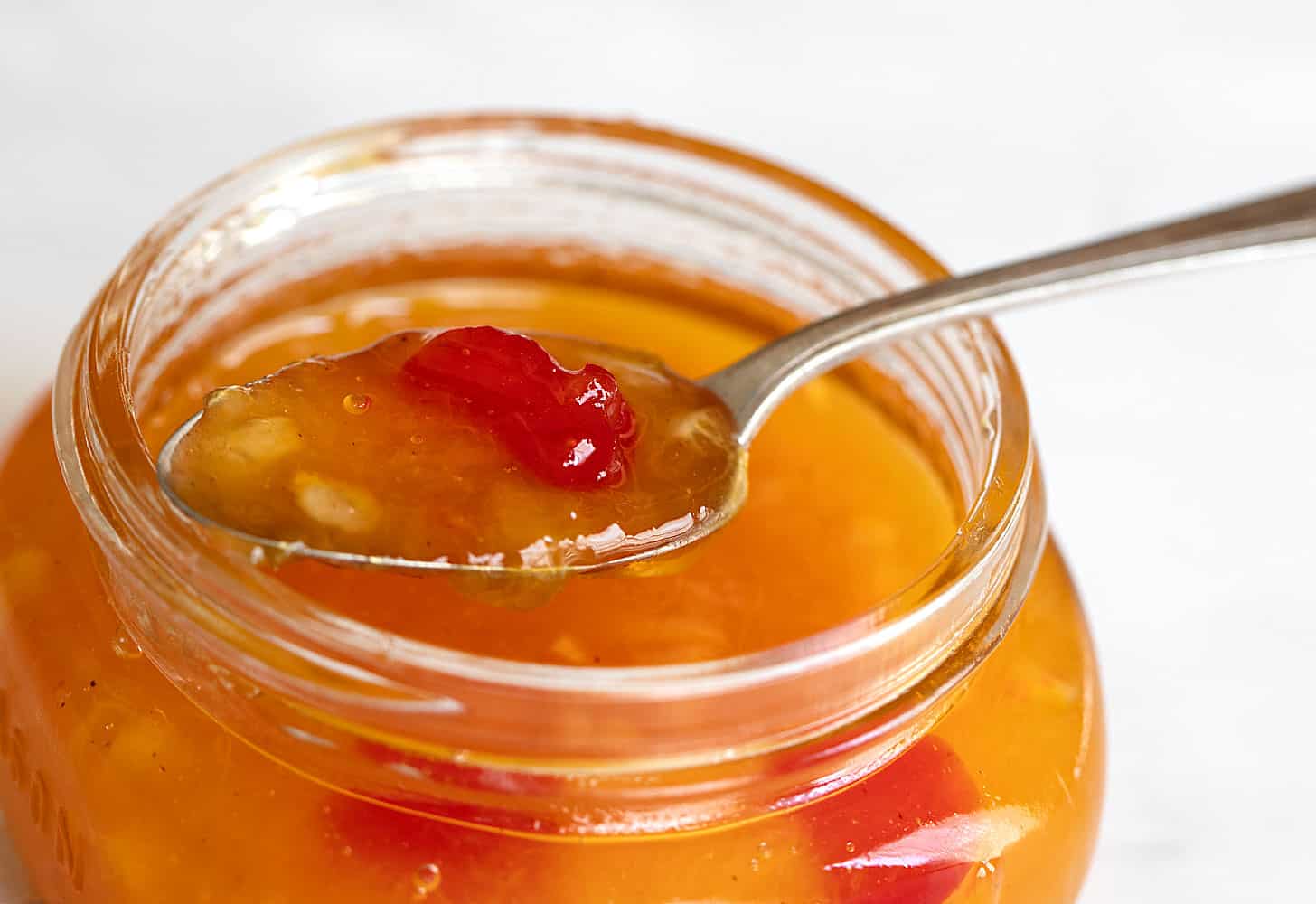
Peach orange and maraschino cherry: at a glance
This delicious peach marmalade has been a favourite of mine since childhood, when my Mom made it every Summer. It’s sweeter than orange marmalade, but not as sweet as peach jam. I think it looks like a Summer sunset in a jar, and that thought always makes me smile when I pull it out of the fridge.
- A small batch marmalade recipe that is perfect for refrigerating to use in the short term.
- This peach marmalade can also be frozen or preserved (in a hot waterbath).
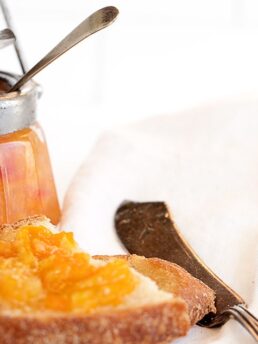
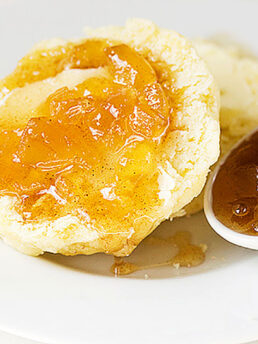
- Delicious on warm buttered toast or scones, spooned onto vanilla ice cream or a natural to use in my Peach Flip sweet bread recipe.
If you love preserving peaches, you might also enjoy my Peach and Pepper Jam!
- Peach orange and maraschino cherry: at a glance
- Ingredients and substitutions
- How to make peach orange marmalade: step-by-step
- Peach marmalade tips!
- How to know when marmalade is set
- The cold plate test for jam or marmalade
- Peach orange marmalade storage
- Get the Recipe: Peach Orange and Maraschino Cherry Marmalade
- More marmalade and jam recipes to love!
Ingredients and substitutions
A few notes about the key ingredients …
Peaches – This jam is perfect to make during peak Summer peach season, when peaches are both beautiful and economical. Look for larger peaches, as they are easier to peel.
Orange – A regular Navel orange is perfect for this jam, though any orange will work here, if you’d prefer to use another variety.
White sugar – It is very important that you don’t arbitrarily adjust the amount of added sugar in a jam. The sugar in jams and marmalades plays an important role in preservation and shelf life, as well as sweetness. While the amount of sugar in jam may seem like a lot, always remember that jam is a condiment and you will only be using a small amount at a time. If you want your jam to set and keep a long time in the fridge, stick to the recommended amount of sugar.
How to make peach orange marmalade: step-by-step
This is a visual summary of the steps to make this recipe. Scroll down to the Recipe Card below for the complete list of ingredients and instructions.
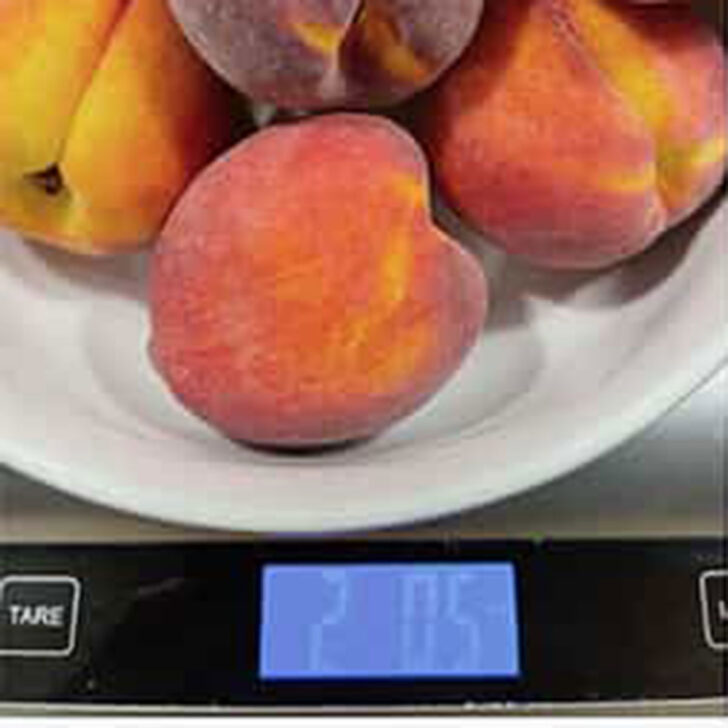
Step 1: Start by weighing out the peaches.
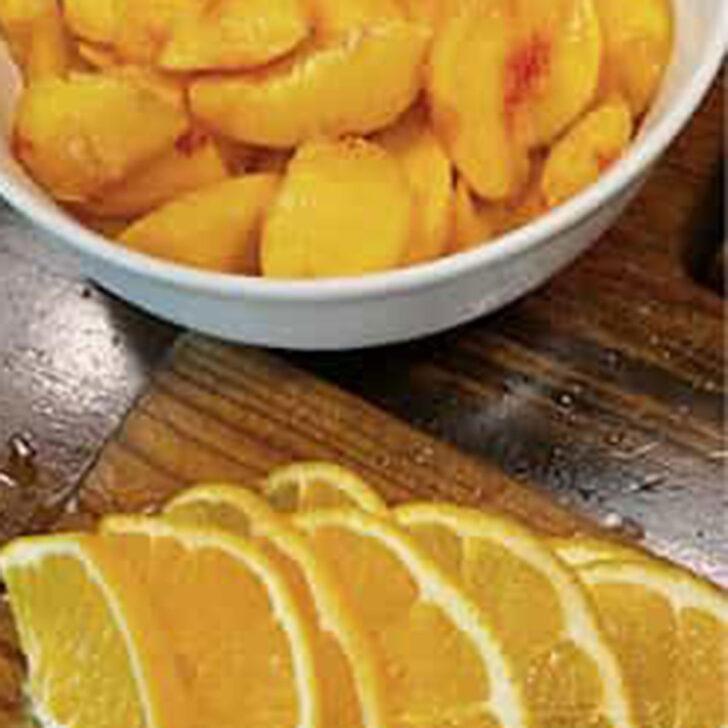
Step 2: Peel and slice the peaches and slice the oranges.
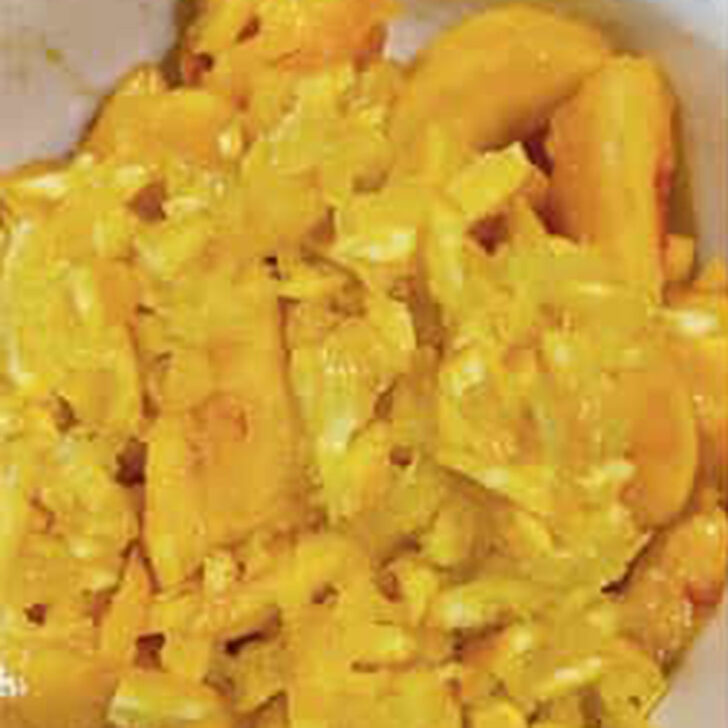
Step 3: Add the sliced peaches and chopped oranges to a bowl.
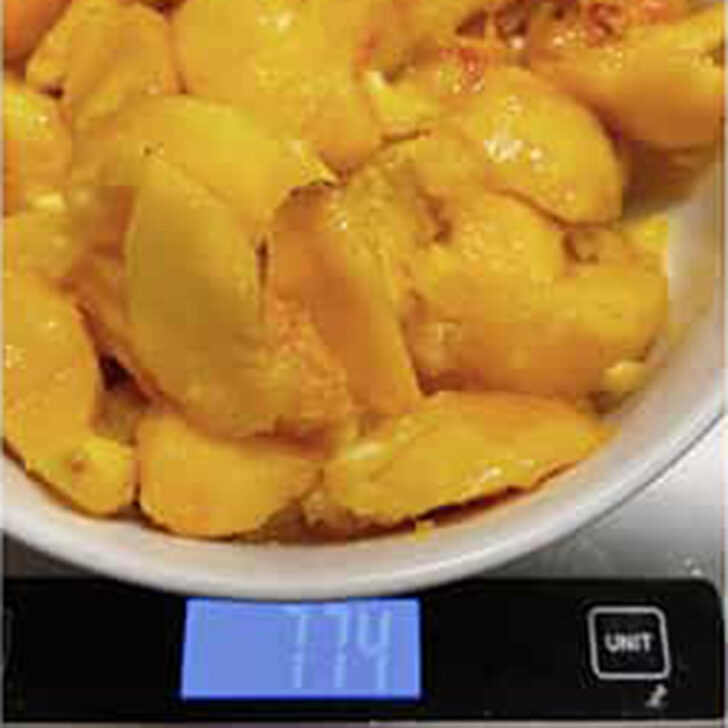
Step 4: Weigh the prepared peaches and oranges and use the same amount of sugar by weight.
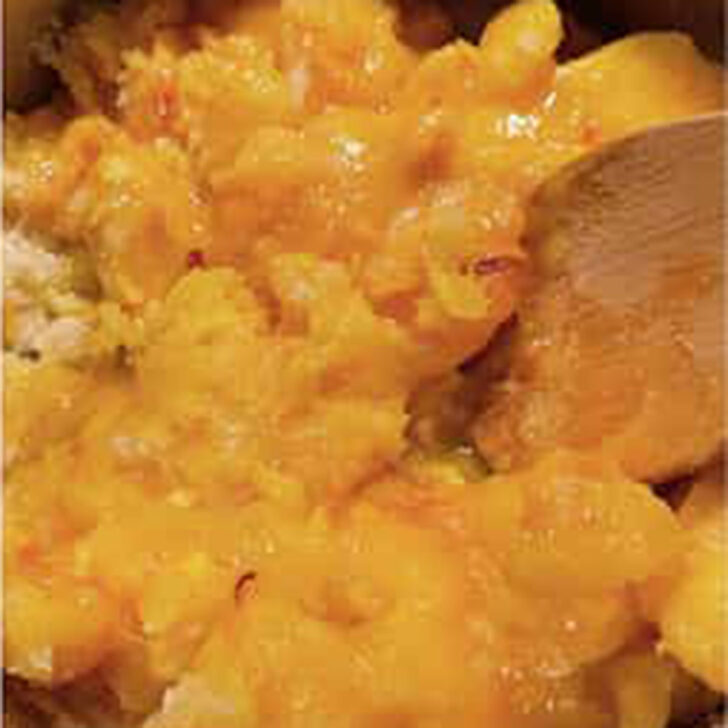
Step 5: Add the fruit and sugar to a large pot.
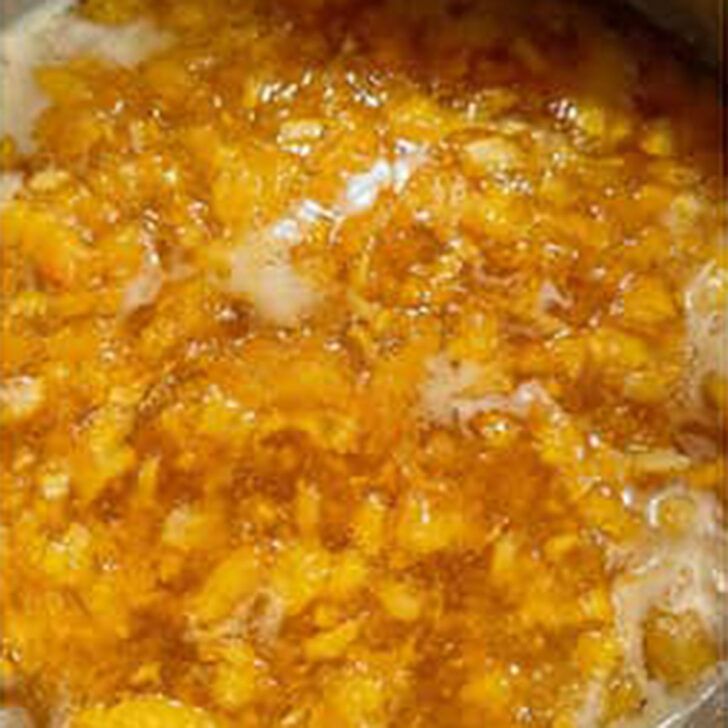
Step 6: Bring the marmalade to a boil until it reaches 221F.
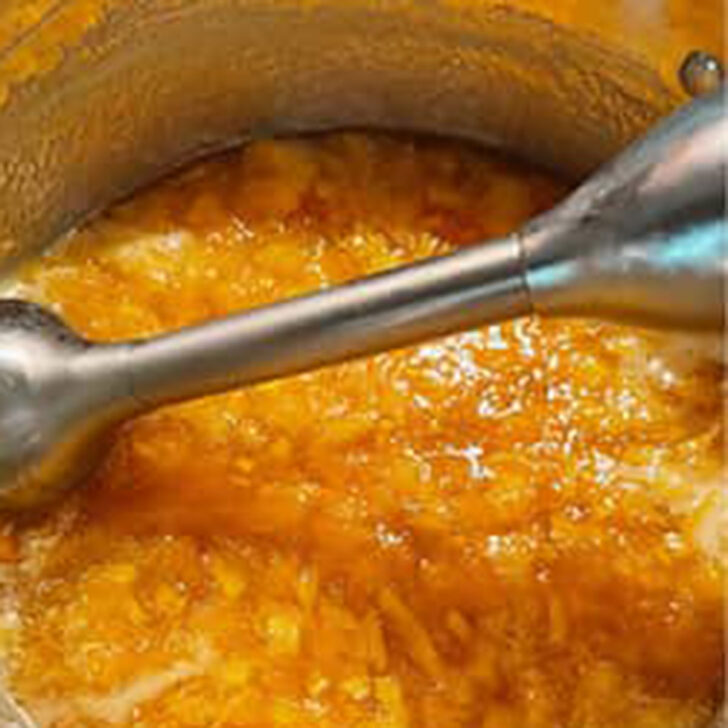
Step 7: Break down the fruit a bit with an immersion blender (optional).
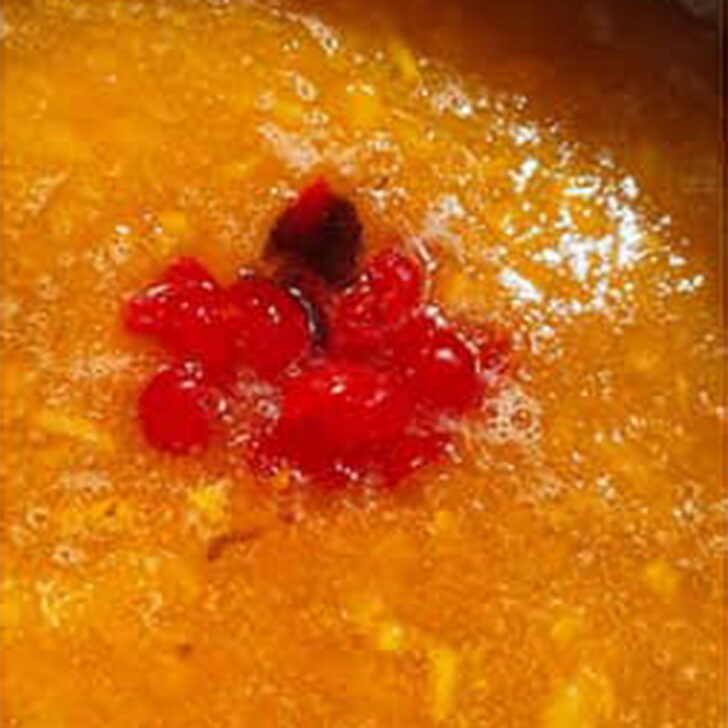
Step 8: Add the maraschino cherries and vanilla and stir in.
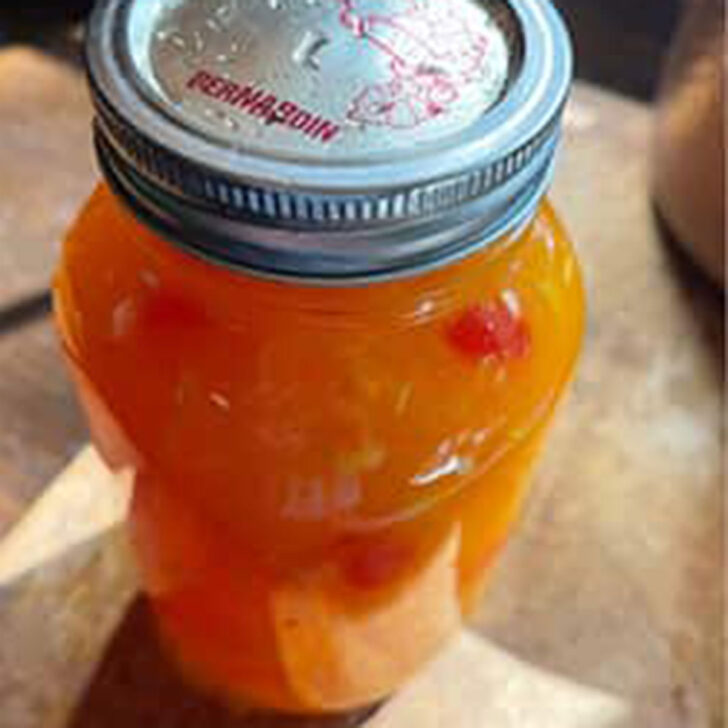
Step 9: Transfer the jam to jars and refrigerate or follow safe-canning steps to preserve.
Peach marmalade tips!
- Making jams and marmalades is best done with access to a scale, so you can weigh the fruit and sugar. The classic ration of fruit to sugar is 1:1, so you start by weighing your fruit mixture, then you add an equal amount (by weight) of sugar). Sticking to this ratio will ensure your jam will set and will ensure that the mixture can be preserved and have good shelf-life. If you don’t have a scale, you really should get one :) Seriously, you can get a great kitchen scale for $20 or less and it is an invaluable kitchen tool! Alternately, you’re left with best guessing.
- I know the usual method recommended for peeling peaches involves boiling them, then peeling. I’ve always preferred to simply peel them with a sharp vegetable peeler. Works like a charm!
- You can keep this jam chunkier or smoother, simply by how much you mash it down (or blend with an immersion blender).
- This small-batch recipe will make 4 cups of jam. You can halve the recipe and make just one, smaller jar, if you like. You can also double or triple the recipe to make more, if you want to preserve it. I prefer to make a small batch and simply refrigerate and use from the fridge, rather than canning.
- If you wish to can this jam for longer, room-temperature storage, you will need to follow recommended canning practices regarding jar and lid sterilization and canning in a hot water bath. Always refer to a reputable canning resource for guidance on doing this.
How to know when marmalade is set
- You want to be sure not to over-boil your marmalade, or it will turn out dark and almost caramelized, which is not what you’re after. That said, it is not always easy to know when your jam or marmalade is done. Jams will set at 221F (at sea level), and slightly higher for every 1000ft above sea level. You can test the liquid with a thermometer or use the Cold Plate Test detailed below.
- For this marmalade, watch the colour. As it nears done, the marmalade will shift colour from bright to a slightly more muted colour. Start testing at that point.
- This marmalade will be quite liquid-y still when done. It will set further in the jar/fridge. That said, as this marmalade has no pectin added, so it will be little looser that a pectin-added marmalade or jam.
The cold plate test for jam or marmalade
Before you start your jam or marmalade, plate a small dinner plate into the freezer. As your jam comes close to done, remove the plate from the freezer and place a drop of the hot jam liquid on the plate. run your finger through the drop. If the space where you ran your finger through runs back together and fills in the space, your jam is not done yet. Boil a little longer and test again. When the space where your finger run through it remains AND the edges along where you ran your finger appear slightly raised (as opposed to flat and thin) or wrinkled, your jam is ready.
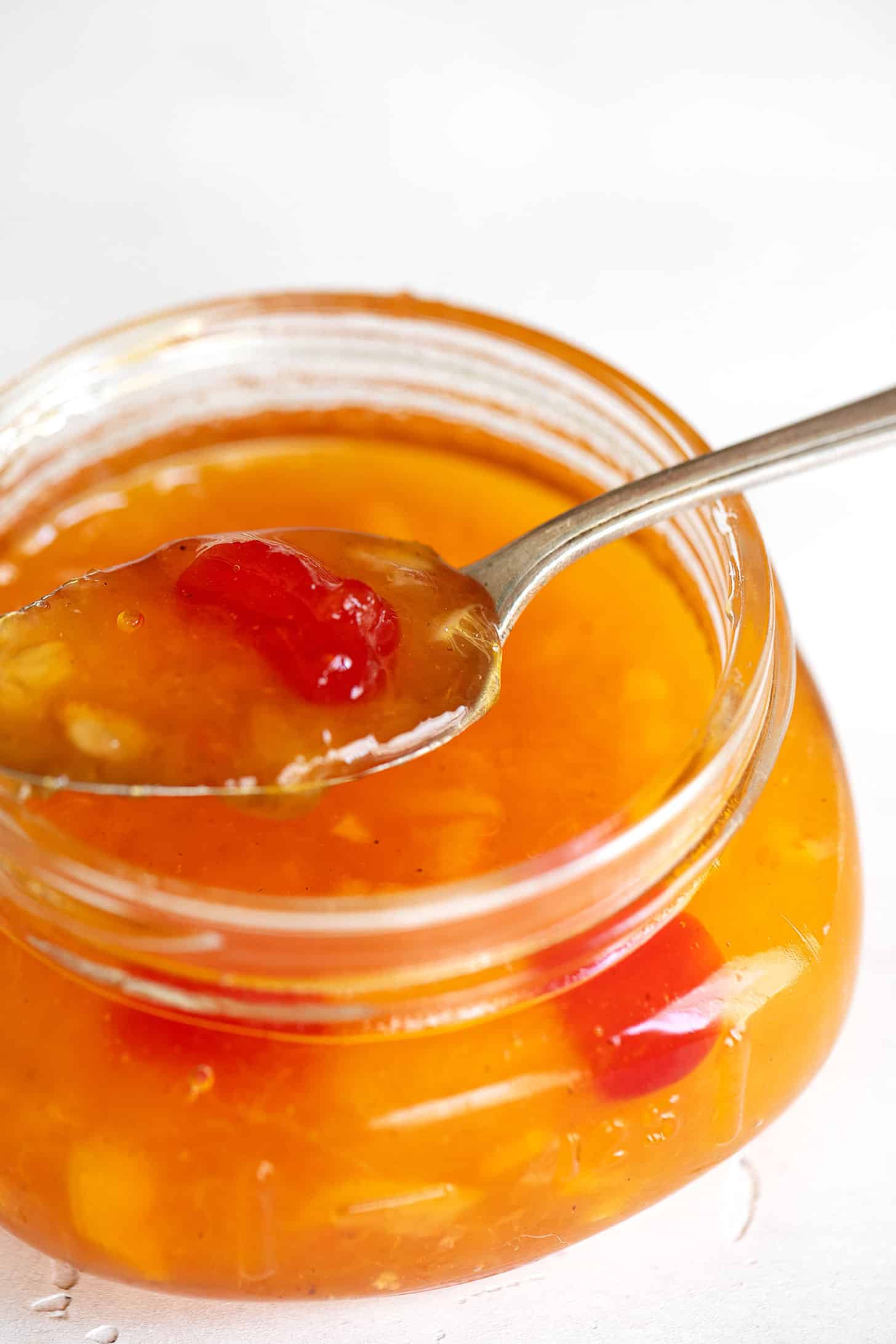
Peach orange marmalade storage
Unless the marmalade is placed into sterilized jars and processed in a hot water bath to seal, this marmalade must be stored in the refrigerator or frozen. Marmalade will keep in the fridge for 6-8 months or up to a year if frozen.
If properly processed for canning, the marmalade will keep at room temperature for a year or more. Always seek canning guidance from a reputable source for detailed instructions on how to properly can/preserve marmalade.
Want to save this recipe?
Enter your email and I’ll send it to your inbox. Plus, you’ll get great new recipes from me every week!
By submitting this form, you consent to receive emails from Seasons and Suppers.
You can unsubscribe at any time.
Get the Recipe: Peach Orange and Maraschino Cherry Marmalade
Ingredients
- 2 lbs peaches, peeled, pitted and sliced
- 1 medium navel orange
- Juice from 1/2 lemon
- 3- 3 1/2 cups granulated white sugar, approximately *see Note 1
- 1 teaspoon vanilla or vanilla bean paste
- 10 maraschino cherries, halved or quartered
Equipment
- Kitchen scale for weighing fruit and sugar
Instructions
- If you don't have a jam/sugar thermometer, place a small dinner plate into the freezer before starting your marmalade, to use for the Cold Plate Test for done-ness (see Note 2 below).
- Peel, pit and slice the peaches. (I like to use a nice, sharp vegetable peeler to peel peaches). Remove the ends from orange and slice across the equator as thinly as you can. Chop the peel and flesh into smaller pieces. (You can chop as finely or as coarsely as you prefer).
- Cut maraschino cherries in half or quarters and place on a paper towel to absorb the juices. Set aside.
- Place the prepared peach slices and chopped orange into a large bowl. Add the lemon juice. Weigh the fruit mixture. Add an equal weight of granulated sugar to the bowl. (So, in my case, my fruit weighed 774g/27oz) so I weighed out that same amount of sugar by weight and added it to the fruit mixture). Stir to combine.
- Place the fruit/sugar mixture in a large, heavy bottom pan (not aluminum) over medium heat and stir until the sugar dissolves. *I like to use a potato masher to break down the peaches a little bit at this point. Raise heat to medium-high and continue cooking until juices start to thicken and jam tests done on a chilled plate *, about 10-15 minutes. *If you like a chunkier marmalade, you don't need to do anything. For a less chunky marmalade, you can use an immersion blender at the end of cooking (before adding vanilla and cherries), to make a smoother marmalade. Be careful with the immersion blender as the liquid is very hot!
- Remove the pan from heat. Stir in vanilla and cherries. Spoon into clean jar or jars, leaving 1/2-inch headspace. Place lid and ring on just fingertip tight and invert jar on tea towel. Allow to stand (inverted) until cooled to room temperature, then immediately refrigerate. (Inverting hot jam will give you a "soft seal" of the canning lid, but is not considered a sufficient seal for room-temperature storage, so the marmalade MUST be stored in the refrigerator unless you take the extra step of properly sealing by the boiling water bath sealing method.
- *If you wish to can the jam, spoon into sterilized jars and process in a water bath. Always refer to a reputable source of canning information for how to sterilize and how long to process in a boiling water bath.
Notes
- The sugar amount is approximate. You will need to weigh your peach/orange mixture and then add an equal amount (by weight) of white sugar. The general ration of fruit to sugar is 1:1 and it is always best to stick to this ratio for proper setting and prolonged shelf-life. Always remember, jam is a condiment, not a meal :)
- Cold Plate Test: Before you start your jam or marmalade, plate a small dinner plate into the freezer. As your jam comes close to done, remove the plate from the freezer and place a drop of the hot jam liquid on the plate. run your finger through the drop. If the space where you ran your finger through runs back together and fills in the space, your jam is not done yet. Boil a little longer and test again. When the space where your finger run through it remains AND the edges along where you ran your finger appear slightly raised (as opposed to flat and thin) or wrinkled, your jam is ready.
More marmalade and jam recipes to love!

Hi! I’m Jennifer, a home cook schooled by trial and error and almost 40 years of getting dinner on the table! I love to share my favourite recipes, both old and new, together with lots of tips and tricks to hopefully help make your home cooking enjoyable, stress-free, rewarding and of course, delicious!


made this today…delicious! Thanks for sharing!
Thanks Pat!
So glad to see this today. I stopped at a locally owned “owner/grower produce market” yesterday. I can find fig preserves,peach preserves all good products for sale. My Mom used to make peach marmalade and we never could find her recipe. I remember she put spices in hers, not sure if it was allspice, ginger, cinnamon or what . She did use lemon and orange juice plus she would zest them to add to mixture. I don’t see any recipes with spices, any ideas would be appreciated.
You could definitely use the base peach marmalade recipe and add spices, to taste.
Can I make this with a mandarin orange? (I’ve made your mandarin marmalade and loved it!). I’m planning on making half a recipe.
Hi Julie and yes, you definitely could. The marmalade will be a little bit sweeter with the mandarin orange, but otherwise, will be fine :) Enjoy!
I made few jars last night. Jam came out wonderful….eating some on my toast now…As easy as it gets to make in small batches. Thanks!
So glad to hear, Pat :) Thanks so much!
Orange marmalade was my Dad’s favorite growing up Jennifer. It also became a favorite of mine. I LOVE summer peaches, so I will definitely need to give this recipe a go! New memories to make! Thanks!
Thanks Mary Ann :) It’s a favourite of mine and perfect for marmalade lovers.
Your recipe is almost the same as my Mom’s. She diced the cherries so you got bits in every bite and grated the orange rind. My Mom made it every summer and we would share summer memories during many a winter snow storm with the jam on homemade toast. My children have also been raised on this as I bought property that had a peach tree! My children would pick the peaches and swing in the tree then help make it. There is something satisfying about canning your own peaches.
Third generation making it again this morning in my kitchen on the beach surrounded by fog.
Great recipe.
Hi Patricia and enjoyed hearing your memories of this jam. And yes, it was a ray of Summer sunshine all winter long :) Thanks!
Do the peached have to be ripe or is it ok if they are a little hard.
I think it would be fine if they are a little hard. They will soften as they cook and the flavour will still be there.
I love the idea of this Jam. Can you do it without the maraschino cherry?
Hi Nancy and absolutely. You can just skip the maraschino part altogether, if you like.
I have been looking for this recipe for years!!! My mother used to make this every year. She called it Heavenly Hash. I think it was my dad’s favourite or all of her homemade jams! It was always like a taste of summer sunshine on cold winter days. As both mom and dad are gone now, I plan on making this in their honour and enjoy that wonderful taste from years ago. Thanks so much for posting it to my “fellow” Ontarian…lol!!
So glad you found it, Colleen. I have fond memories of this jam, too and would always look forward to peach season as I knew there would be a new batch of this in the pantry. Enjoy!
This looks so nice – I love peaches and I love marmalade, can’t wait to try it!
I’m sure you will enjoy it and a fairly easy jam to make (except for that peach peeling thing ;)
I never like marmalade as a kid but I love it now as an adult. This peach marmalade sounds like the perfect way to use up some of those extra peaches I have laying around!
It is delicious, Liz. Not as tart as traditional marmalade, but in the same spirit, for sure.
Thanks Sophie. I’m a huge maraschino cherry fan and so is everyone in my family. In fact, I have to hide them at the back of the fridge or they will disappear. That would be cool if they came from your coop!
Hope you try this jam. If you like marmalade, you’ll love this.
[Girl, a totally amazing recipe with maraschino cherries, I love it! I like to share recipes like this that I come across with our CEO because he gets pumped about new applications for our cherries ;) I wonder if the cherries you bought came from our co-op??]
This sounds absolutely delicious! I was just thinking that if I could reduce or jammy-up some beautiful summer peaches, it might be nice swirled into homemade ricotta with some crackers for dipping. Hello, this is perfect! Love that you shared a childhood food memory with us :)