

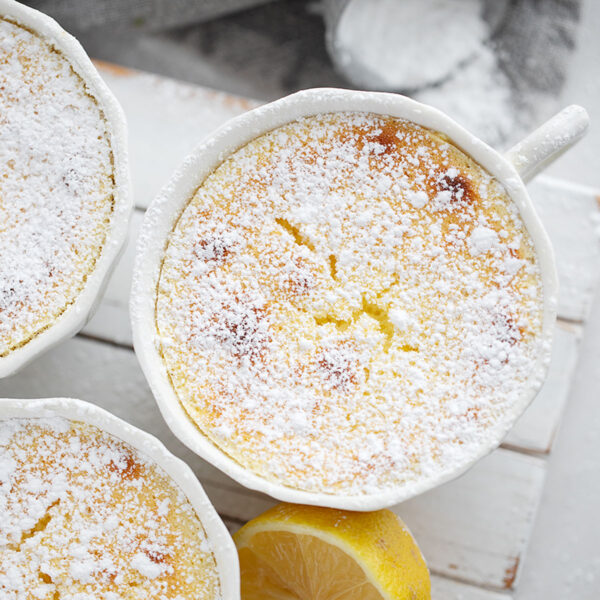
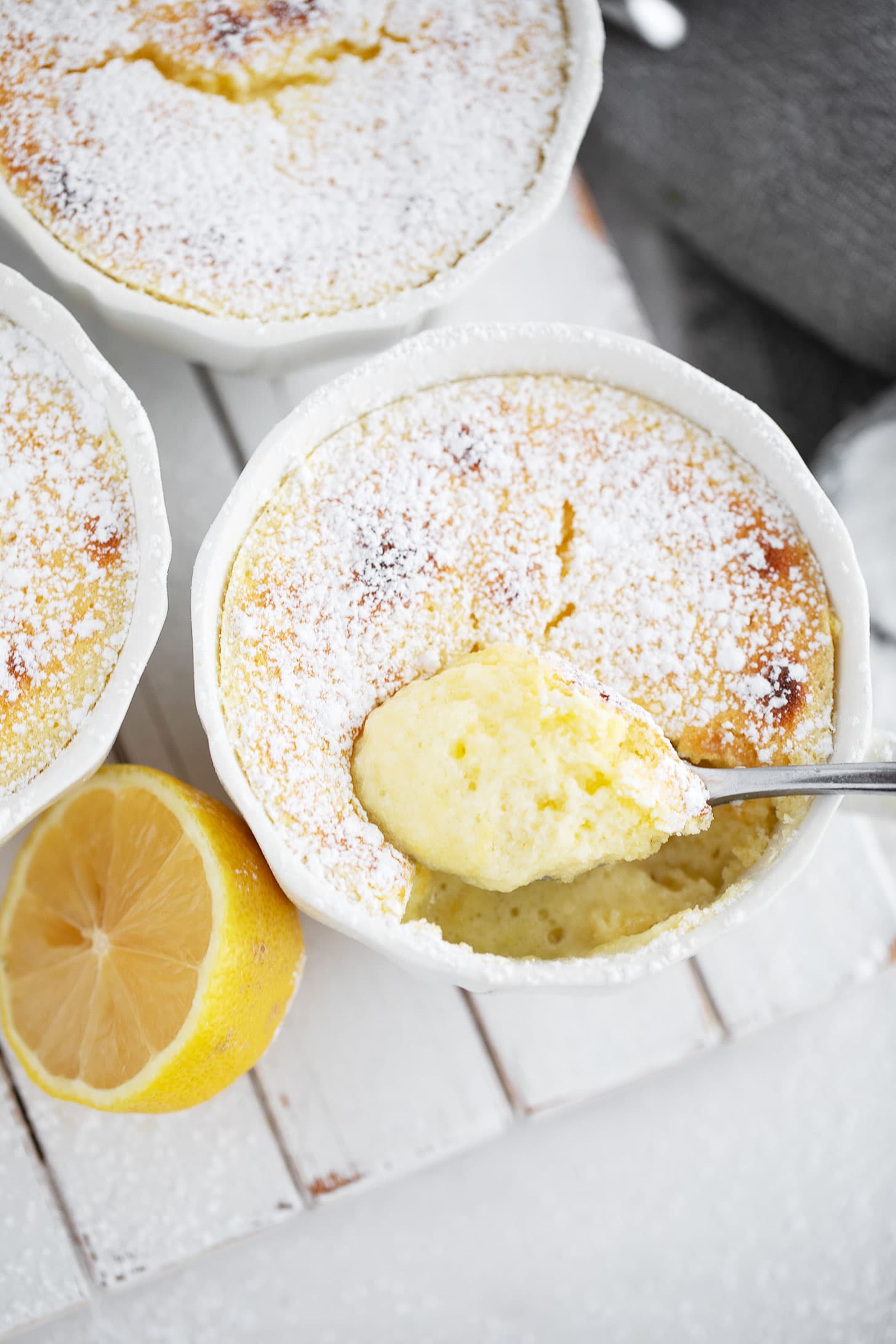
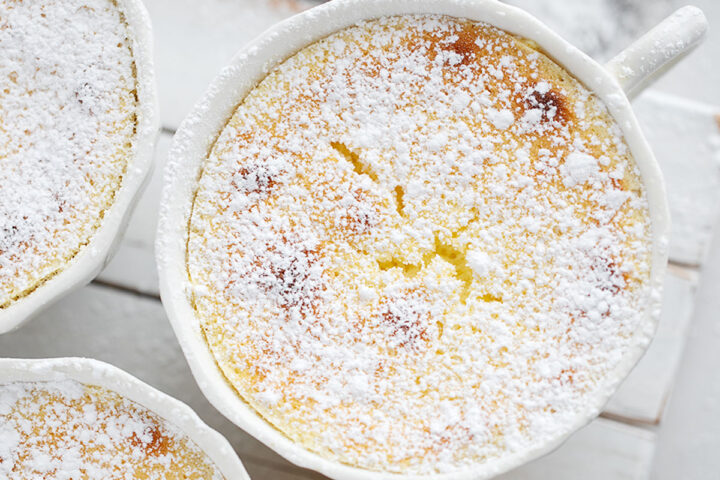
These lovely lemon pudding cakes magically bake up with pudding at the bottom and a light-as-air cake on top. Make as individual servings or as one large pudding.
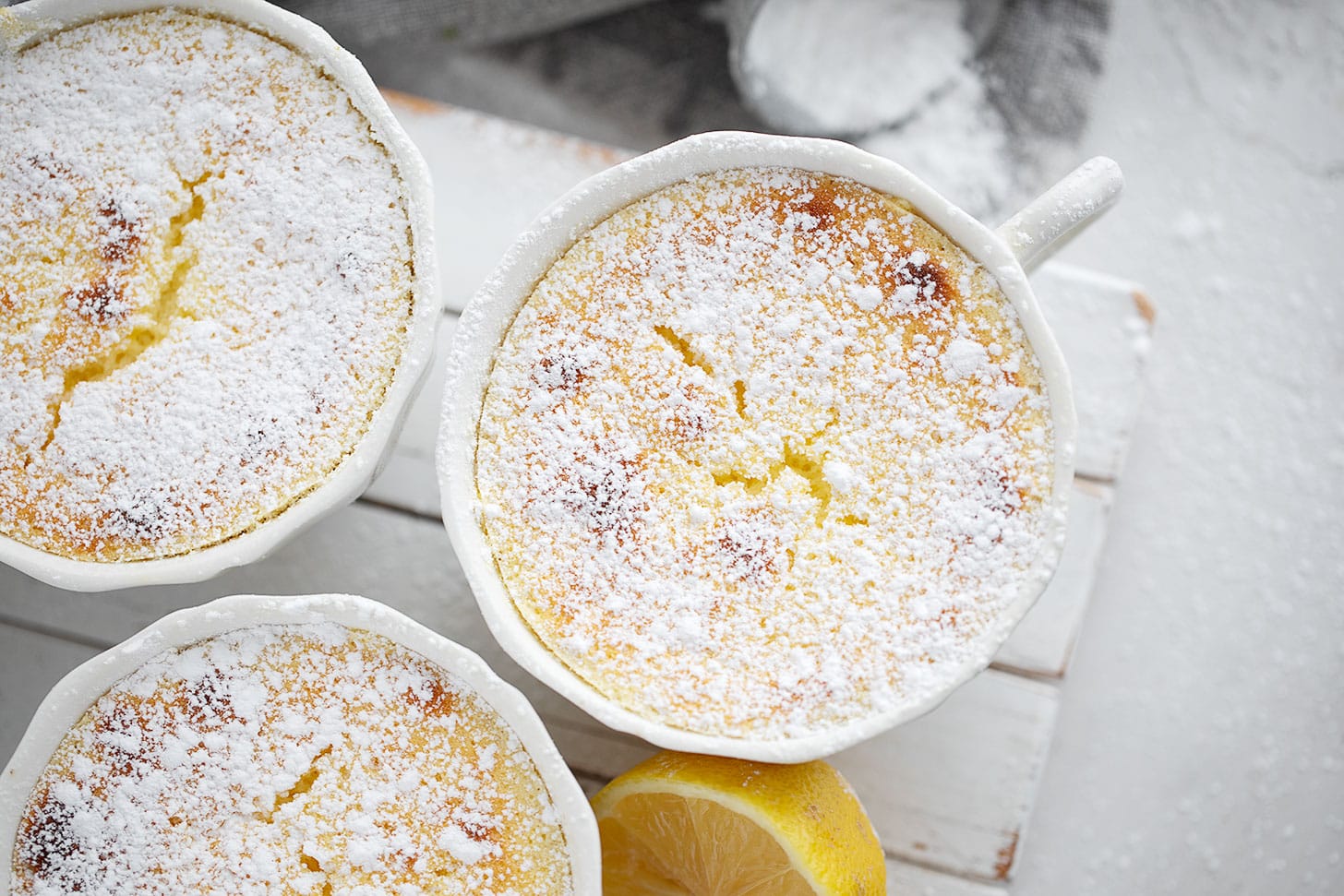
I am a sucker for anything lemon, but warm lemon pudding cakes might just be my favourite way to enjoy lemon. Preparing these pudding cakes involves a couple of steps.
First, you make the lemony pudding base, using egg yolks, lemon juice, lemon zest, and sugar. Then, separately, you whip up the egg whites. Both of these parts are then gently folded together. As it bakes, the creamy lemon pudding cooks on the bottom while the egg whites float to the top and cook up into a soft meringue-like “cake”. I should point out that it really isn’t cake, as we typically think of it. It’s very light. Souffle-like. I’ve offered some tips on both these things below in the recipe tips!
If you’re looking for a dessert that is light and not too sweet, this is a perfect choice. It would be great for finishing a special meal as the flavour is fresh, but it’s light enough to be enjoyed on top of a big meal. This pudding kept well in the fridge, without suffering much at all, if you need to make it ahead a bit. Just cover with plastic wrap once cooled.
You can enjoy these lemon pudding cakes warm, at room-temperature or cold from the fridge.
Ingredients and substitutions
A few notes about the key ingredients …
Lemons – you will need to start with fresh lemons. You can use regular lemons or Meyer lemons. Use slightly more lemon juice if using Meyer lemons.
Cream of Tartar – this is added to help stabilize the egg whites. It is optional, so simply omit if you don’t have it on hand.
How to make lemon pudding cake
This is a visual summary of the steps to make this recipe. Always refer to the complete instructions in the Recipe Card below when making this recipe.
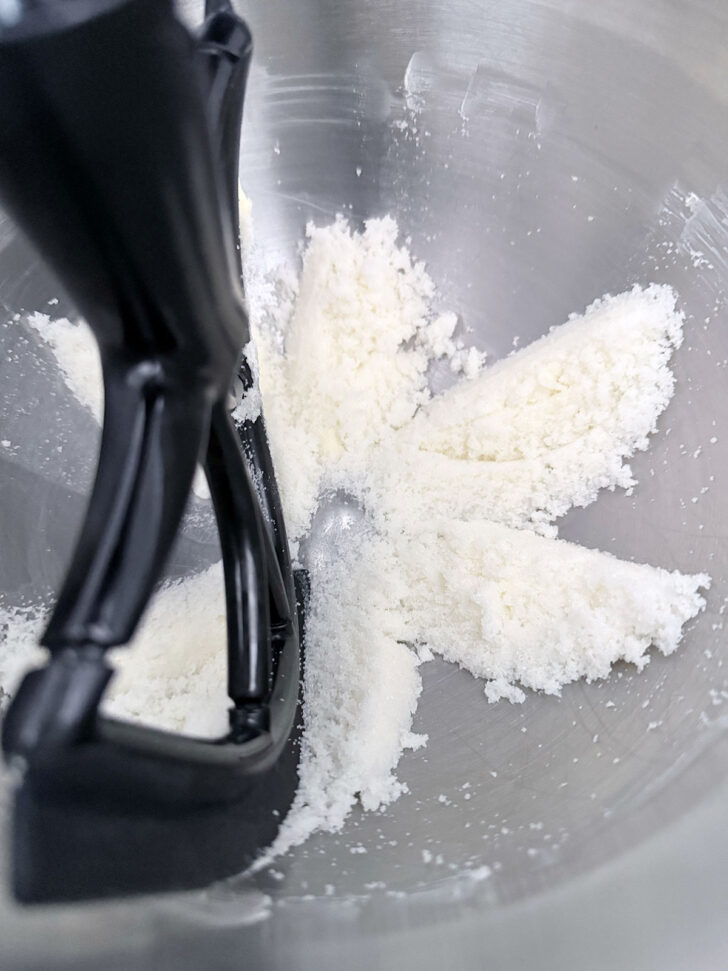
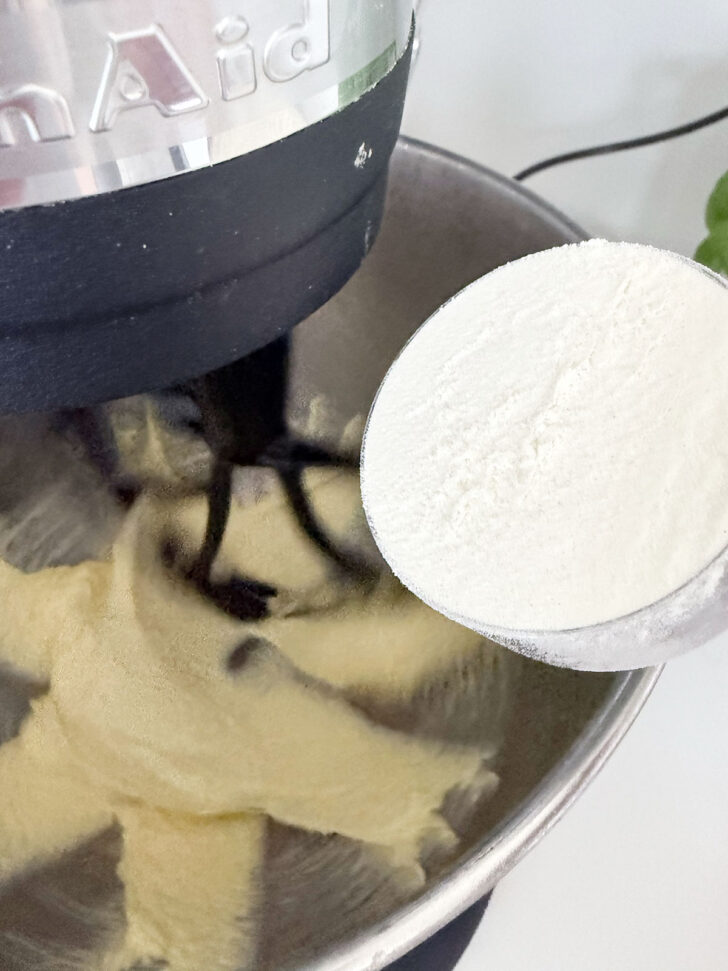
- Set aside 2 Tablespoons of the white sugar to be used for the egg whites. Add the remaining white sugar to the mixing bowl and beat together with the butter until it is sandy and lightened in colour.
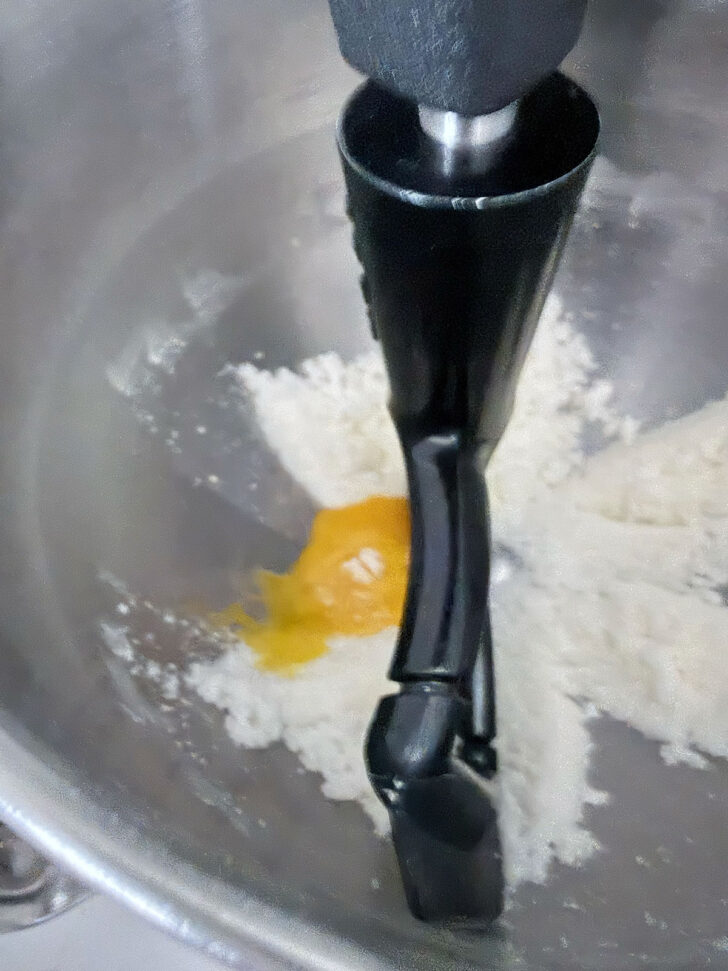
- Beat in the egg yolks one at a time, then add the lemon zest and vanilla and beat in.
- Add the flour and salt and mix in.
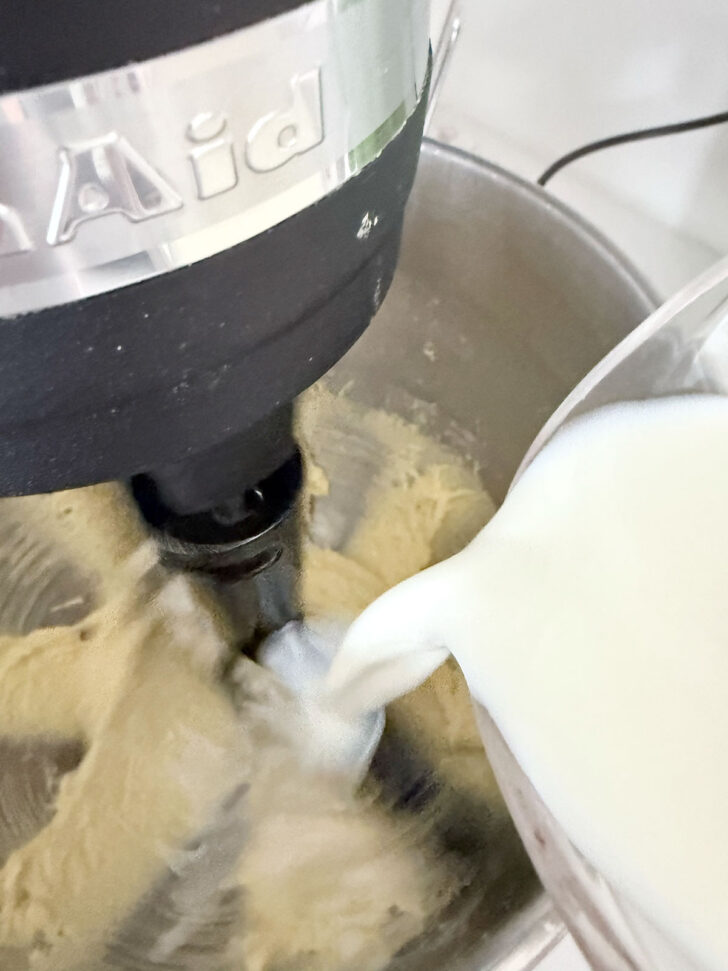
- Add the milk to the batter.
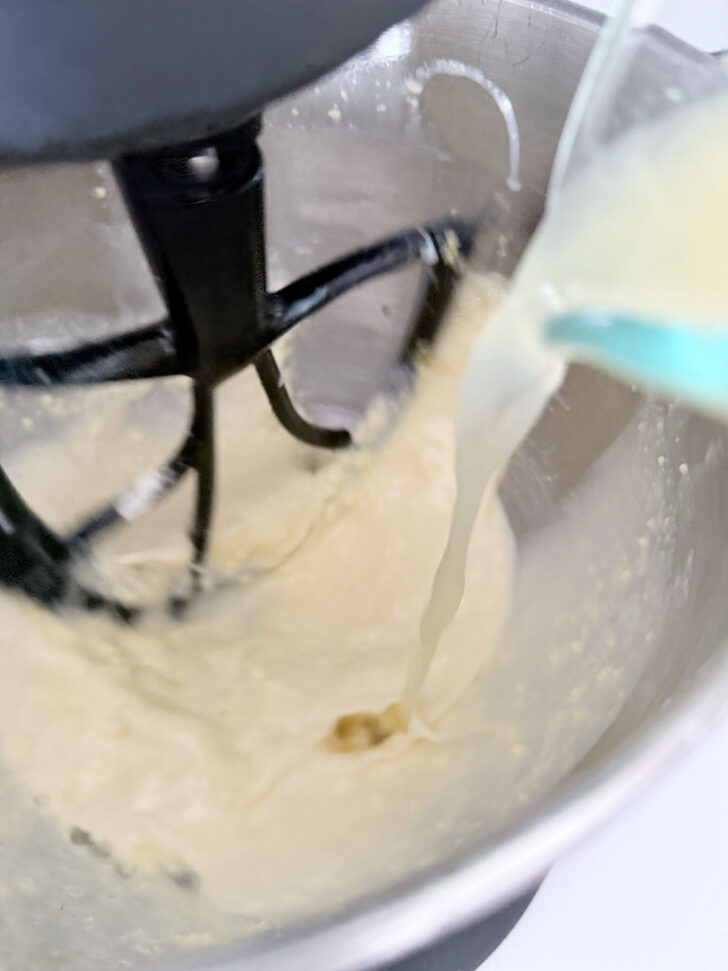
- Add the lemon juice to the batter.
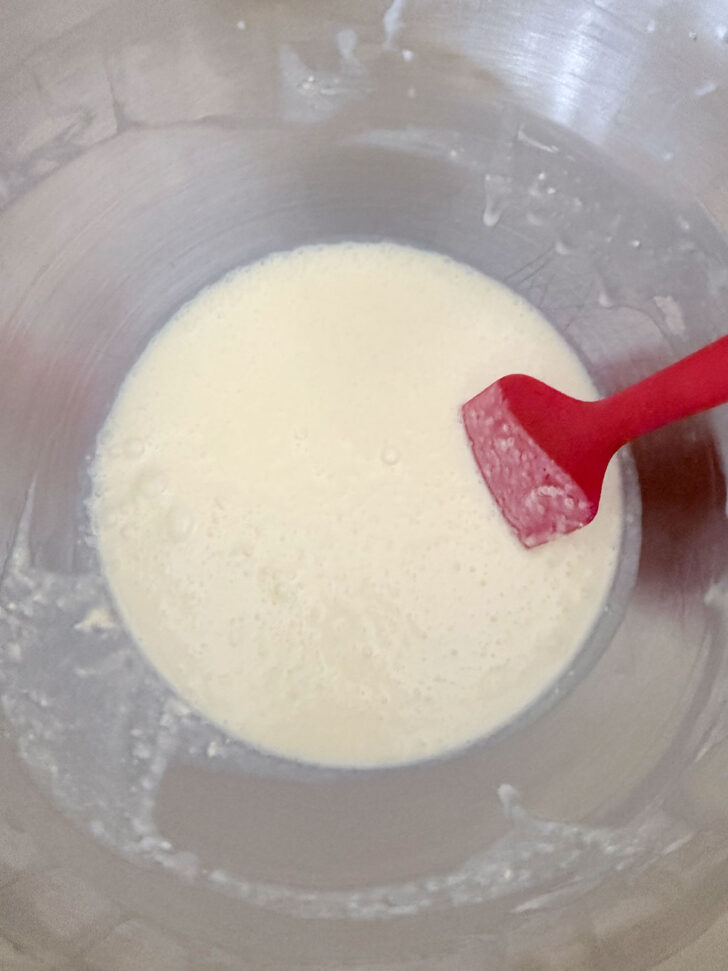
- The finished batter will the smooth and thin. Set aside.
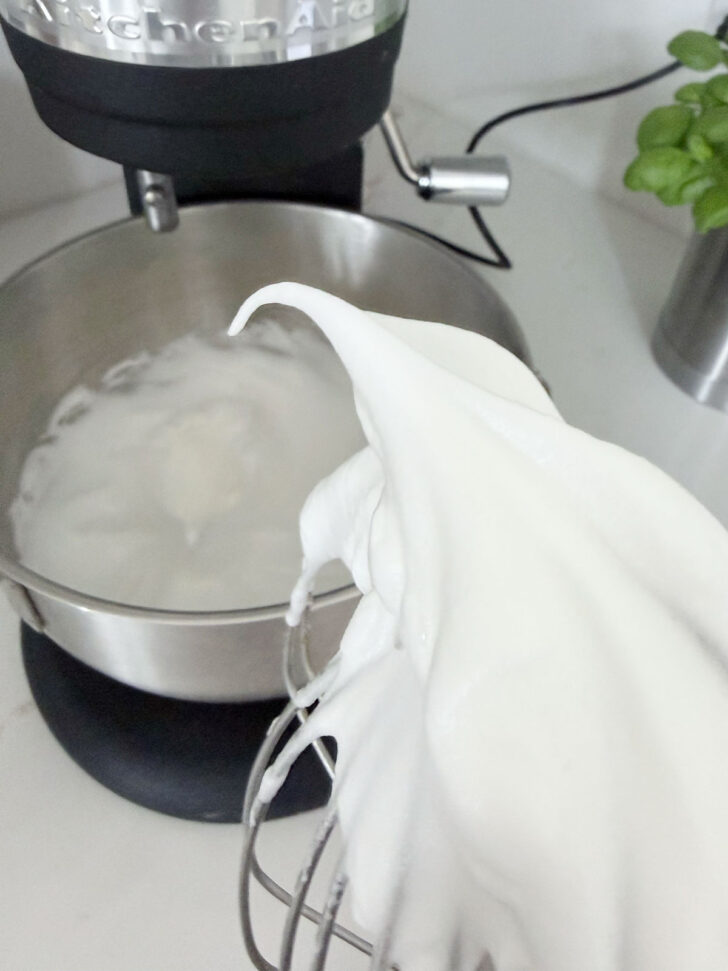
- Beat the eggs whites with the reserved white sugar until stiff peaks form.
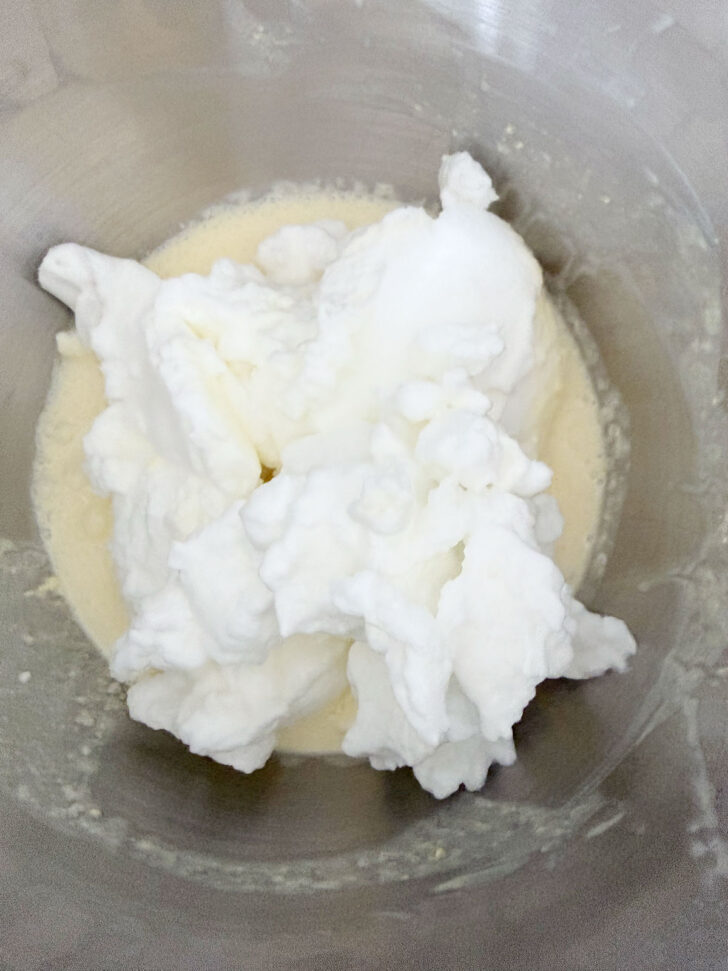
- Spoon the egg whites into the bowl with the batter and gently fold them into the batter until they are evenly combined.
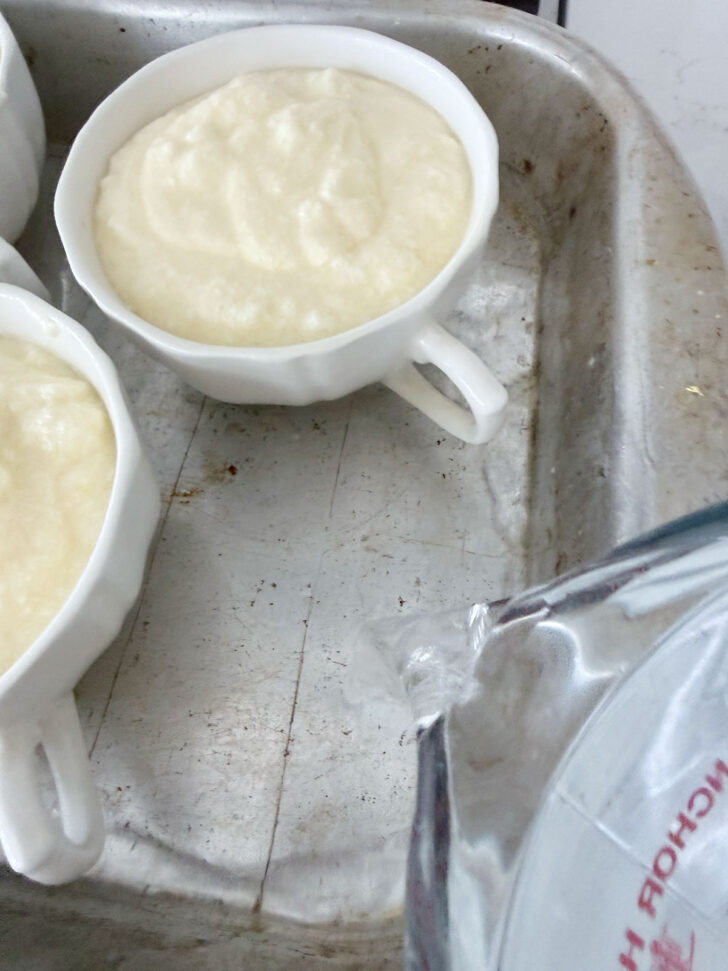
- Spoon the mixture into the prepared ramekins or baking dishes. Place into a roasting pan and add hot water to the pan until it comes halfway up the sides of the baking dishes. Bake.
Recipe tips!
- Separate your eggs carefully. Even the smallest amount of yolks in your whites will cause your egg whites not to whip up well.
- Eggs separate most easily when cold, but whip up best when at room temperature, so separate the eggs ahead and let them stand before using.
- If using the same bowl for both the cake and egg whites, be sure to wash well in between. Egg whites will not whip up well if there is any grease or oil in the bowl.
- Using 1-cup ramekins will yield 6 puddings. You can use larger ramekins or cups or one large baking dish.
- The puddings don’t rise much, so you can fill them almost to the top, if you like.
- It never hurts to check the baking puddings early. If the tops of the puddings are browning too quickly, you can lay a sheet of aluminum foil loosely over the top of the pudding to prevent further browning while they finish baking.
- The cups that I baked my puddings in are marked as oven-safe. I wouldn’t suggest using cups that don’t clearly indicate they will be safe in the oven, as bad things could happen to them and I’d feel terrible about that.
How to whip egg whites
- Always start with a squeaky-clean and completely dry bowl. Any bit of water or grease in the bowl will interfere with the egg whites whipping well. Wiping the inside of the bowl with a little white vinegar is a great way to ensure it’s perfectly clean.
- Starting with fresh, room-temperature egg whites is best. They will whip up better if not cold.
- If using a stand mixer, use the whisk attachment. Start mixing the egg whites on LOW speed (Speed 4 on a KitchenAid mixer) and mix until they are very foamy, like a bubble bath!
- Increase the mixer speed to MEDIUM speed (Speed 6 on a KitchenAid mixer) and continue mixing until soft peaks form. To test for soft peaks, you would stop the mixer. Dip the whisk or beaters in the egg whites, then lift out and turn upside down with the peak at the top. Soft peaks will form, but then start to droop. The soft peak stage is typically when sugar is added to the egg whites. Add sugar slowly, with the mixer running.
- For stiff peaks, increase the mixer speed a bit (Speed 7 or 8) and continue mixing, testing regularly. When you lift the beater and turn it upside down, the peak will form and stay upright, without drooping. You know you have stiff peaks if you could hold the bowl of whipped egg whites over your head and stay clean :)
How to fold in egg whites
- Once you have your perfect egg whites, be sure you don’t stir out all the wonderful lightness you just whipped in. “Folding” involves using a rubber spatula to carefully incorporate the egg whites with the batter. Since the batter is much heavier than the whites, you need to do this slowly and lightly.
- Once you’ve spooned the whites over the batter, use a rubber spatula using the following technique: Using the edge of the spatula like a blade, slice through the mixture from the 12 o’clock position to the 6 o’clock position. When you get to 6 o’clock, twist the spatula blade at an angle and use it to lift some of the batter from the bottom of the bowl over the top of the egg whites. Rotate the bowl slightly and repeat this motion. Keep doing this until the whites are combined with the batter.
Want to save this recipe?
Enter your email and I’ll send it to your inbox. Plus, you’ll get great new recipes from me every week!
By submitting this form, you consent to receive emails from Seasons and Suppers.
You can unsubscribe at any time.
Get the Recipe: Lemon Pudding Cake
Ingredients
- 2 Tablespoons butter, at room temperature
- 1 cup white sugar, DIVIDED
- 3 large eggs, separated
- 1 teaspoon vanilla
- 1 Tablespoon lemon zest
- 1/3 cup all-purpose flour, spooned and levelled
- 1/4 teaspoon (g) salt
- 1 cup milk, whole milk recommended
- 1/2 cup freshly squeezed lemon juice, from 3 or 4 fresh lemons
- 1/8 teaspoon cream of tartar, optional
For serving:
- 2 Tablespoons icing/confectioners sugar, for garnish
Instructions
- Preheat oven to 325° F (regular bake setting/not fan assisted) with rack in centre of the oven. Lightly butter one 1.5-quart baking dish or 4-6 individual, small ramekins. (1-cup ramekins will yield 6 puddings). Have ready a high-sided roasting pan and place the prepared dish (or dishes) into the roasting pan. Bring 8-10 cups of water to a simmer (will be added to the roasting pan to bake the puddings). Separate your eggs and have them ready.
- Set aside 2 Tablespoons of the white sugar. Add the rest of the sugar to a large bowl or the bowl of a stand mixer. Add the butter and beat (with a stand mixer or electric mixer) until the mixture is grainy but light. Add the egg yolks one at a time, beating well after each addition. Add the vanilla and lemon zest and mix in. Add the flour and salt and mix. With the mixer on low, add the milk and lemon juice and mix until combined. Set aside, or if using your stand mixer, remove to a large bowl and wash your mixer bowl really well (you'll be whipping the egg whites in it next, so be sure it is squeaky clean!).
- In another bowl or the bowl of a stand mixer, beat your egg whites until they're frothy. Add the cream of tartar to the bowl, if using and continue beating until soft peaks form. Sprinkle in the reserved 2 Tablespoons of white sugar and continue beating until stiff peaks form.
- Spoon the whipped egg whites on top of the egg yolk mixture. Using a spatula, gently fold the egg whites in to the egg yolk mixture by pulling a bit of the batter up and over the egg whites. Continue working gently until the mixture is uniform in color and texture. Do not over mix, but be sure there aren’t any large chunks of egg whites.
- Pour or ladle your batter into the prepared dish or dishes and level the top with the back of a spoon. (The puddings don't rise much, so you can fill the ramekins quite full). Set into the roasting pan. Carefully pour simmering water into the roasting pan, so it comes about halfway up the sides of the baking dish. Carefully transfer the roasting pan with the water and ramekins into the preheated 325F oven. Bake for about 40-45 minutes for individual ramekins (or longer for one large pudding) or until the puddings are golden brown and a tester comes out clean when inserted into the top cake portion (avoid pushing the tester down too far or you'll reach the pudding layer).
- Remove the pudding from the oven and transfer the baking dish or dishes to a cooling rack. Allow to cool for 10 minutes before dusting with icing/confectioners sugar. Serve warm and enjoy or allow to cool and serve at room temperature. You can refrigerate puddings and enjoy them from the refrigerator, too!
Notes
Adapted from a Joy of Cooking cookbook recipe
More lemon recipes to love!
Hi! I’m Jennifer, a home cook schooled by trial and error and almost 40 years of getting dinner on the table! I love to share my favourite recipes, both old and new, together with lots of tips and tricks to hopefully help make your home cooking enjoyable, stress-free, rewarding and of course, delicious!


I serve these with a dollop of whipped cream on top and then I sprinkle toasted coconut on top of the whipped cream. Delicious.
Sounds lovely, Cathy :) Thanks!
Hi Shauna, about 2/3 full should be good. They will rise slightly as they bake, but then fall a bit as they cool.
This sounds delicious but I am English – please advise what all-purpose flour is. We have plain or self raising ( which is plain flour with a raising agent already added. Thanks
Hi Megan, it would be your plain flour. Generally speaking, self raising flour is not used very much in North America, so rarely is it what is meant when you see “all purpose flour” in a Canadian or US recipe. Personally, on the few occasions that I use self raising flour, I will always specify it by name. I think most North American recipe writers would do the same. Hope that helps :)
This looks amazing. Does pudding cake have to be served warm? Can they be served at room temperature or chilled? Does the pudding start to break?
Hi Julia and no, you can serve it anyway you like – warm, chilled or room temperature. Once baked, the pudding is set and won’t change at all, so you could chill then re-heat, if you wanted.
Can I use a springform mini pans?
Hi Victoria, this is a very soft pudding so it wouldn’t stand on it’s own once you took the springform pan off. Ramekins or one large baking pan (even a cake pan) would be a better option.
These turned out perfect! Definitely a keeper to try again!
I’ll be looking for other flavours to try
So glad you enjoyed it, Jan! Thanks so much :)
Hello, I am new to your site and these lemon cups look lovely, as do lots of other recipes. I would like to know, can you make the batter ahead and pop in the oven so that can be served warm at a dinner party?
Hi Christina and thanks :) I have never tried it with this dessert, but I feel like it could work if made just a bit ahead. I’m wondering how well the egg whites that are folded in would hold up if done too far ahead. If you do make ahead and refrigerate, unless you take them out of the fridge to come to room temperature before baking, they will take longer in the oven if cold.
These puddings were incredibly delicious – light and just the right amount of tartness. I will definitely be making these next time I have people over for dinner. Further proof that you can never go wrong by keeping a bag of lemons in the fridge!
So glad you enjoyed them, Eileena and I agree, I always have lemons on hand :) Thanks!
Thanks and yes, you can certainly tweak the lemon juice to your taste :)
Yum, that looks amazing!! Pinning this to try for our next family meal weekend! :)
Thanks so much, Jamie :)
These lemon dessert looks scrumptious! Can this recipe be easily doubled? I’m hosting dinner party for 12. Would love to serve this following a meal of Seafood Gumbo.
Hi Dorothy. I don’t see any reason why it wouldn’t double just fine. Enjoy!
I made this for the first time. It came out perfect and it was delicious. It’s good either hot or cold. Thank you for sharing this recipe.
So glad you enjoyed these :) Thanks!
Thanks for this lovely recipe. I tried this evening and the puddings turned out beautifully. Too many limes in the garden this year, I managed to use over ripen limes to substitute lemons and the taste and texture were fantastic good. Well done!!!
Thanks so much and it must have been lovely with limes! I must try that :)
Wow! I was curious how a one liquid mix could turn into two distinct layers, but it did!! And is delicious! Pudding and a light cake, just as promised. Definitely making this one again!
It’s magic, isn’t it?! So glad you enjoyed it :)
I’m going to make these for Christmas dessert and I can’t wait – my husband LOVES lemon desserts. I am totally in love with your cup dishes – where did you find oven save coffee cups?
Hi Sandi, Believe it or not, I found them at a “thrift” store. They are clearly stamped “oven-safe” on the bottom, so I snapped them up. If you have a second-hand type store around, scout out there. It was quite common in a previous generation to make oven-safe dishes, so check the bottom of cups and hopefully you can find some! Good luck and enjoy the pudding cake :)