

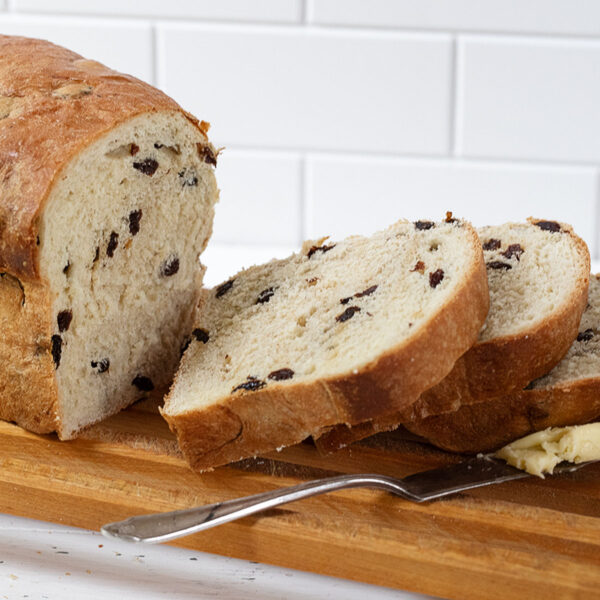
This is a soft, classic raisin bread loaf (without cinnamon), made with milk, butter, and plenty of juicy, plumped raisins. It bakes into a tender, sliceable sandwich loaf that toasts beautifully and stays fresh for days, and it freezes well for longer storage. Leftovers make great French toast and bread pudding, too!
You’ll find step‑by‑step tips for scalding the milk, plumping the raisins, and keeping them from burning so the loaf turns out perfectly every time.
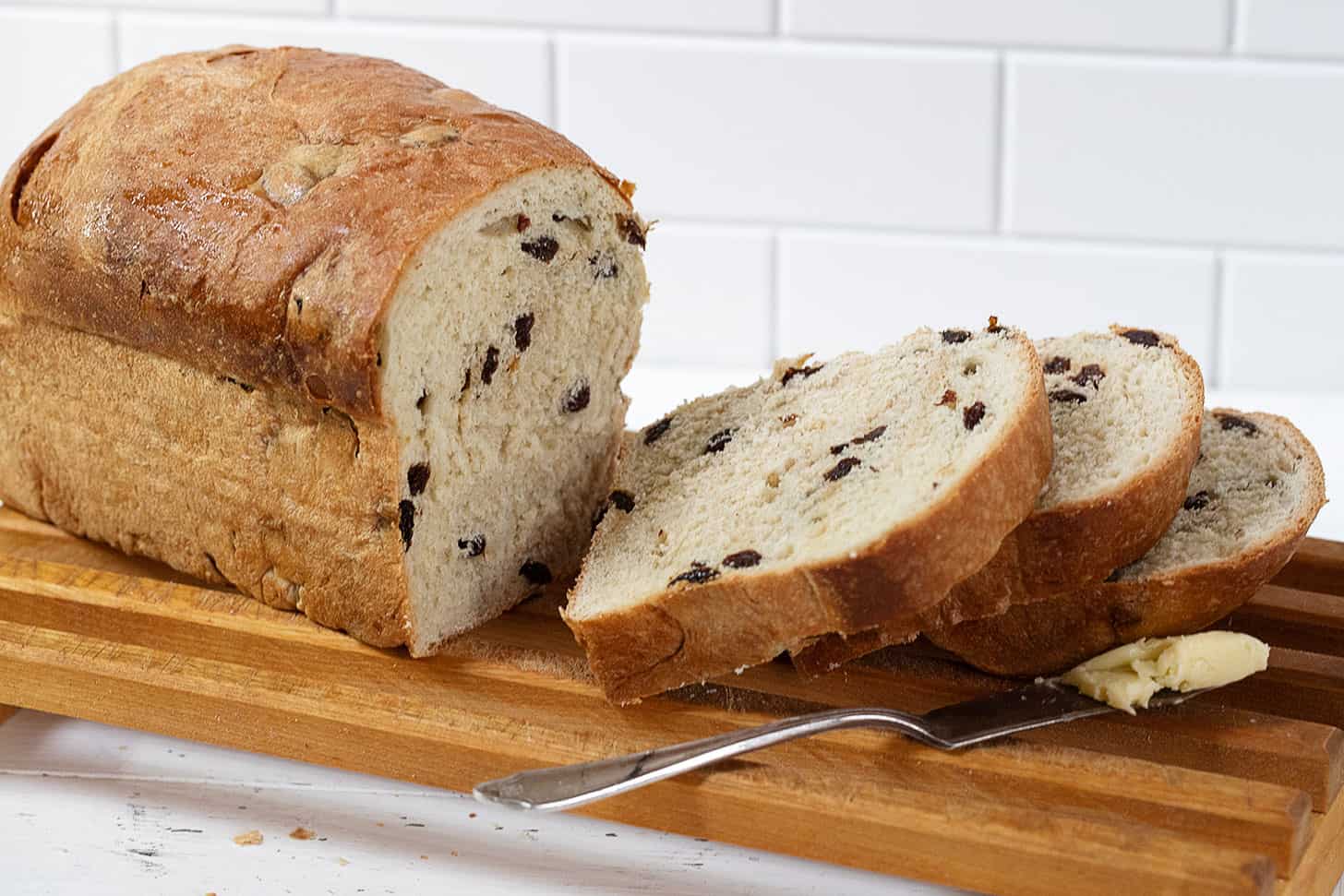
Classic raisin bread: at a glance
This classic raisin bread (without cinnamon) is in regular rotation in my kitchen. It’s one of my favourites and there are lots of reasons to love it!
- First, this bread makes great toast, so it is perfect for morning enjoyment. And if you think you’ll miss the cinnamon, try adding cinnamon sugar to your toasted raisin bread.
- Secondly, it also makes great sandwich bread. Yes! Try it with a turkey, havarti (or Swiss) and sprouts sandwich and I think you’ll agree :)
- When the end of the loaf starts to dry a bit, use it for delicious French toast or bread pudding.
- This bread freezes beautifully and you can easily double the recipe, if you’d like to double your pleasure and stash some away in the freezer to enjoy anytime.
Why this classic raisin bread works
great toast, sandwiches, freezing, non‑cinnamon angle, scalded milk, plumped raisins)
Ingredients and suggested substitutions
A few notes about the key ingredients …
Raisins – You can use any kind of raisin you like. I have used Thompson raisins here. I have also used Sultanas and Golden Raisins in the past. You can use what you have, what you prefer, or use a mixture, if you like.
Milk – Milk in yeast bread doughs provides wonderful flavour and texture. Whole milk (3%) will produce the nicest results, but any milk will work. That said, if you aren’t wanting to use dairy, you can replace it with an equal amount of water.
Butter – Like the milk, the melted butter provides nice flavour in this loaf, but can be replaced with an equal amount of liquid oil, such as vegetable, canola or any neutral-tasting oil.
Flour – unbleached all-purpose flour is always my first choice for yeast bread baking. If you don’t have unbleached, regular all purpose flour is fine. If you only have bread flour, it can be used, but you will probably need less flour over-all. If you like, you can replace up to 1 cup of the all purpose flour with whole wheat flour. (You may need less flour over-all if you add whole wheat flour and your loaf will be more dense in texture.)
Yeast – You can use either active dry yeast or regular instant yeast here (such as SAF Brand). As this is a classic two-rise recipe, rapid or quick rise yeast isn’t recommended here.
Recipe testing notes and tips
- Scalding improves yeast performance and loaf texture – It is often suggested that milk used in yeast breads be scalded. That just means heating it to 181F. The heating process denatures the whey proteins in the milk, which tend to inhibit yeast activity. If you don’t mind the extra step, it’s a worth it, in my opinion. Just be sure to have a thermometer to be sure you heat it to 181F and then it’s very important to let it cool sufficiently before add your yeast. Again, use a thermometer to test. You want the milk to cool to 105-110F for active dry yeast. Instant yeast can handle a little warmer, up to 125F.
- Plumping prevents the raisins from stealing moisture from the dough – As raisins are by nature a dehydrated fruit, the process of “plumping” them by soaking in hot water is just returning some hydration to the fruit. Not only are they lovely in the bread after plumping, but they don’t soak in any of the moisture from the dough, which un-plumped raisins can, drying out the dough and the resulting loaf.
- Plump raisins by soaking them in very hot or boiling water for 10-15 minutes. Drain and pat dry. I like to toss them in a bit of flour when adding to bread, as it helps them grab onto the dough and incorporate more easily and quickly.
- Hiding the raisins in the dough – if you’ve ever tasted a burnt raisin, you know that it’s not a pleasant flavour. It’s bitter and unappealing. The best tip for raisin bread is to be conscious of keeping all the raisins inside the dough and not exposed on the outside of the dough after your form it into a loaf. Push any exposed raisins into the dough and you won’t have any bitter raisins to deal with after you bake your loaf.
- Always add flour gradually so the dough reaches the right consistency in your kitchen – While all yeast bread recipes include a quantity for the flour, it will never be exact, as flour brands or humidity can vary from kitchen to kitchen. As such, you never want to just dump the specified quantity of flour into the bowl all at once. A good rule of thumb is to add 3/4 of the specified flour and mix in well. Then, if needed, continue adding more flour, in very small increments, mixing between additions, until your dough is the desired consistency. Generally you’re looking for a smooth, moist, but not sticky dough, that wraps around the kneading hook and cleans the bowl.
- Cinnamon – This is a classic raisin-only bread, which is a different bread from a cinnamon raisin bread. If you really want to add cinnamon, you could add some (a teaspoon or so) to the dough, but keep in mind that cinnamon is a yeast inhibitor, so its presence in the dough will slow the rise. Be prepared to extend the noted rising times. (This is why you often see cinnamon raisin breads swirled/rolled in the dough, rather than mixed with the dough, to prevent slowing the yeast.)
Classic raisin bread FAQ
Yes, you can replace up to 1 cup of the all-purpose flour with whole wheat flour. As whole wheat flour will absorb more of the liquid, you may need to reduce the amount of all-purpose flour slightly to achieve the correct dough texture.
While you could add cinnamon to the dough, cinnamon is knows to inhibit or slow yeast dough rising. If you add it, expect the rising times to be longer.
Yes, you can. Place the dough into the greased bowl, but place into the fridge instead of dough the first rising period. The next day, remove from the fridge, shape into a loaf, place into a loaf pan (well-covered) and allow to rise before baking. As the dough will be cold, the rising time could be up to 2 hours.
This classic raisin bread is perfect for French toast or cube it up and use it for bread pudding or bread pudding muffins.
Yes, simply double all the ingredients, divide the dough in half and bake in two loaf pans. You can use the “2X” button at the top of the Recipe Card to automatically double all the ingredients.
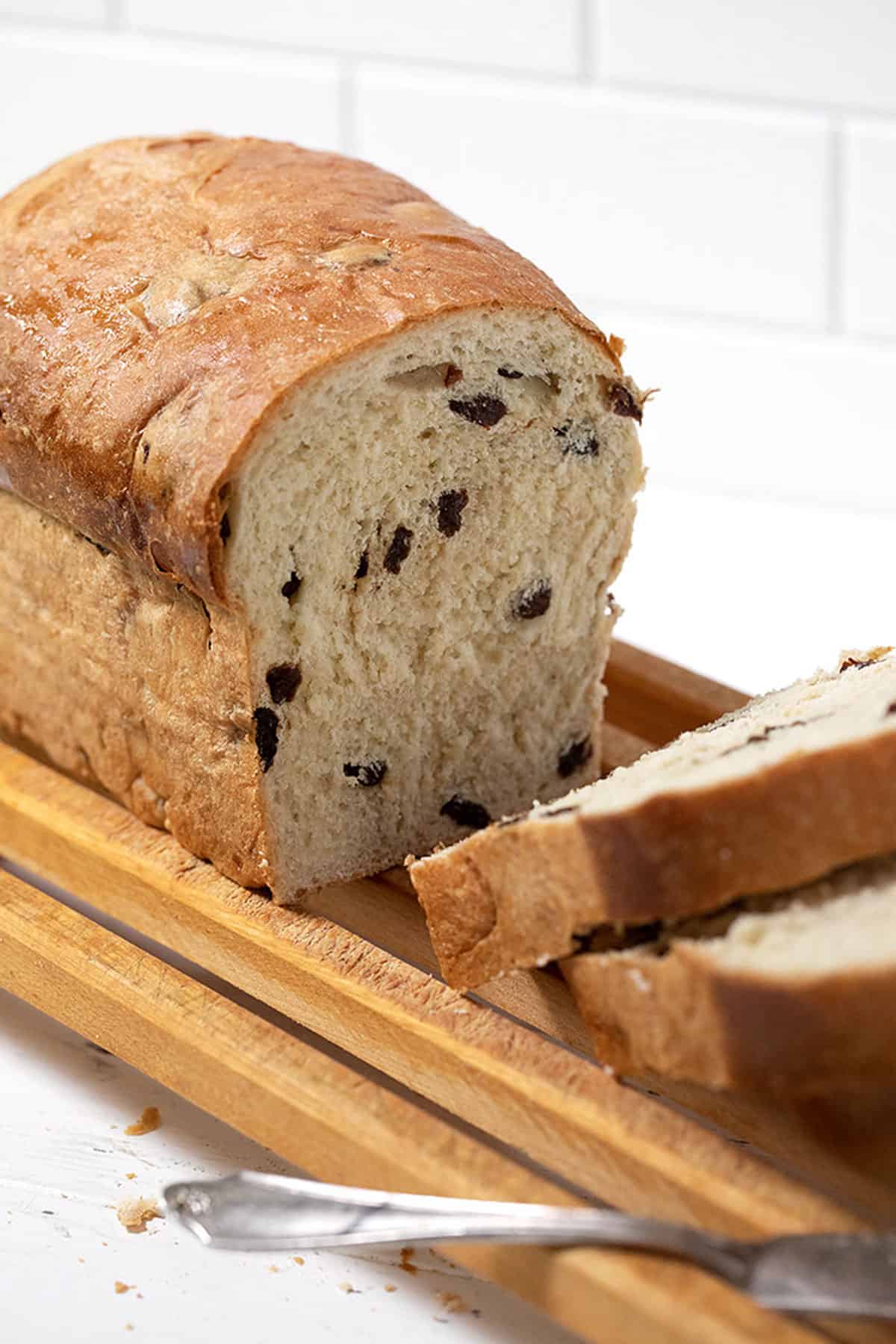
Storing and freezing raisin bread
Store cooled bread in an airtight container at room temperature for 2-3 days. You can extend the shelf life by refrigerating.
This bread will also freeze well up to 2 months.
For more freezer‑friendly loaves, see my light and fluffy multigrain sandwich bread and soft cheese bread.
Want to save this recipe?
Enter your email and I’ll send it to your inbox. Plus, you’ll get great new recipes from me every week!
By submitting this form, you consent to receive emails from Seasons and Suppers.
You can unsubscribe at any time.
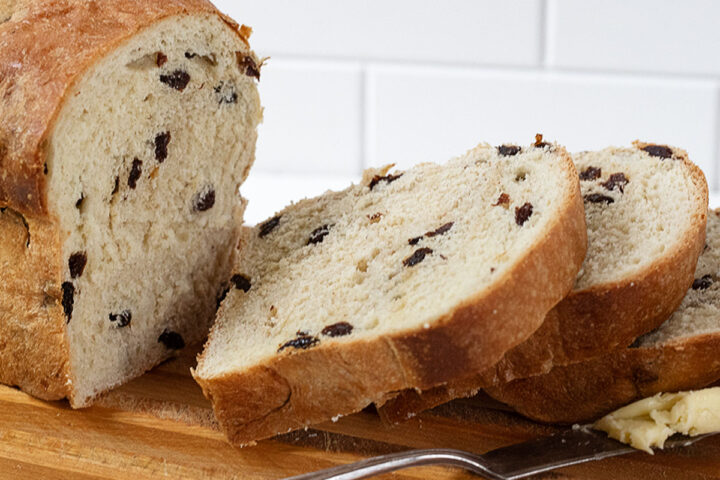
Get the Recipe: Classic Raisin Bread
Ingredients
- 1 cup (240 ml) milk, scalded *see instructions below
- 1 cup raisins, plumped *see instructions below
- 3 cups (375 g) all purpose flour, unbleached recommended, spooned and levelled
- 2 1/4 teaspoons active dry or instant yeast
- 1 1/2 Tablespoons white granulated sugar
- 1 teaspoon fine table salt
- 1 1/2 Tablespoons butter, melted and cooled, salted or unsalted
- 1 large egg
For glazing after baking:
- 2 Tablespoons white granulated sugar
- 2 Tablespoons hot water
Instructions
- Scald the milk: Heat the 1 cup milk (scalded *see instructions below) in a small saucepan on the stove-top over medium heat, stirring occasionally, until it reaches 181F. (If you don't have a thermometer, this will be when the milk starts to steam and small bubbles form around the edges. Don't let the milk boil! Pour milk back into the measuring cup and let stand until cooled to lukewarm or about 105F.
- **If using active dry yeast, add the yeast to the lukewarm milk. *Ensure it has cooled to lukewarm. If it's too hot, it may kill the yeast. Stir in and let stand 5 minutes.
- Plump the raisins: Add the 1 cup raisins (plumped *see instructions below) to a small bowl. Cover them with very hot water and let stand until needed.
- In a large bowl or the bowl of a stand mixer fitted with the kneading hook, add 2 cups of the flour, the instant yeast, the 1 1/2 Tablespoons white granulated sugar and 1 teaspoon fine table salt. Mix briefly to combine.
- Add the lukewarm milk (or milk/yeast mixture if you used active dry yeast) to the flour mixture. Add the 1 1/2 Tablespoons butter (melted and cooled, salted or unsalted) (*be sure it is cooled so it doesn't cook the egg you will be adding next :). Add the 1 large egg. Knead to combine well. Start adding the last 1 cup of flour, in small increments, kneading in after each addition, until the dough wraps around the hook and cleans the bowl. You may not need to use all of the amount of flour or you may need a few Tablespoons more to reach this point.
- Drain the raisins, dry them with paper towel and toss them in a little flour. Add the raisins to the dough in the mixer or bowl and mix to combine. Add a bit more flour, if needed to reduce the moisture and encourage the raisins to knead into the dough. Knead the dough for another couple of minutes.
- Remove the dough to a floured surface and knead briefly by hand (1-2 minutes), until smooth. The dough should not stick to your hands or the work surface. Add a bit of additional flour if it is sticking. Form into a ball.
- Place dough into a greased bowl, cover tightly and let rise until doubled is size, about 1 hour.
- Remove dough to a lightly floured surface and pat into a rectangle about 9 inches long and 5 inches wide. Bring the edges along the long side in towards the centre and pinch together. Flip the loaf over. Push any exposed raisins back into the dough, so they don’t burn. Place into prepared loaf pan. Cover and let rise until doubled, about 45 minutes.
- Grease an 8 1/2 x4 1/2-inch loaf pan and set aside.
- Preheat oven to 350F. (non convection/not fan-assisted)
- When loaf is ready, bake in the preheated oven for about 35 minutes or until it reaches an internal temperature of 190F or until the loaf sounds hollow when tapped on the bottom and feel firm but not hard. **Check loaf after 25 minutes of baking. If the top of the loaf is dark enough already, lay a sheet of aluminum foil loosely over the top of the loaf to prevent further browning. Continue baking until the loaf is done.
- Remove from oven and immediately remove from the loaf pan to a cooling rack. While the loaf is still hot, mix up the sugar/water glaze and brush the top of the loaf. Allow the loaf to cool completely before slicing (cutting into a hot yeast bread can create a gummy crumb).
Notes
More bread recipes to love!
Hi! I’m Jennifer, a home cook schooled by trial and error and almost 40 years of getting dinner on the table! I love to share my favourite recipes, both old and new, together with lots of tips and tricks to hopefully help make your home cooking enjoyable, stress-free, rewarding and of course, delicious!


Can you use honey instead of sugar
Hi Kathy, you could. You would need less honey than white sugar for the same sweetness. It may also affect the hydration slightly, so you may need a touch more flour.
can molasses be added to this recipe ?
Hi Dale, you could try adding some molasses, though you would have to adjust for the extra liquid with a bit more flour more than likely.
Greetings from Queensland, Australia. I made your Classic Raisin bread recipe today for the first time. My wife of 62 years (I’m 85 this year) thought it was the best fruit loaf she has ever tasted. I loved it, too. Thank you for the detailed explanations.
Hi Phil! So glad you enjoyed it. Thanks so much :)
Delicious!!!
Thanks Jacquie!
Fantastic Raisin Bread …. I didn’t have carton milk so I used evaporated milk … had to add some extra liquid (I used warm water) and in turn a little extra flour .
Turn out perfect, awesome texture with great taste!
So glad you enjoyed this bread, Bonny. Thanks so much!
I have made this recipe many times & added cinnamon every time. It’s never affected the rise. I add it to the dough before I add the raisins & more flour to make it just right.
Glad you are enjoying it Kelly. Cinnamon in the dough doesn’t affect the rise per se. It will still rise. It will just be slower. It’s all good if you are an experienced baker, but can present issues for new bakers who don’t expect the slower rise.
Oddly, I only had currants on hand and no raisins but decided to have a go anyway. This was a super easy recipe, the directions are spot on, and the result was so pleasing. I put it in my smallest loaf pan, a 4X8 and got a beautiful high loaf. Both risings went well. Delicious bread with a lovely moist crumb. A real success I’ll make this again.
So glad to hear, Lilly :) Thanks so much!
Hi I have a question: I have extra buttermilk – could I substitute buttermilk for milk in this recipe?
Hi Ann and yes, buttermilk should work fine in place of the milk. I have found the extra acidity of buttermilk sometimes slows down the rise a bit, but other than that it shouldn’t cause any issues. Enjoy!
Could I use dried cranberries
Or a half of each instead?
Also wonder if I could add nuts?
Hi Marcy, I find with yeast bread you can add pretty much any dry ingredients (such as dried fruits, nuts or seeds) kind of at will, as they don’t affect the hydration of the dough at all. So you can mix it up and add these things as you like without issue.
My first attempt at making raisin bread. Bottom line: I can’t believe how good this is. Will make again. Thanks.
So pleased you enjoyed it, Sonia. Thanks so much!
Does this recipe work well in a bread maker and if so are the measurements the same and what is the procedure?
Hi Randy, I have never used a bread make so I don’t exactly know. I suspect that you can use the same measurements as this is a 1 lb. loaf and most bread makers are that size (I think). If yours is 1 1/2 lb. size, you can simply increase the ingredients by 1/2. As for the method, use the bread maker to make the dough itself, minus the raisins (which might be smushed by the kneading of the machine. Remove the dough from the machine and knead in the raisins before rising. Hope that helps.
This is a brilliant recipe. I’ve made it several times.
So glad you are enjoying it, Richard. Thanks so much!
Jennifer, this is a great recipe! I am a novice in the kitchen, I really like it but quite often it doesn’t like me. I followed your instructions and your tips to the letter and it turned out a perfect loaf! I hope the ensuing guard dog noises as we consumed it
Didn’t frighten the neighbours. I’ll be attempting a rerun shortly, thanks girl, it made me an instant kitchen hero!
I’m so glad to hear! Thanks so much and enjoy the bread :)
Why does this bread not rise like your photo? Should I make 2;loaves from this recipe or only one?
It tastes good, but I don’t know why it does not rise higher. Thank you
Hi Kathie and I’m happy to help. First, the bread does rise like the photo, since I made that bread and then took a photo of it and that’s exactly what it looked like when I baked it :) It makes one loaf. If your bread isn’t rising like that, then there is something you are doing that I didn’t do. I’m happy to help you troubleshoot it. Are you using the correct loaf pan size (8 1/2 x 4 1/2 inches)? What type of yeast are you using? Are you a beginner or experienced bread baker? Are you sure that you know when the dough has doubled for the first rise and when the second rise is ready for the oven?
This is definitely a keeper, I didn’t have raisins yesterday so I used currants – oh so tasty – today making another loaf using raisins & I’ll be gifting this to girl at work. I’m not losing this recipe!!! 😋
I’m so glad you enjoyed it, Johanna :) Thanks so much!
I have been baking since I was a kid…I’m a young 60 now..bread has always been my fear…
I have a client that loves raisin bread..they are from Netherlands..
I promised to make it..I have been facing the bread fear..piroshki and no knead breads have been fun..
Made your raisin bread and it turned out perfect!!
Thankyou so much!!
Just about to take it out of oven!!
I did soak my raisins in water and whiskey:)
Nice subtle flavor:)
So glad to hear, Milia! Thanks so much :)