

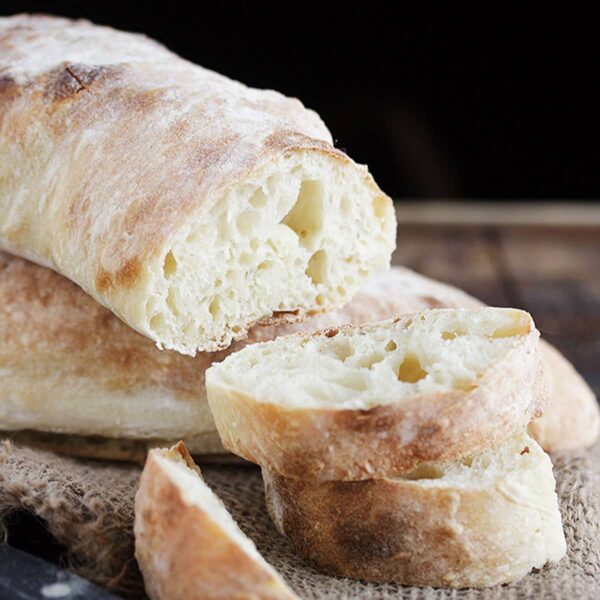
Delicious homemade ciabatta bread is not nearly as hard to make at home as you may think! This ciabatta recipe is great for first-time ciabatta bakers!
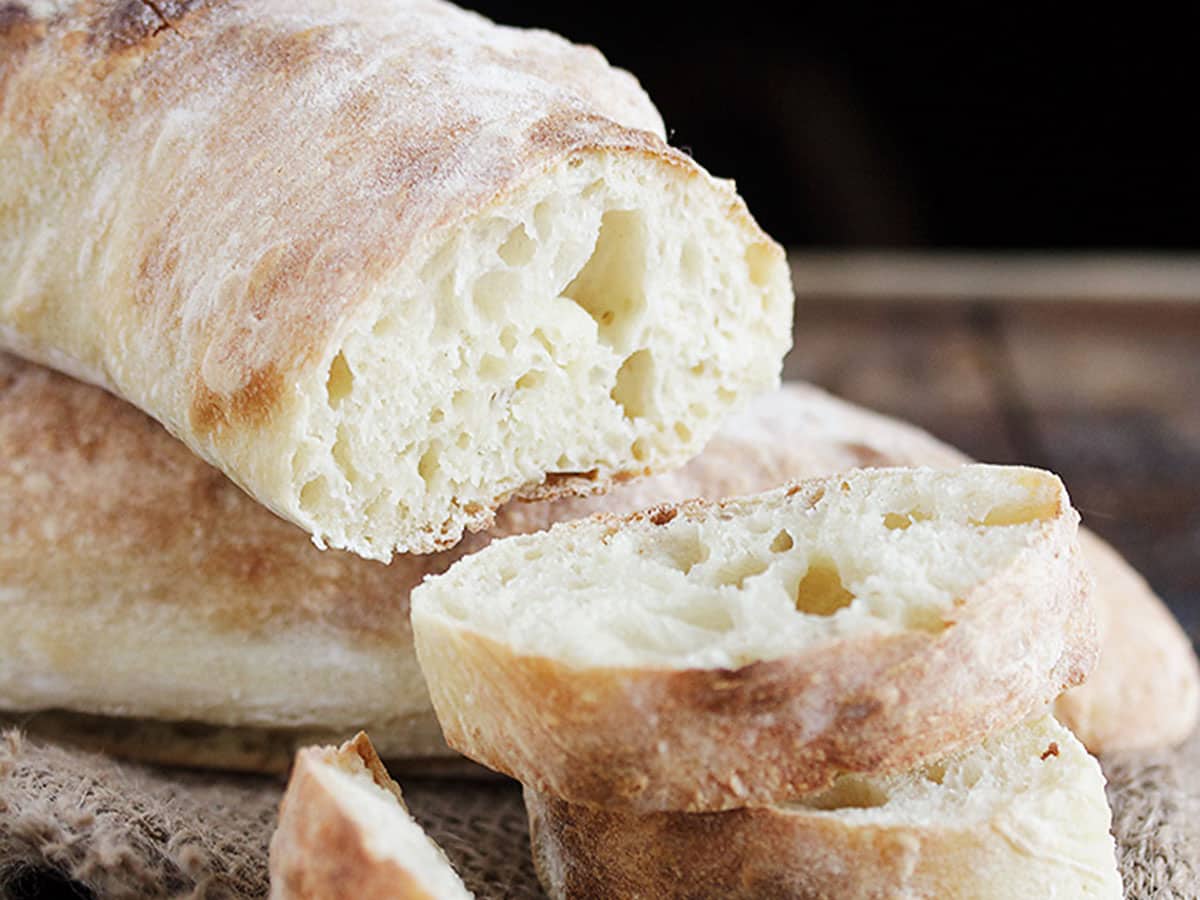
If you’re anything like me, the weekends are when I really dig in to cooking and baking projects. So in that spirit, I thought I’d share a great recipe for making this delicious ciabatta bread recipe this weekend. It’s not nearly as hard to make as you might think.
I’m not going to lie though, this is probably not the bread that should be your first bread-baking experience. It’s somewhat unique in both it’s consistency and method. That’s not to say it’s hard – just different :)
Ingredients and Substitutions
Flour – Bread flour will always give the best results when making ciabatta, but all purpose flour will technically work, with a bit of a compromise on texture. You may find you need a little extra flour is using all purpose flour.
Yeast – I only use SAF Instant Yeast for all my yeast baking. I highly recommend it. Regular Active Dry yeast will also work.
Making this ciabatta bread
This bread starts with a yeast “starter” dough. I like to mix it up quickly before going to bed and then let it bubble away on the counter over-night. Then the next morning, I can just carry on with making the bread.
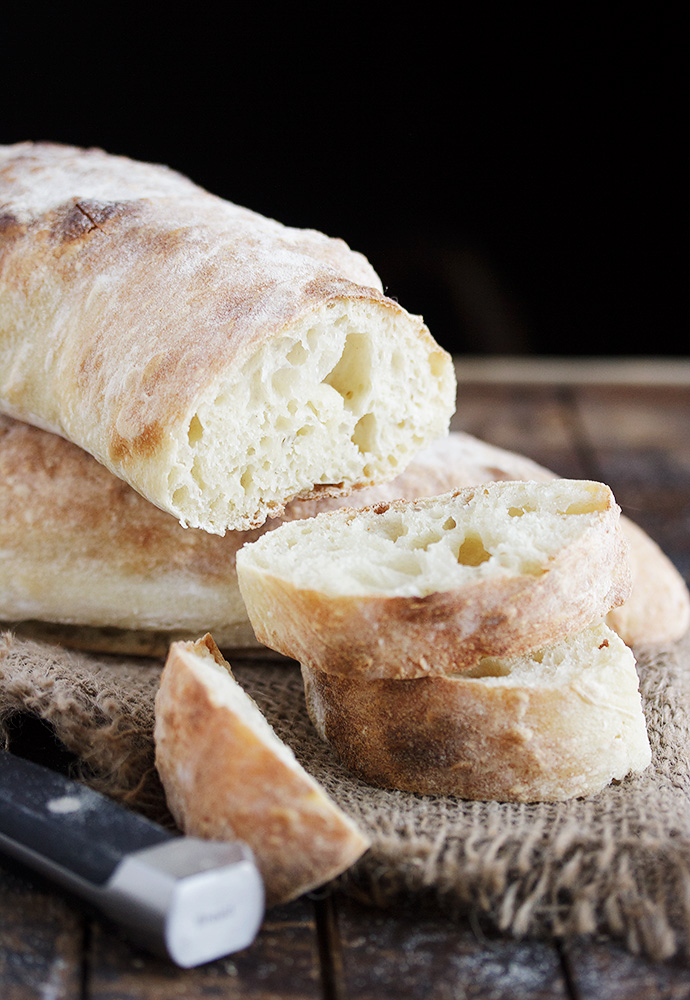
Once you mix the dough, you’re immediately going to notice that you have more of a batter than a dough. Resist the urge to add more flour at this point. The secret to those great holes it to have a really moist dough and the more flour you add, the more you’ll be defeating that.
This is not a bread dough that will ever be kneadable!
That said, you will need to add a little bit of flour along the way here. Purists will suggest flouring your hands (or even wetting them to deal with the dough). That’s great advice if you have lots of experience with wet dough. For the rest of us, a little sprinkling of flour here and there is a sanity saver!
Even as you move along with this dough, it will resemble a jiggly mass that seems to be barely holding its shape. Again, just go with it as much as you can, adding only enough flour to remove extreme stickiness.
Recipe Tips
I cannot recommend the use of a silicone bowl scraper enough when dealing with this dough. It’s worth picking one up for this bread for sure – it’s a sanity saver! A metal bench scraper sprayed with cooking oil will also work. If all else fails, a large silicon spatula would be my choice. All these tools will allow you to work this dough without actually touching it with your hands, which is a bonus when working with a sticky dough.
Storing and Freezing
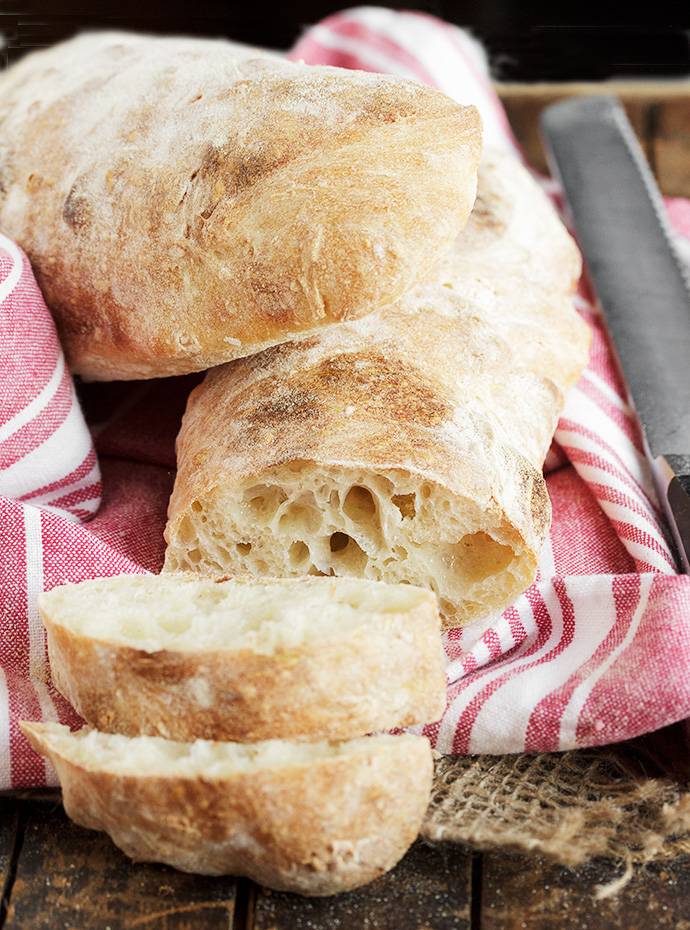
Store baked bread in an airtight container at room temperature for a couple of days, or freeze for longer storage.
Want to save this recipe?
Enter your email and I'll send it to your inbox. Plus, you'll get great new recipes from me every week!
By submitting this form, you consent to receive emails from Seasons and Suppers.
You can unsubscribe at any time.
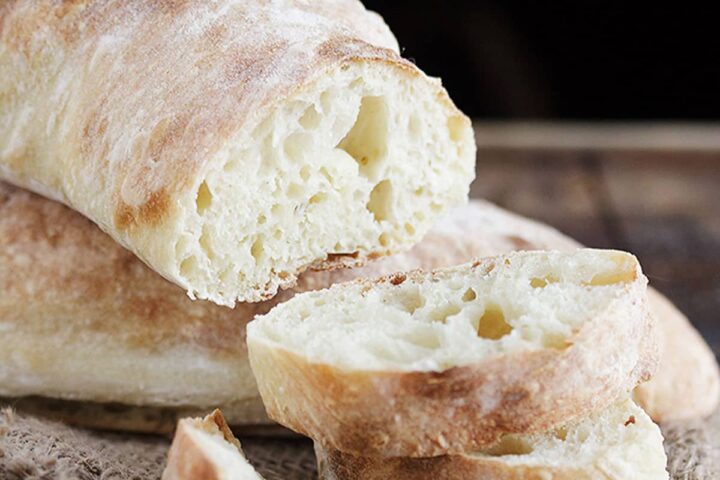
Get the Recipe: Homemade Ciabatta Bread
Ingredients
Yeast Starter Dough: (Start 8-12 hours ahead - the night before works perfectly)
- 1/2 teaspoon active dry yeast or instant yeast
- 3/4 cup (177 ml) water, at room temperature
- 1 cup (125 g) bread or all-purpose flour, bread flour recommended
Ciabatta Dough:
- 1/2 teaspoon active dry yeast or instant yeast
- 3/4 cup (177 ml) water, at room temperature
- All of the Yeast Starter Dough From above, plus the following:
- 2 cups (250 g) bread or all-purpose flour, bread flour recommended
- 1 1/2 teaspoons salt
Instructions
- This bread dough is very moist and loose, but only use as much additional flour as you need to be able to handle it without it sticking. Be sure to start your starter dough 8-12 hours ahead of when you want to make your bread.
- For the Yeast Starter Dough: Combine all ingredients in a 1-quart (4-cup) bowl and stir well. Cover with plastic wrap and allow to sit at room temperature for 8-12 hours (overnight works perfectly).
- For the Ciabatta Dough: In a large bowl or the bowl of a stand mixer fitted with a paddle attachment, stir the yeast in to the water. Add all of the Yeast Starter Dough that you made earlier and has been sitting. Mix briefly. Add the flour and salt and mix to combine. Beat on medium-low for 3 minutes. Stop the mixer and let dough rest for 10 minutes. Beat again on medium-low for 3 minutes. Stop again and let dough rest for 10 minutes.
- Remove dough to a lightly oiled bowl large enough to hold double the amount of dough. Cover the bowl with plastic wrap and let the dough rest until it starts to puff up, about 30-45 minutes.
- Using a silicone bowl scraper or spatula, scrape the dough on to a well-floured work surface. Have a cup of flour handy to use. Sprinkle the top of the dough with some flour. Using your silicone bowl scraper, scoop up one edge of the dough and fold it over the top of the dough to reach the middle. Scoop up the opposite edge and scoop it up to cover the fold you just made. Add some more flour to your board and the top of the dough (just enough to control stickiness). Let dough rest for 15 minutes and then repeat this same folding. Let rest another 15 minutes.
- Line a baking sheet with parchment paper. Sprinkle the parchment paper with flour. Roughly shape the dough in to an 8x8-inch square . Using a sharp knife, cut your dough into two 4x8-inch rectangles. Gently transfer to the parchment-lined baking sheet by using a bench scraper positioned underneath the rectangles to support it. Flour the top of the dough then cover with a tea towel and allow to rise until puffy, about 30 minutes.
- Meanwhile, preheat oven to 475° F. (regular bake setting/not fan assisted)
- Bake in the preheated oven for 20-25 minutes, or until deep golden brown and the internal temperature is over 200° Transfer to a cooling rack to cool.
Notes
More Bread Recipes to Love!
Hi! I’m Jennifer, a home cook schooled by trial and error and almost 40 years of getting dinner on the table! I love to share my favourite recipes, both old and new, together with lots of tips and tricks to hopefully help make your home cooking enjoyable, stress-free, rewarding and of course, delicious!


I have a question. When you divide the dough for the final rise, the instructions say to let it rise, then place it on the baking sheet. Could you place it on the baking sheet and let it rise there, thus not disturbing it and risking deflating the dough? I made a different recipe last week and clearly added too much flour, so I was looking for a different recipe and more instruction – which you have provided! Thanks in advance for answering my question.
Hi Nancy and yes! I thought maybe I had updated it, but I actually let it rise on parchment, then transfer it to the baking sheet on the parchment, for the reasons you stated.
Omg. This recipe is INCREDIBLE. This was my first time making it and it’s so good. I am saving this recipe forever. My whole family loves it. Thank you!!!
So happy to hear, Holly :) Thanks so much!
Made this to a T using all purpose flour and it was incredible. Better than any I’ve had from Italian bakeries even. So to anyone knocking this recipe, I have to say, it is definitely a problem on your end.
Thank you very much for this one, will be making it again 100%
So glad to hear, Mike :) Thanks so much!
Omg. This recipe is INCREDIBLE. This was my first time making it and it’s so good. I am saving this recipe forever. My whole family loves it. Thank you!!!
Hi, made this recipe yesterday and was somewhat disappointed. Dispite following all the wait/rest/ride times, my bread was flat and had little to no bubbles/holes in it. Any suggestions. More yeast in the starter/dough? More waiting?
Hi Dan, ciabatta is a tricky bread to make and it’s rare to nail it on the first try. This recipe will work as written. This is a super wet dough, so the problems usually arise from adding too much flour (thinking it should be a kneadable dough). The dough should be a little bit like silly putty, where the best you can do is flop it around with a silicone scraper. It’s that high hydration, wet dough that will produce the big holes you are looking for. You know you are on the right track if you can’t handle the dough with your hands because it’s too wet. Hope that helps a bit. Let me know how your next try goes :)
Jennifer, your recipe is amazingly simple, and quick to prepare. I’ve already had a fair amount of experience with high-hydration baguettes, but ciabbata has its own personality. My only advice to anyone trying this bread is to be patient with the dough, and touch it as little as possible. I actually don’t use much flour in the shaping and folding at all, but you’d be best served using flour as Jennifer advises when first starting. Otherwise, you might find youself with dough all over the counter and your clothes, and a paving block to show for it. :)
Great advice Peter! I remember my first go at this bread and I was trying so hard not to add more flour, but it truly does have its own personality :) Thanks!
So good. first attempt and it was very rewarding!
Glad to hear, Emily :) Thanks so much!
I found the parchment paper burned at 475 degrees. I’ve attempted this now twice with the same results. Anyone else have this issue? Would the baking time be the same at a two of 450 degrees?
Hi Steve, you could reduce to 450F and bake a little longer. Another trick is to trim the parchment mostly away, leaving it just under the bread and a bit of a margin. Parchment won’t scorch underneath, just the exposed parts, so trimming solves that issue.
I’ve tried this recipe in the past with active dry yeast and it turned out amazing! I plan on making this recipe again tomorrow morning (meaning I’ll have to start the yeast starter dough tonight) however, I only have instant yeast on hand. Would substituting active dry yeast for instant yeast negatively impact the end results? Is there anything I else I might have to change (for example, is less time required for the yeast starter dough)?
Hi Dia, As long as it is regular Instant Yeast (such as SAF Brand Instant Yeast) and not rapid-rise or quick-rise yeast, everything should be the same. In only bake with SAF Instant Yeast myself and it behaves just like Active Dry.
I make bread a lot, but I have NEVER made a ciabatta baguette as good as this one! My whole family is in love.
A word of warning though: I thought the “paddle attachment” instruction was unusual for a bread recipe, but I went with it anyway. My mixer sounded louder and rougher than usual, but the dough was definitely not as thick as regular bread dough, and seemed to be doing well otherwise (so shiny and silky!). That was yesterday. Today I made the recipe again and my mixer paddles broke.
I’m switching to the dough hook, and hopefully the results will be as good!
Hi Julie and sorry to hear about your paddle. I have never had that experience. I think the paddle does a much better job with this dough, so you could try decreasing the flour for the first part of mixing (with a paddle), then switch to the kneading hook to add the rest of the flour.
Just made this and it was perfect!! I’ve tried other recipes and they were ok, but this was so easy and turned out exactly the way I wanted it from both taste and texture!
So glad to hear, Larry :) Thanks so much!
Hi Jennifer
I just followed your recipe and taste is awesome.
Thank you
So glad you enjoyed it, Jaya :) Thanks!
I’ve made this several times. It’s always delicious. I found bread flour to create fewer holes and be more dense. The ideal flour IMO is a high protein (4g) all-purpose flour, like a King Arthur’s. My store brand and some of the others are 3g. The slightly higher protein gave the chewiness on the inside that I like and the crustiness on the outside. Bread flour was too firm and 3g all-purpose was too soft.
So glad you are enjoying it! Thanks so much :)
First time baking bread without a bread machine. Went exactly as described and came out great! Thanks.
This is my go to. Love it. I do a couple of things diff. I make the sponge in the mixing bowl. I use my spatula to take sponge of the sides and just add the dough to that mixture. I also add olives here. At the end i add the finished product to the baking sheet right away after splitting the dough and the final rise is on the baking sheet so it does not deflate.. works wonderfully.
So glad you are enjoying it :) Thanks so much!
Made this for the first time but doubled the recipe. When I cut it in two, I thought I might lose some bubbles but it was fine. The tips from the comments were fantastic, especially the silicon spatula, using a dough hook instead of the paddle, and putting the dough on parchment paper. I just picked up the parchment paper and put it on my pan. I also added some ice in a pan to give it an extra crunchy crust. All wonderful suggestions from comments.
I do have one question. Someone said they made it with whole wheat flour. All whole wheat?
So glad you enjoyed it Rose :) To try whole wheat, start with replacing only about 1/4 of the white flour with whole wheat. A 100% whole wheat bread would be very dense.
Hello, I just made your bread! I have a question. The top is beautiful and brown the internal temperature is 200-201. I took it out to cool. Is that hot enough? You said over 200. I just want to make sure all is well. Thank you super excited to try it!
Should be fine, Alexis :) Just be sure to let it cool completely before slicing (I know, it’s hard!). Enjoy!
Thank you! I just cut it up and tried a piece toasted with butter and it was delicious!
So glad to hear, Alexis :) Thanks!
Awesome recipe I am new to baking and the instructions were easy. I don’t have a mixer so I did it my hand I guess that’s on the Xmas list. Thanks again for sharing
So glad to hear, Bik and yes, put one on your xmas list. I love my mixer for so many bakes, but especially for making bread-making easier :) Thanks so much!