

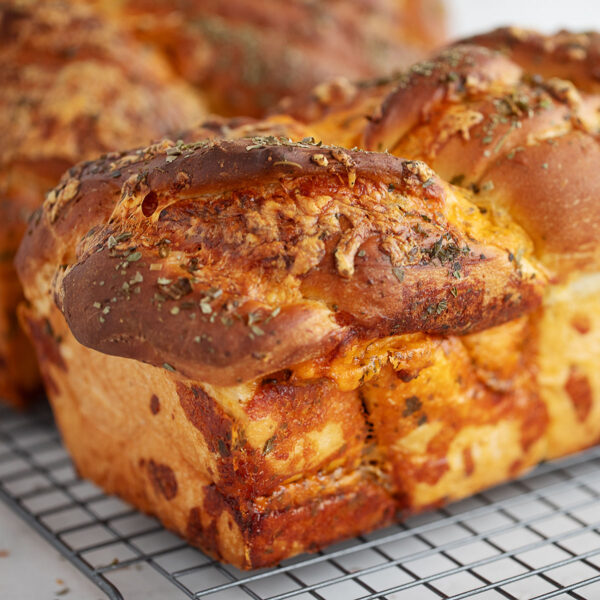
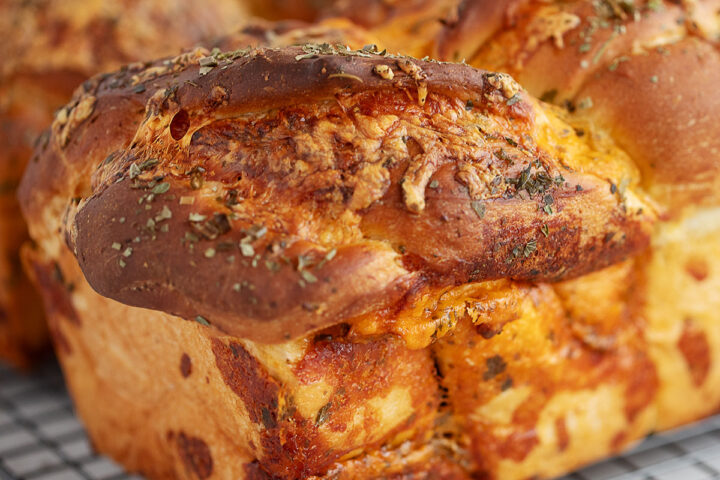
This is my absolute favourite cheese bread recipe! This recipe produces delicious homemade soft cheese bread that’s filled with cheddar cheese and herbs. The dough is a dream to work with, and the twisted shape makes for a beautiful loaf (with none of those dreaded rolled cheese bread gaps).
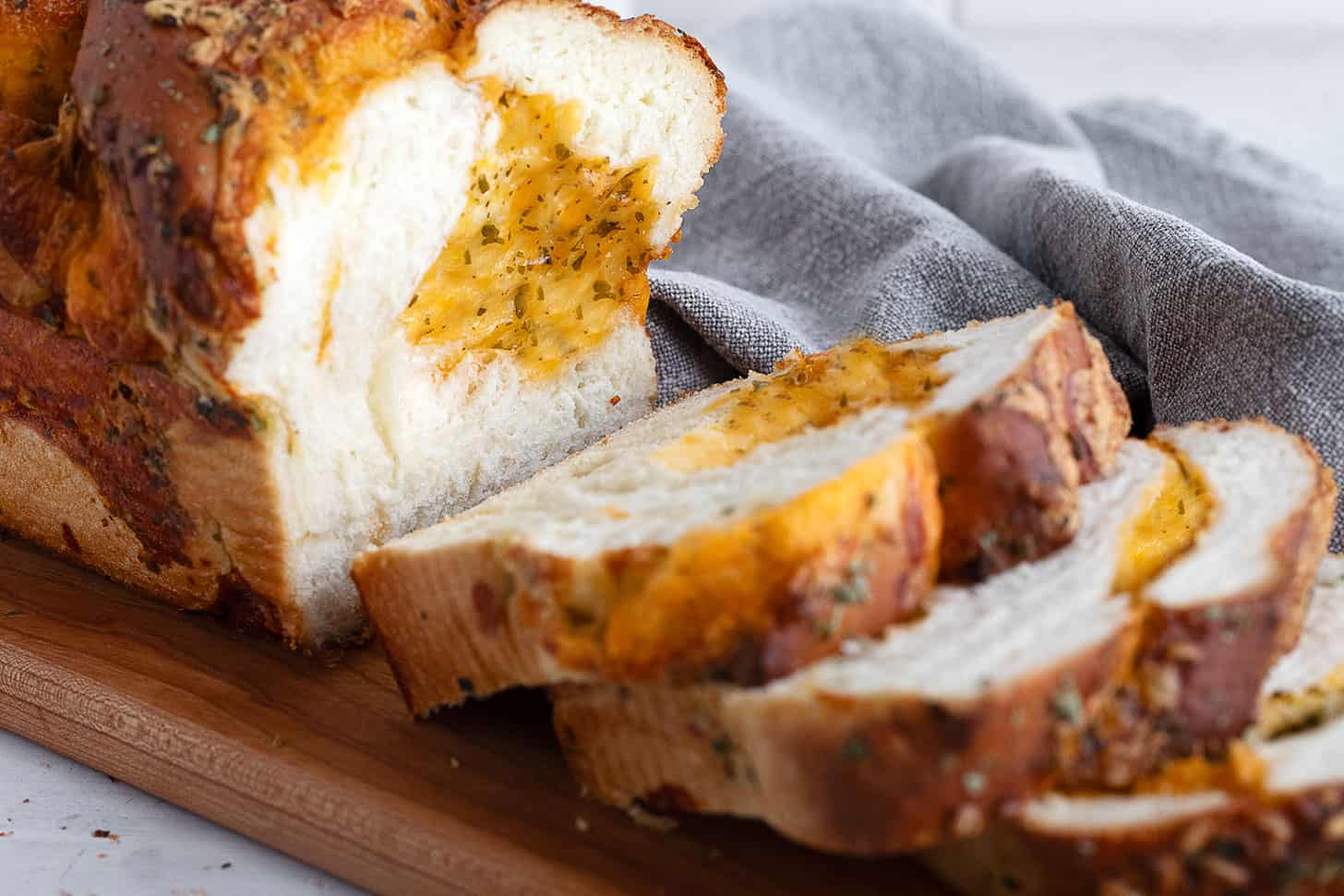
Homemade cheese bread: at a glance.
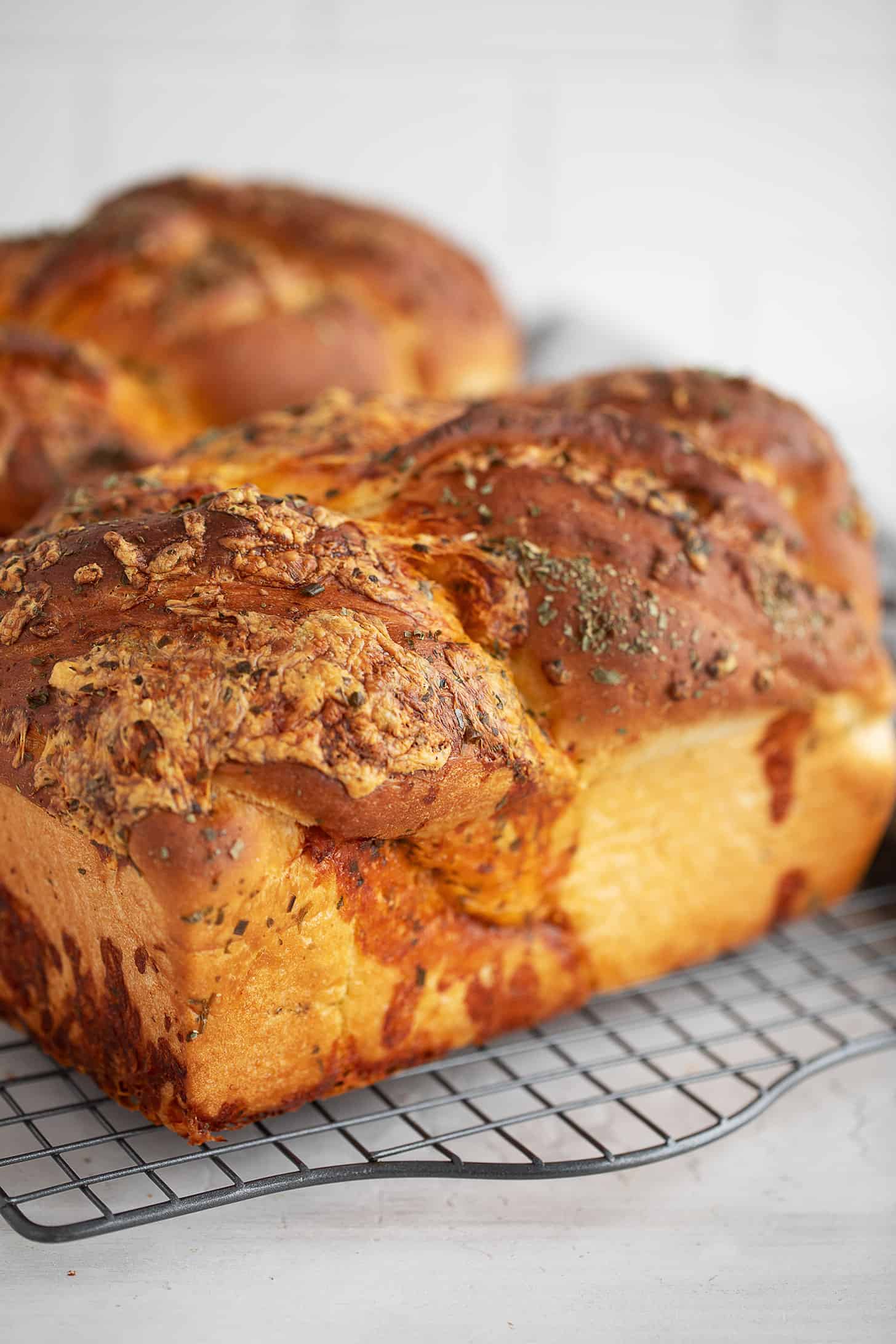
This cheese bread recipe produces two tall, beautiful loaves with veins of cheese running throughout. The crumb is wonderfully soft, yet still perfectly sliceable, so it’s perfect for sandwiches. It also provides a small moment of joy when enjoyed toasted and buttered.
Despite its impressive appearance, this is an excellent beginner bread-baking recipe. As it has ample yeast and sugar, it is a fast-riser, which reduces a lot of guesswork. It is also a beautiful dough to work with, as it is perfectly smooth and moist.
This cheese bread recipe is also endlessly customizable for more or less cheese, different cheeses or cheese combinations, or just about anything else you can imagine adding to the mix!
- Homemade cheese bread: at a glance.
- Ingredients and substitutions
- How to make homemade cheese bread: step-by-step
- How to make homemade cheese bread: video
- Recipe tips!
- New to bread baking? Here is my best advice!
- Storing and freezing cheese bread
- Get the Recipe: Simply Perfect Homemade Cheese Bread
- More cheese bread recipes to love!
Ingredients and substitutions
A few notes about the key ingredients …
Bread flour – High-protein bread flour will provide the nicest texture for your finished loaf. If you only have all-purpose flour, you can use it, but do note that you may need to add a bit more flour to get that moist, smooth dough when using all-purpose flour. The texture of your loaf will be slightly heavier than it would have been if using bread flour, but will still be nice and soft.
Yeast – You can use Instant yeast or Active Dry yeast to make this bread. I recommend and use SAF Brand (Red) yeast for all my bread baking.
Milk – I recommend whole milk (3.5% b.f.) if possible, or at least 2% milk, for best results. Warm the milk just slightly in a saucepan or in the microwave.
Cheese – use a sharp/old cheddar cheese for best flavour and grate it yourself. I find a yellow cheddar cheese makes a prettier loaf, as you can see the cheese, but an old white cheddar also works here.
How to make homemade cheese bread: step-by-step
This is a visual summary of the steps to make this recipe. Scroll down to the Recipe Card below for the complete list of ingredients and instructions.
Start by mixing the bread dough. You can mix the dough in a stand mixer with the kneading hook or in a bowl with a spoon and some elbow grease.
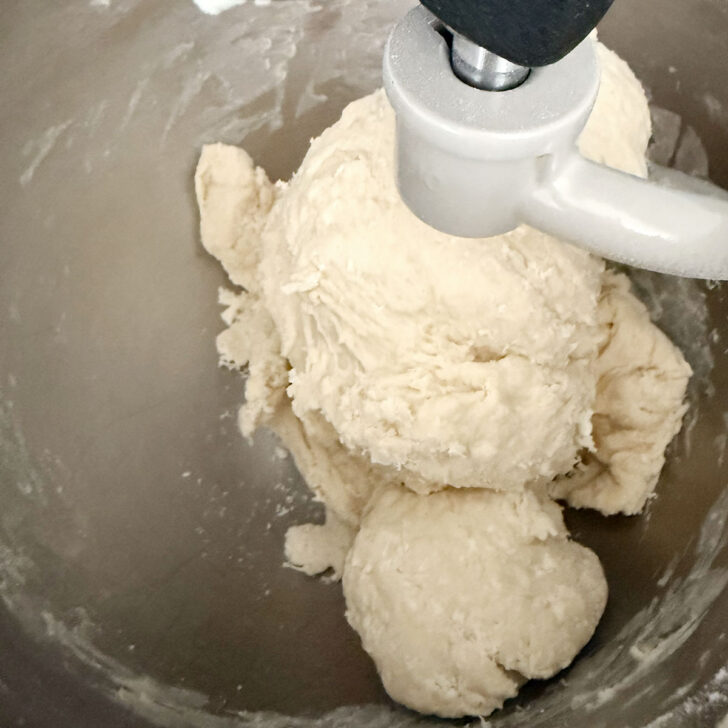
Step 1: Begin by mixing together the dough ingredients into a shaggy, just moistened dough. Let the dough rest for 5 minutes.
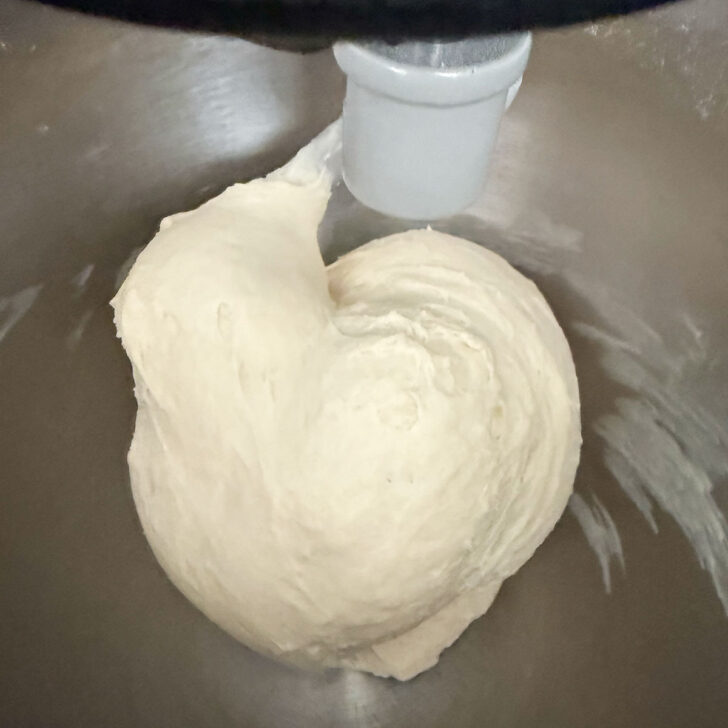
Step 2: Start kneading the dough on Speed 2 on a KitchenAid mixer and knead for 5-7 minutes until you have a smooth, moist dough that wraps the dough hook and cleans the bowl.
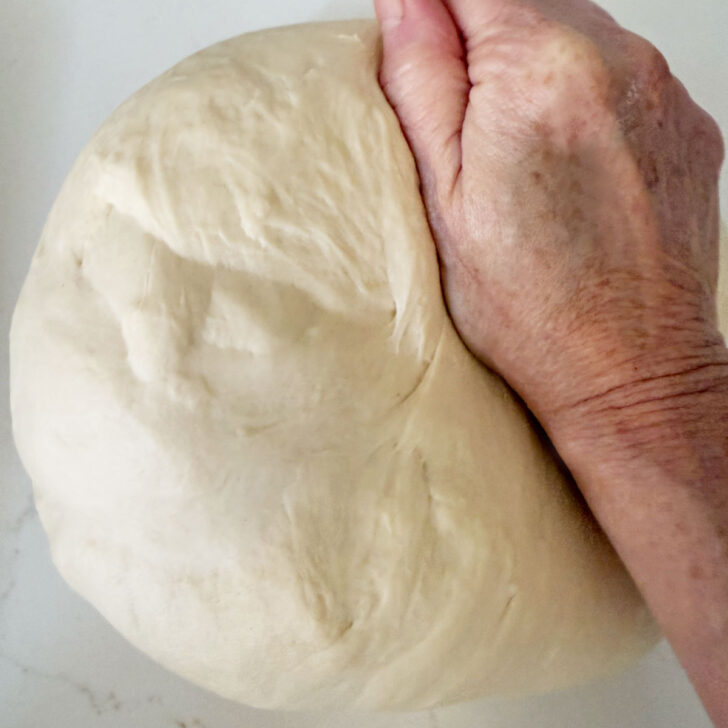
Step 3: Remove the dough to a work surface and knead briefly.
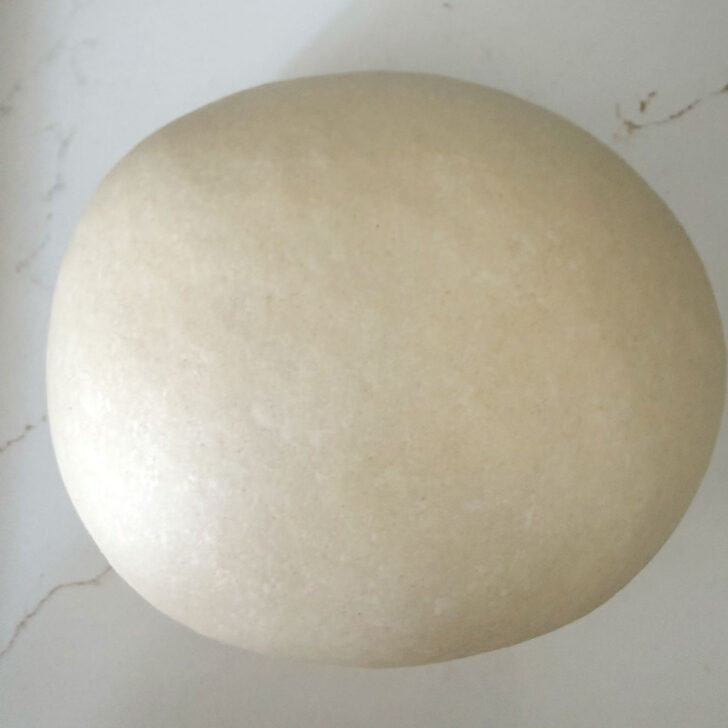
Step 4: Form the finished dough into a ball. It should be smooth like a baby’s bottom!
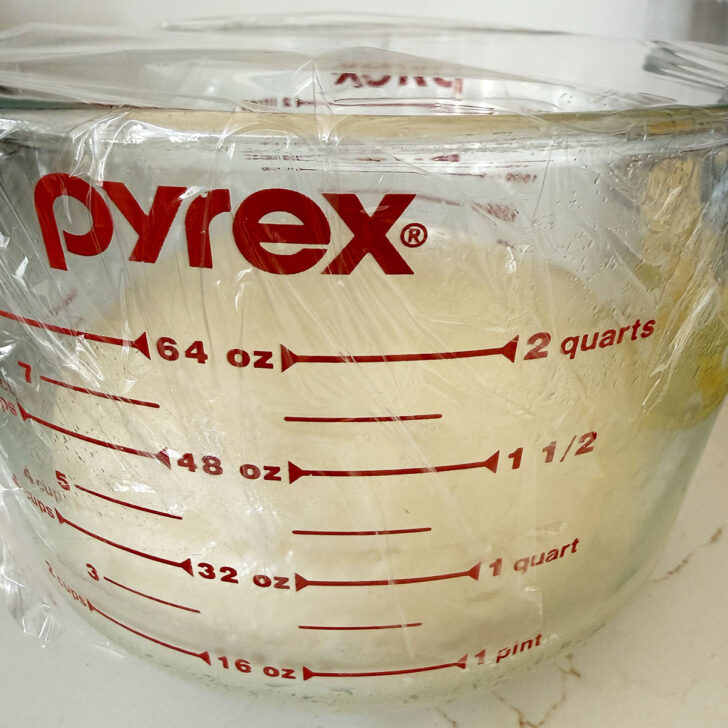
Step 5: Place the dough ball into a greased bowl or large measuring cup to rise.
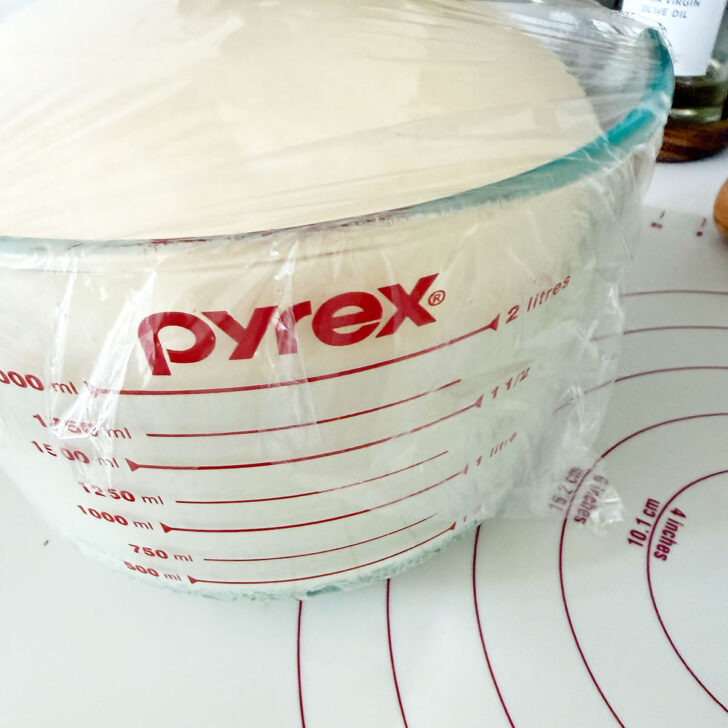
Step 6: Cover and let rise until doubled in size, about 45-60 minutes.
Once the dough has risen, here are the steps to roll, fill and shape the bread loaves.
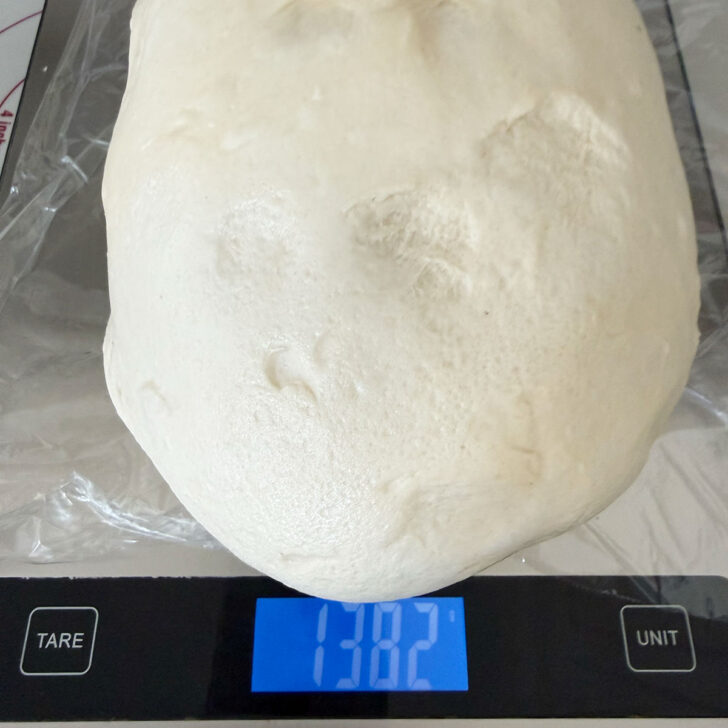
Step 7: If you have a scale, weigh the dough to get the total weight.

Step 8: Divide the total weight by two and weigh out two equal-sized dough balls.

Step 9: Cover one ball of dough with plastic wrap while you work with the other ball.
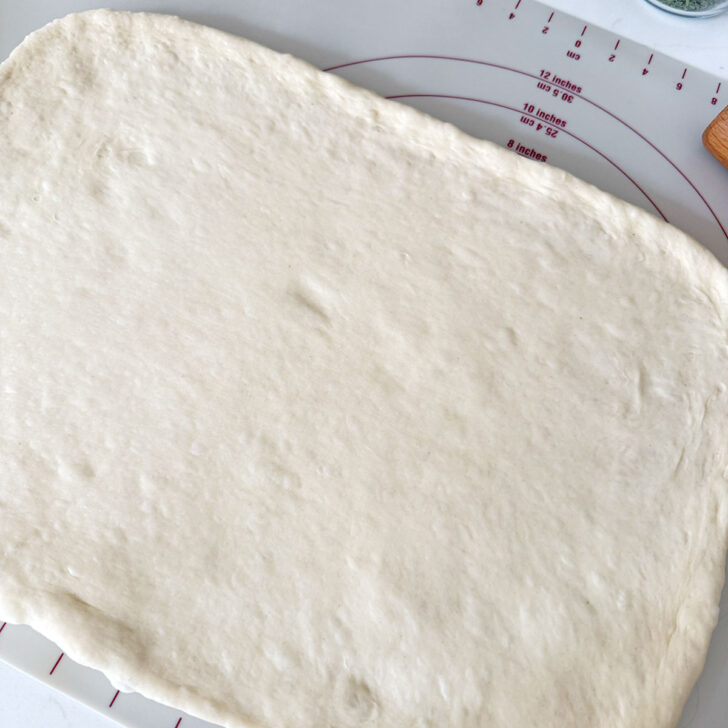
Step 10: Roll the dough ball into a 12×16-inch rectangele.

Step 11: Scatter half of the shredded cheese over the rolled dough and sprinkle with some herbs, if using.
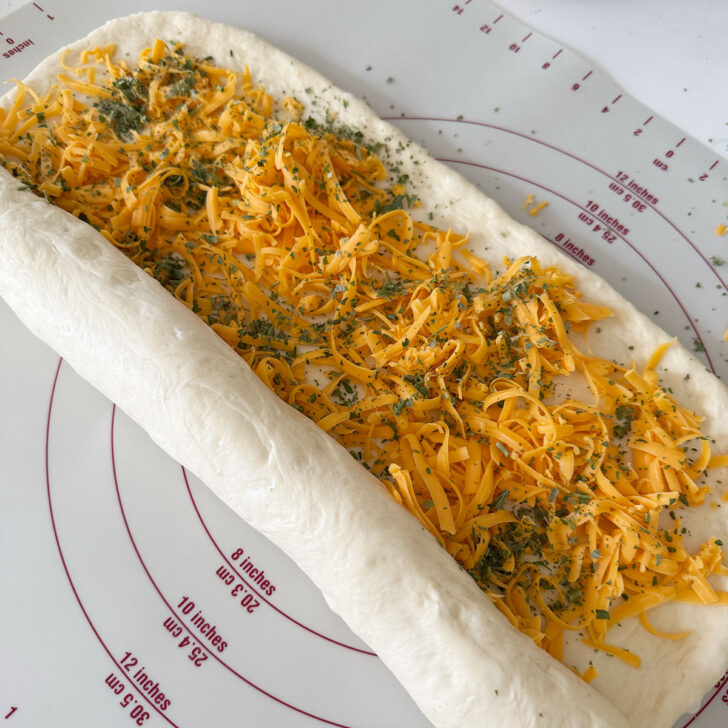
Step 12: Roll the dough up jelly-roll style, rolling from the long side.
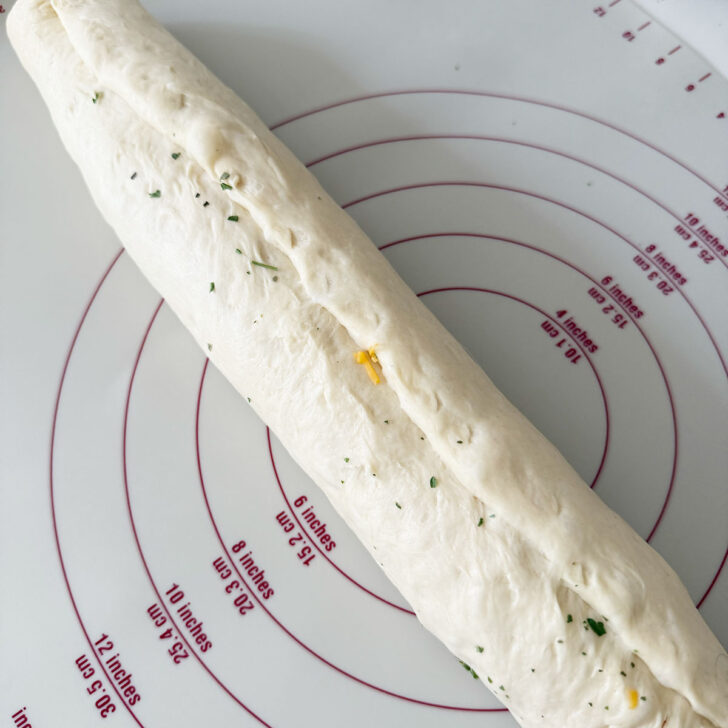
Step 13: Pinch the seam together.
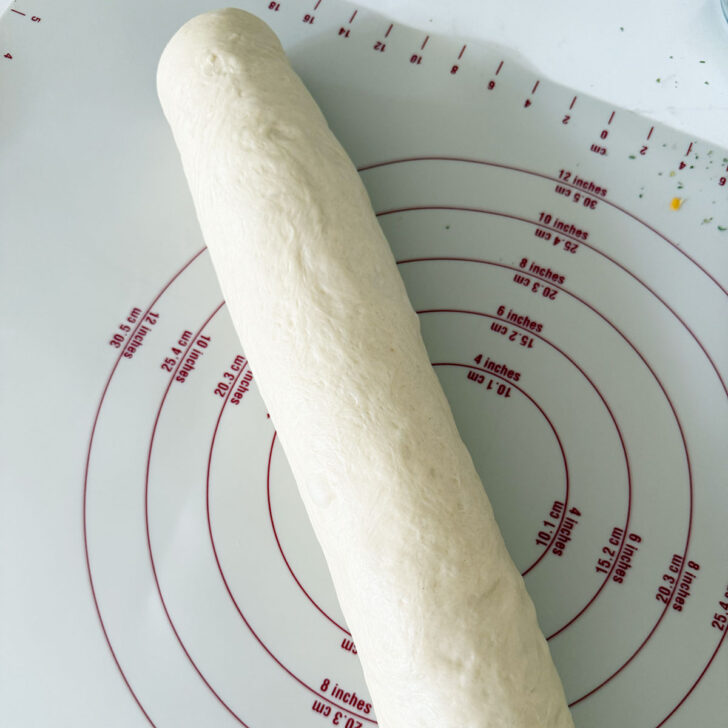
Step 14: Flip the dough over so the seam is down.
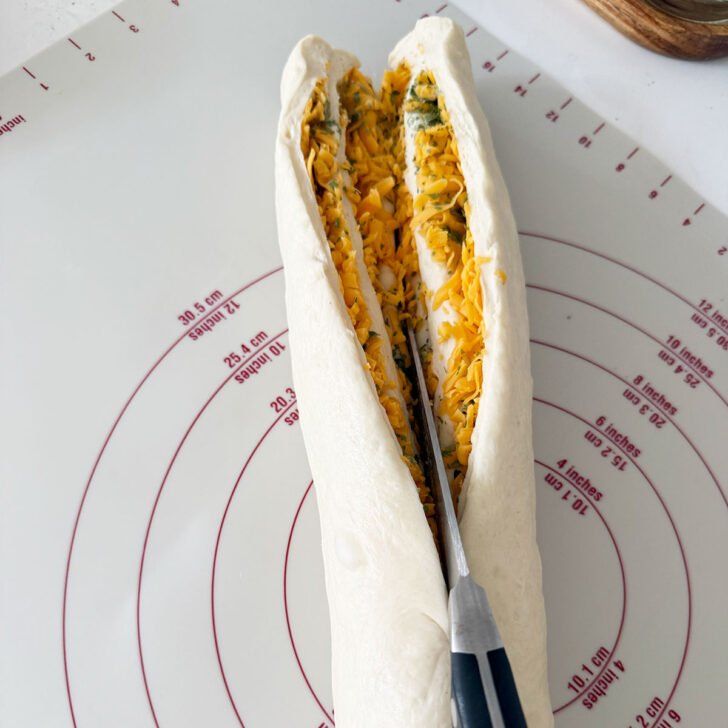
Step 15: Using a sharp knife, slice the rolled dough lengthwise down the centre.

Step 16: The dough is not cut into two pieces.
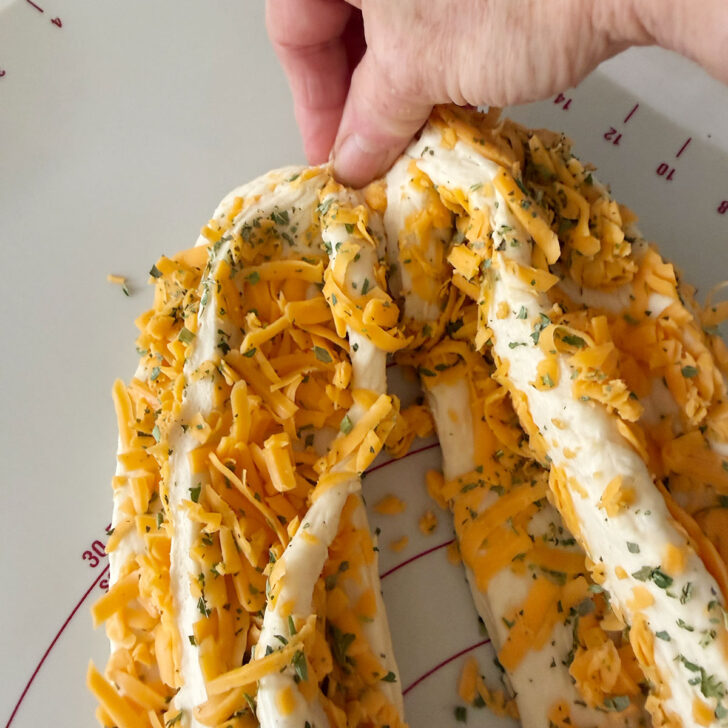
Step 17: Pinch the two pieces together at the far end.

Step 18: Begin to twist the dough together by placing the right side over the left side.
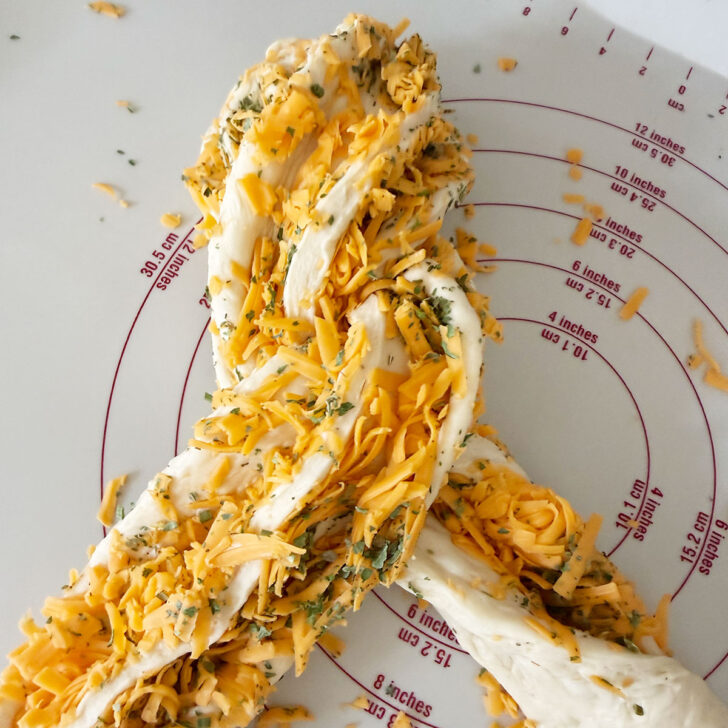
Step 19: Continue twisting the dough pieces together.
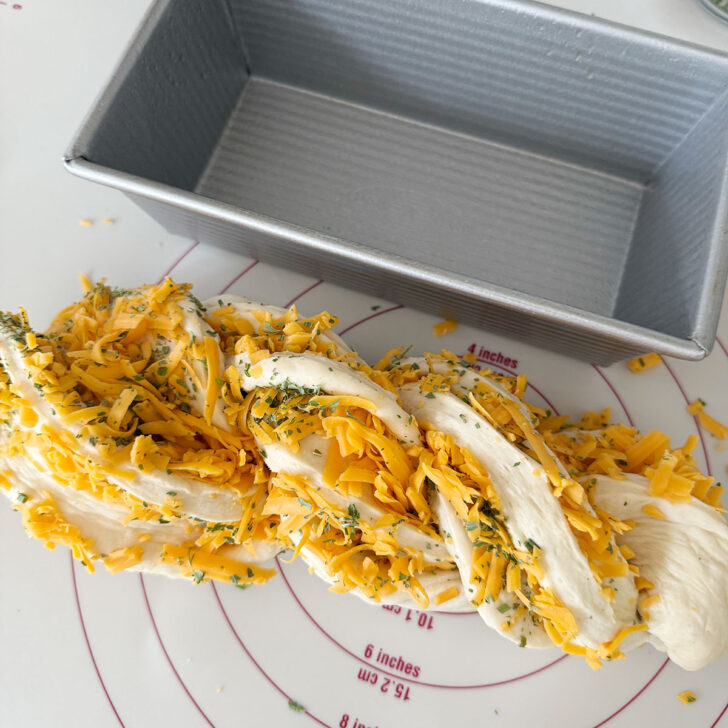
Step 20: Pinch together the closest ends once the dough is fully twisted together.
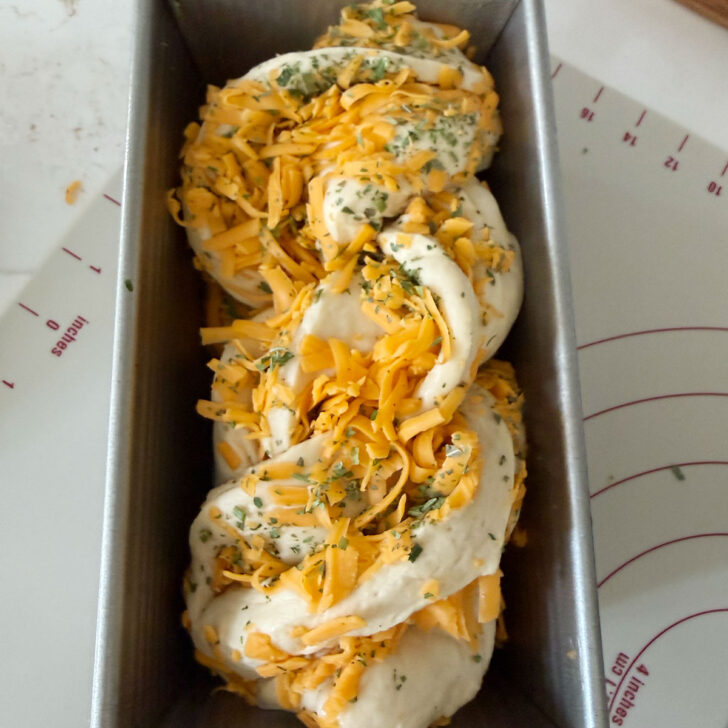
Step 21: Gently lift the shaped dough into a greased 8 1/2 x 4 1/2-inch loaf pan, then repeat with the second piece of dough to make two loaves.
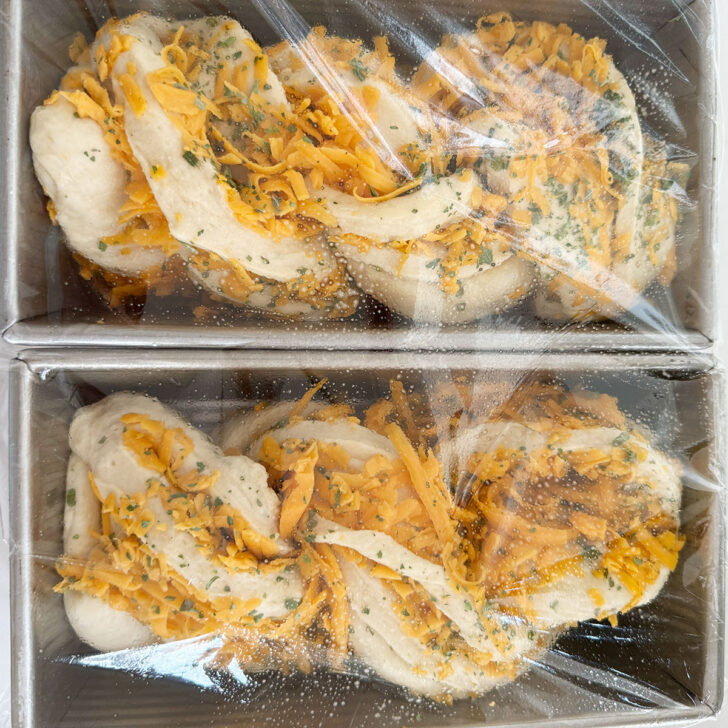
Step 22: Cover the loaves with plastic wrap and set to rise until they rise to an inch above the sides of the pan, about 30 minutes. Bake and enjoy!
How to make homemade cheese bread: video
Confused about how this cheese bread is shaped? Be sure to watch the video to see how easily it is done!
Recipe tips!
- If you want to take your bread game to the next level, you really need to be using a kitchen scale and weigh out the ingredients. You will quickly find that doing so will produce a perfect loaf every time! No more uncertainty about how dry measuring cups were filled. No more variations between the exact volume of a liquid cup. You can pick up a kitchen scale for only $20, and it’s the best investment you will make for your kitchen.
- This bread is endlessly customizable. All kinds of cheese, herb and other add-in combinations will work. Want to throw in some sun-dried tomatoes and/or a bit of pesto? Why not! Olives? Sure. Lots of cheese or just a bit? It’s up to you.
- There is an option to overnight-rise this dough in the fridge. I rarely do that, because I’m a) impatient and b) not that organized, but feel free to do so. There’s no doubt that any bread benefits from a longer rise for better flavour.
New to bread baking? Here is my best advice!
I think most of the problems people have when starting out baking bread are treating bread recipes like, say, a cake recipe, where you just measure the ingredients, mix them all together and bake.
Things like kitchen temperature, humidity, moisture in the flour you are using, the season you are baking in and rising time can differ from one kitchen to the next. All that makes bread recipes less consistent from one kitchen to the next.
Now that you know this, though, that’s more than half the battle :) What you’ll need to add to the mix to be a successful bread baker is some trust in what you see and feel.
- Does the dough look and feel too sticky, and does the recipe say it should be smooth and not sticky? Go ahead and add a bit more flour, as your dough needs it.
- Does the dough look moist and smooth, but you haven’t added all the flour specified? Trust what you see in the bowl and stop adding more flour.
- When it comes to dough rising times, trust your eyes and not the clock. Your dough in your kitchen may rise more quickly or slowly than it suggests in the recipe. Using a straight-sided rising container will make it easier to see when the dough has doubled. (I like to use a 4- or 8-cup glass measuring cup.) In any case, you want the dough to just double in size. No less. No more.
Trust what you SEE and FEEL, and don’t be too tightly tied to the specifics of the recipe. Do that, and all will be good!
Storing and freezing cheese bread
Allow the bread to cool completely, then store at room temperature in a bread bag or simply place on a cutting board with the cut end wrapped tightly with plastic wrap. This bread will keep well for 2-3 days at room temperature.
You can refrigerate bread to extend the shelf life, but I don’t recommend refrigerating it right away. I keep my bread on the counter for about 2 days, then after that I might refrigerate what’s left to extend the freshness another 2 or 3 days.
Bread freezes beautifully! Wrap tightly and freeze for up to 3 months.
Want to save this recipe?
Enter your email and I’ll send it to your inbox. Plus, you’ll get great new recipes from me every week!
By submitting this form, you consent to receive emails from Seasons and Suppers.
You can unsubscribe at any time.
Get the Recipe: Simply Perfect Homemade Cheese Bread
Ingredients
- 6 1/2 cups (794 g) unbleached bread flour, spooned and levelled *see Note 1 below
- 2 teaspoons (14 g) fine salt , reduce slightly if using salted butter
- 5 Tablespoons (64 g) white sugar, or brown sugar or 3 1/2 Tbsp. honey
- 1 cup (227 g) lukewarm water, about 95F
- 1 cup plus 2 Tablespoons (255 g) milk, or buttermilk, lukewarm, about 95F
- 1 1/2 Tablespoons (14 g) Instant yeast or Active Dry Yeast
- 1/4 cup (57 g) unsalted butter , melted and cooled slightly, or the same amount of vegetable/canola oil
Cheddar and herb filling (for two loaves):
- 3 cups (340 g) sharp/old orange cheddar cheese, shredded and packed
- 2-3 Tablespoons (60 ml) dried parsley, optional *see Note 2 below
Instructions
- In a mixing bowl or the bowl of a stand mixer, combine the 6 1/2 cups unbleached bread flour (spooned and levelled *see Note 1 below), 2 teaspoons fine salt (reduce slightly if using salted butter) and 5 Tablespoons white sugar (or brown sugar or 3 1/2 Tbsp. honey ) together and stir together well.
- In a large measuring cup or bowl, combine the 1 cup lukewarm water (about 95F ) and 1 cup plus 2 Tablespoons milk (or buttermilk, lukewarm, about 95F) and whisk in the 1 1/2 Tablespoons Instant yeast or Active Dry Yeast until dissolved. Add this mixture, along with the 1/4 cup unsalted butter (melted and cooled slightly, or the same amount of vegetable/canola oil), to the dry ingredients. Mix by hand or with a dough hook at Speed 2 until the mixture is combined and all the dry ingredients are incorporated into a shaggy dough, about 2-3 minutes. Let the dough rest for 5 minutes.
- Continue mixing the dough with the kneading hook at Speed 2 for 5-7 minutes, until a smooth dough forms that wraps the dough hook and cleans the bowl. The dough should not be sticking to the mixing bowl at all.
- Transfer the dough to a lightly floured surface and knead for a couple of minutes, adding more flour only if the dough is sticking to your hands or the work surface; then form the dough into a ball. (If the dough feels smooth like a baby's bottom, you've nailed it!).
- Place the dough in a lightly oiled bowl or an 8-cup measuring cup, then flip the ball over in the bowl so the top of the dough is covered in the oil from the bowl. Cover the bowl tightly with plastic wrap and allow the dough to rise until just doubled, about 40-60 minutes in a 72F kitchen. (This dough is a fast-riser! Don't wander too far. You want the dough to just double in size – no more and no less – however long that takes.)
- Note: Alternatively, you can refrigerate the dough, well covered, for up to 4 days. If you have refrigerated your dough, remove it from the refrigerator 2 hours before you plan to bake to allow it to come to room temperature.
- Grease two 8-inch by 4-inch loaf pans and set aside.
- Divide the dough into 2 equal pieces. Cover one piece with plastic wrap and set aside. Working with one piece of dough, use a rolling pin to roll it into a rectangle approximately 12 inches wide and 16 inches long. (If the dough seems to spring back and not hold its shape while rolling, allow it to sit for a few minutes and try again.)
- Once rolled out, scatter 1/2 of the shredded cheddar and 1/2 of the herbs evenly over the surface of the dough. Starting with the long side of the rectangle, roll the dough up jelly-roll style and pinch the seam together. Rotate the rolled dough so the seam is underneath.
- Using a sharp knife, cut the roll of dough down the centre, lengthwise. Rotate each piece so that the cut sides are facing upward and place them side-by-side. Pinch together the farthest end. Keeping the cut sides facing upwards as much as possible, place the right-side piece over the left-side piece. Straighten it up all the way and then repeat twisting together down the length of the dough, then pinching together the end closest to you. If any cheese escapes, just place it back on top. Using a bench scraper or spatula, carefully lift the dough into the greased loaf pan. Repeat with the other piece of dough, then cover both pans with a greased piece of plastic wrap (I like to spray the plastic wrap with cooking spray).
- Allow the loaves to rise until the dough rises about 1 inch above the side of the pans in the middle, about 30-40 minutes.
- Preheat the oven to 350F (non-convection/not fan-assisted), with the rack in the centre of the oven.
- Place the loaves on top of a baking sheet to catch any cheese that might fall off the loaves as they bake. Bake the loaves for 40-45 minutes total, but set a timer for 20 minutes, at which time you'll rotate the pans from front-to-back in the oven and loosely cover the top of the loaves with a piece of aluminum foil if the bread is already well-browned. The foil will prevent the top from over-browning. Continue baking the bread for about 20-25 minutes more, until the bread reaches about 185F° internal temperature in the centre when tested with an instant-read thermometer.
- Remove the bread from the oven and allow it to cool in the pans for a couple of minutes. Run a sharp knife around the edge of the bread, then carefully remove the loaves to a cooling rack. Allow the loaves to cool for 1 hour before slicing. *Slicing hot or very warm bread will make for a gummy crumb, so resist the urge and let it cool :)
- Store the baked bread at room temperature for several days, storing it in a bread bag or, at least, wrapping any cut ends tightly. You can also freeze this bread for up to 2 months.
Notes
Watch how to make it
More cheese bread recipes to love!


Hi! I’m Jennifer, a home cook schooled by trial and error and almost 40 years of getting dinner on the table! I love to share my favourite recipes, both old and new, together with lots of tips and tricks to hopefully help make your home cooking enjoyable, stress-free, rewarding and of course, delicious!


Made this yesterday. Halved the recipe and made the parmesan one alone. Our whole family loved it. Thanks a lot for the recipe.
So glad you all enjoyed it, Lakshmi :) Thanks so much!
Probably the finest special bread ever! I’ll never bother with making foaccacia because this bread tops it all. It’s a never fail for me after making it several times.
I’m so glad to hear, Jan :) It’s a favourite of mine, too (the dough is always so nice to work with!). Thanks so much!
Hello Jennifer… What a bread! It is delicious and the shape has its effect too …. I also made it with the cranberry filling but this time I would like to make it with chocolate for Easter, do you have a filling to suggest me, thank you !
Hi Guylaine and so glad you are enjoying this bread :) As for chocolate, I think I would look for chocolate Babka recipes and borrow the chocolate filling from there, as it is a classic when combining bread and chocolate. Let me know how it came out!
We made this yesterday – the video showing how to make the loaves was essential – the bread is a joy to knead and it smells amazing whilst baking. Thank you for the recipe!
So glad to hear :) Thanks so much!
Thanks for the detailed video on how to shape and plait the dough. I’ll try this out next time I make the cheesy loaf. My plaiting technique needs practice. I guess my family will have to suffer.
So glad you found it helpful. Even the slightly less pretty ones are still delicious, so I’m sure your family will enjoy the all :) Thanks!
Just tried it. Only made one loaf, so just divided everything by 2.
Turned out perfect. Best bread I ever made. Thanks so much.
Happy to hear, Andre :) Thanks so much!
Haven’t tried it yet still hot! Cant wait.would live to post a pic of the results!
Do enjoy, Bobbi. If you are on Instagram, you can post a photo and tag me at @seasonsandsuppers
Hi, Jennifer! Just a quick question about the yeast: Are you letting the yeast sit and foam up before adding it to the rest of the recipe, or are you just dissolving it and then immediately mixing it into the dry ingredients? Thanks in advance!
Hi Wendy, it really depends on what type of yeast you are using. Active Dry Yeast will always need proofing in water and will benefit from sitting a bit. Instant Yeast doesn’t need proofing in water, though it won’t hurt it if you do. It doesn’t need to sit or soak to do it’s thing, so you can just dump it in.
Thanks, Jennifer, I appreciate that you replied! I love to bake, but when it comes to yeast, I always manage to get confused with which kind, and how much, etc., lol. I made your recipe today as just a plain loaf (no cheese or spices, and not twisted), and it was delicious! I have a super-hot oven, and I didn’t adjust the temp quite enough, so the crust was a bit harder than I prefer, but that’s a “me” issue, not a recipe issue! I always have to make things at least twice to get the proper adjustments. I needed some plain bread today to go with what I was making, but since your recipe tasted so good, I WILL end up trying your fancy cheese version too. Thanks for sharing a terrific recipe! :)
So glad you enjoyed it, Wendy and enjoy the cheese version, too. This is one of my favourite doughs to work with. I have adapted it to use many different fillings, both savoury and sweet :)
YES!!!! I did it!!! And they turned out just like your pictures! I made them following your very clear step by step instructions and I did it!!! I really don’t know how though… answered prayer, my hubby’s and kid’s motivation, your true recipe and video… probably all of the above! I have been baking basic white bread, rolls, pie shells for over 20 years now, but never had the courage to try something as “challenging” as this, and to braid it ? What? Wait, Whoa, Never! But I did… and they’re beautiful loaves and my family raved about them.
Thank you Jennifer for sharing your recipe, time, and if you don’t already know it, faith in believing that modest bakers like me could even try to make a delicious bread like this! You have motivated me to try harder and break out of my “old white-bread bread box”.
Thank you Thank you Thank You!
So glad to hear Tonya!! And so glad my tips helped you along the way :) Thanks and Happy baking!
Hi,
Is it possible to use sourdough starter in this?
Hi Cassy and yes, it would, though it would obviously require other adaptations.
Hi Jennifer,
I made this multiple times and it’s great! I was wondering if you can share some tips on the sourdough starter. I have some ready to go but would I need to let the dough rise for 12 hours? Also is 1 cup enough for two loaves?
Hi Cassy, I’m afraid I haven’t tried this one with a sourdough starter. I know it’s technically possible, as it is with any bread, but I don’t have any advice for you I’m afraid, on amount and timing. Perhaps someone has tried it and can weigh in for you.
I halved the recipe so as to only make one loaf. Used the white sugar, milk, and vegetable oil options from the recipe. Used a bread machine to make the dough and then rolled out to assemble the bread for baking.
The final result was delicious. It felt a little bit sweet for a savory bread. I am hoping I could cut back on the sugar without it impacting the yeast / dough. But overall was great. My fillings were cheese and green onions. Great recipe to use and I plan on trying it with other fillings (garlic, tomato, olive, parsley, jalapeno, and more).
So glad you enjoyed it and yes, you can reduce the sugar. You’ll want to keep some of it, to feed the yeast. You can probably go down to about 1/2, without issue.
Hi there! This recipe looks amazing and I really want to try it this weekend…but I have a question being a somewhat novice bread baker. The bread pan I have is an enamelled 1.5 kg to 2.5 kg round pan so how do I figure out whether I make the whole recipe or 1/2 or 2/3 etc?
Thanks in advance for any advice!
Hi Joss and wow, I’m not really sure. I’m trying to picture the pan, but struggling. I guess my best advice would be to make a 1/2 recipe and form into a round, that should fit in your pan to bake. Sorry, just guessing here.
Thanks; I figured it was a bit of a tough question. Maybe I will look at some other recipes that use a round pan (like for a sourdough miche) and compare quantities of ingredients. Will keep you posted 😊
Yes, please do and curious how it comes out as a free-form loaf, too!
1 cup plus 2 Tbsp lukewarm buttermilk? Do I just measure it and leave it out on the counter ? I’m going to make this today looks and sounds easy to make :)
Hi Donna, you want it to be a little more than room temperature, to help the yeast do its thing. I generally warm a little bit in a saucepan or microwave. You only want it about 105F. Not any hotter, or you could kill your yeast. Think baby bottle warm :)
When you follow the measurements for 1x that’s makes one loaf correct?
Hi Robin and no, in this case “1X” is the 2-loaf recipe. You can half it (just half all the ingredients), but you’ll have to do the math :)
Thank you so much for this recipe. I have made this numerous times many different ways. Cinnamon raisin, even apple cinnamon with small chunks of apple. Every single variation was amazing.
So glad you enjoying it, Tyler :) It’s my favourite dough to work with and I have made a dozen variations as well. Thanks so much!
Can you over prove at room temperature?
Hi Belinda, I’m not exactly sure what you’re asking. Are you asking if it is possible to over prove it? If so, then yes, definitely.